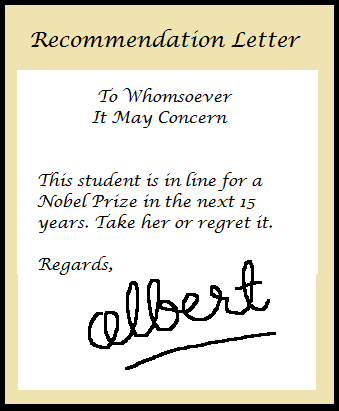

Dr. Harchol-Balter on the Recommendation Letter

Ideally you would like to make all your letters of recommendation count. Consider the following two letters:

(i) Letter 1: “I highly recommend student X for your graduate program. Student X received an A+ in my undergraduate algorithms class. He was ranked Number 2 out of 100 students. He got the highest score on the final. He worked very hard all semester, never missed a class, and was always able to answer the questions that I asked in class. This conscientious attitude makes him an excellent candidate for any graduate program. ”

(ii) Letter 2: “I highly recommend student Y for your graduate program. Student Y received a B in my undergraduate algorithms class. He was ranked Number 29 out of 100 students. Halfway through the semester we started working on network flows. Student Y seemed extremely excited by this topic. He disappeared for 4 weeks and even missed an exam. However when he came back, he showed me some work he had been doing on a new network flow algorithm for high-degree graphs. He had done some simulations and had some proofs. I’ve been working with student Y for the past couple months since then and he is full of ideas for new algorithms. I think student Y’s initiative makes him an excellent candidate for any graduate program.”

Which letter do you think is stronger? It turns out that Letter 2 is very strong. Letter 1 actually counts as 0. At CMU we mark all letters like letter 1 with the acronym D.W.I.C.. This stands for “Did Well In Class” which counts for 0, since we already know from the student’s transcript that he did well in class. By contrast, student Y’s letter gives us a lot of information. It explains that the reason student Y didn’t do better in class was that he was busy doing research. It also tells us that student Y started doing research on his own initiative, and that he is quite good at doing research. The professor was impressed enough with student Y’s ideas that he took him on as a student researcher despite student Y not having high grades.

You want your letters to all be of type 2 (this doesn’t mean that you should skip class!). Remember that letters of type 1 will not count. You want words like self-motivated, strong research potential , own initiative, independent, and driven to appear in your letters. These are the words that we circle when reading recommendation letters. You therefore want to ask letters from people who have seen you do research. These may be professors or employers.

Related Blogs on Application Documents

Related

Great FREE Application Tools on DOA Online: Part 3 – Question & Answer Forum

Question & Answer Forum

Question & Answer Forum

– What are transcripts?
– When should I register for the GRE test?
– Where can I find university deadlines?
– From whom do I need to take recommendation letters?

The list of questions that come up when you are applying to American universities is endless. Most probably you won’t know where to look for solutions or, whom to ask for the answers. That’s where the next of our great free application tools comes in – the DOA ONLINE Q&A FORUM.


On the Q&A Forum (click screenshot below for enlarged view) you can:

  • ask any questions you have regarding the application process for American universities
  • get answers and expert advice from the academy (look for answers by the admin!)
  • get valuable tips and insights from other registered users – since they have gone through the same situations and problems, their advice is often the best: no one understands your situation better than those traveling on the same path!
  • consult the vast database of questions and answers already on the Q&A forum.

Continue reading

MS-in-US: Vital Information, Key Decisions, Crucial Steps!

This post brings together a list of must-see links to our most important posts on ‘Admissions to American Universities’. The links are arranged under different headings:

  • university deadlines (spring 2014, fall 2014)
  • selecting which semester to join
  • step-by-step explanations of the application process
  • tips on the F1 visa and on preparing your Statement of Purpose
  • and several others.

This is important information. Don’t miss out on it!

Deadlines for Application

Did you know that there is no standard deadline for application for American universities? Deadlines for fall range from November of the previous year all the way up to August of the year in which you will join your university. Deadlines for spring range from June of the previous year to Jan of the year of joining. Your planning of the application process depends on the deadline for the most important university you are applying for. Check out the deadlines for your university through the links below.

  • Spring – 107 universities accepting students in spring (2014). Remember to check out the timeline for applying for spring (available December onward).
  • Fall – 125 universities accepting students in fall (2014). Remember to check out the timeline for applying for fall (available April onward).
Note: to find out what universities to apply to check out a list of the top 220 American universities at online.dilipoakacademy.com – look for ‘university information’ under the ‘applications’ button. You will find the following information:
  • departments and courses
  • university rank
  • documents required for application
  • the university website URL
For more information on these useful online services see:

Continue reading

Dr. Harchol-Balter on the Statement of Purpose

The statement of purpose is an extremely important part of your application packet (click here for an explanation). A well-written SOP that brings out the most important facts about you as a candidate for higher studies, can open the doors of opportunity for you. On the other hand an SOP that tries to impress but focuses on facts that the admissions committees consider irrelevant can lose you the opportunity that you have dreamed of.

In the extract below Dr. Harchol-Balter, an Associate Professor of Computer Science at Carnegie-Mellon University points out two common mistakes that many applicants make:

The grade regurgitator – “In my high school, I was ranked Number 1. Then I got a perfect score on my college entrance exams. Then I competed in a statewide math competition and I was the best. Then I competed in a national programming competition and I was 5th. In college, my GPA was 3.95 out of 4.0. For these reasons, I believe I will do well in your graduate department.”
What’s wrong with this? This portion of the essay is a waste of space. Awards are certainly relevant, however any award you won should be listed on a separate piece of paper which is titled “Awards and Honors” and which you can include with your application. There is no reason to tell us all this in your essay. It will only piss-off the people reviewing your application because they already read all this information earlier in your application and they now want to hear about research.
The boy genius – “When I was born, my mother gave me a glass ball to play with. I would lay and look at the prisms of light shining through my ball. At age 3, my father brought home our first computer and I disassembled it and then put it back together. It was then that I knew I wanted to become a computer scientist. By age 5, I had taken apart every appliance in our house. At age 6, I became a chess whiz ….”
What’s wrong with this? We simply don’t care what you did as a child, and we don’t believe you either. You’d be surprised how many applications from Einstein-wanna-be’s we get. If you really think this is relevant, put the important facts on a separate sheet of paper, and include it in your application. It’s best if your essay can stick with stuff you did in college and later.


Related Blogs on Application Documents

Related
 

Deadlines for Spring 2014 in this Month (Oct 13)

The application season is on, December is just round the corner …and the deadlines for spring 2014 are drawing to a close. So here are the deadlines for spring that are falling due in this month.

Important Question: “Do you know which university you should apply to?”

A deadline is of use only if you know what university you should apply to. For those of you who are not too clear, here is how to decide:

1. Talk to seniors and decide which specialization you should apply for (examples: Networking, Data Bases etc. for Computer Engineers; Digital Signal Processing, VLSI etc. for Electronics and Telecommunications Engineers; MEMS, Robotics etc. for Mechanical Engineers)

Continue reading

5 Reasons Why Students Going to America Should Join LinkedIn

LinkedInIf you are reading this blog the chances are that you are a net savvy user, you have accounts on Facebook and Twitter and you are a student going to America for higher education. But have you ever thought of signing up for a LinkedIn account? Probably not: LinkedIn is supposed to be meant for professionals, and none or few of your friends are on it, so what good would it do a student to have a LinkedIn account?

When you don’t know many people on LinkedIn, it is easy to think that it doesn’t matter. Actually however, there are 5 reasons why having a LinkedIn account is very useful if you are heading for higher education in the States.


  • LinkedIn offers several tools to help get information and ideas from experts in your field viz.:
  1. LinkedIn Groups
  2. LinkedIn Answers
  3. LinkedIn Today

For college students these tools offer a great way of learning the professional language of your field, keeping up with the latest trends and topics in the field and becoming a well-informed ‘insider’. With more than 120 million users worldwide, LinkedIn offers a lot of potential avenues for learning.

Continue reading

Great FREE Application Tools on DOA Online: Part 1 – the University Info Feature

Is the Admission Process Becoming a Hassle?

If you have been struggling with the complexities of getting admission to an American university, then you need to know about the great FREE tools available on our online‘ site. They are great for two reasons. First, they will simplify the process of applying to American universities for you. Second, they are free.

There’s no payment and there are no obligations even for students who haven’t enrolled for admissions counseling at Dilip Oak’s Academy. To use them, all you have to do is sign up and start using them. So, tell all your friends about them so they can benefit from them too! This week we will begin with the University Info feature.

Continue reading

What to Do When You Get Admission

Congrats! Now you have the admission message or letter you were waiting for. After all the celebrations though, it is the beginning of yet another round of many things to be done before you reach your ultimate aim: enrolling for the program you desire. So, what things come next? Well, you have to get the I-20 form and the visa. The approximate sequence of what you have to do to get these two crucial documents is as follows:

Admission in US for MS1. Read the letter or email carefully. If you have to send an acceptance of the offer do it promptly. Even if you have multiple offers it makes sense to accept more than one when there is no offer of funding.

2. If you have received the I-20 form along with the offer of admission you can straightaway start the preparations for visa.

3. More likely, however, the university will ask you to send affidavits of support from your sponsors as well as the bank statements of your sponsors showing that you have sufficient funds for meeting the I-20 form amount (that is, the total cost of the first year which, includes tuition, other fees and living expenses.)

Continue reading

Should I Do a PhD?

PhD for Me?

That’s the big question facing some of you. There are also some other related ones: “Will I be able put in the intensive work that a PhD requires?” “Is it going to be worth it?” – and perhaps, most important of all: “What scope is there for me after I get my doctoral degree?”

In her article entitled ‘Applying to Ph.D. Programs in Computer Science’ Dr. Harchol-Balter (an associate professor of computer science at CMU who has been involved in the Ph.D. admissions process at CMU, U.C. Berkeley, and MIT) answers these questions in-depth and with a great deal of insight. What is more she does so in a clear, concise, straight forward manner that allows her to cover a lot of ground in one brief, easy-to-read document.

Though she writes with a focus on doctoral programs in Computer Science, students applying for almost any program can read it with profit. In fact all students whether they are applying to master’s or doctoral programs in an American university should read her comments on the ‘Application Process’. They give invaluable tips (especially for top-notch students) on the recommendation letter and the statement of purpose.

Continue reading

All About the I-20

I-20The I-20: What It Is and What It Contains

Once you have been admitted by an American university, your university will send you an I-20 to enable you to enter the U.S. on an F-1 (student) visa. The I-20 is a certificate of non-immigrant eligibility i.e. it certifies that you are eligible to travel to the United States as a student and are not traveling as an immigrant. This document, sometimes referred to as a DS-2019, is usually sent to you by the admissions office in your university.

The I-20 certifies that you have enough financial resources to attend school and pay for your living expenses while attending school without resorting to illegal employment or relying on public funds. For this reason, the I-20 states:

Continue reading

MS in US Career Opportunities For Computer Science / ECE Students

This post is written by our guest author: Ameya Kanitkar

Ameya holds master’s degree from Carnegie Mellon University. Currently he works as a Software Engineer at a startup in Silicon Valley, California.

Computer Science Jobs: Google, Facebook, Apple, MicrosoftIf there is one industry which is booming in US, it’s the technology industry. If you hold an engineering degree in Computer Science/ Computer Engineering/ Information Systems/ ECE, you should strongly consider pursuing your postgraduate degree in the US. Here in the valley, companies are fighting for top tech talent – and the scenario is going crazy: entry-level software engineer salaries have already crossed $100,000/year mark. But when we say Computer Science there is more to it. This post is attempt to dive into various branches and see how various opportunities are stacking up in the US in general.

Continue reading

Recommendation Letters – Part 2: Ingredients of a Good Recommendation Letter

What Recommendation Letters should Cover

Recommendation letters should cover the following points (also see the links to great sample recos at the end of this post):

  • How long the recommender has known you and in what capacity (teacher, seminar or project guide, practical supervisor, project leader etc.)
  • His or her assessment of your academic performance (relative rank etc.), intellectual abilities, work habits and character
  • Your special achievements – especially in projects or in papers presented
  • Your communication skills – how well you were able to present your seminars
  • Your social skills – ability to work well with others, leadership qualities
  • Some background about the recommender – this is useful in the case of professors whose work in a field might be good but little known outside India; things to highlight include area of work, achievements in that area (papers published, awards etc.), prominent places worked in, length of experience and so on