
The Academic Year in American Universities

The academic year in American universities is usually of a total length of 9 months (excluding a 3-month summer holiday). But the division of these 9 months into terms varies from university to university. Generally, the system will be one of these 3 types:

The Quarter System

In this system the academic year is divided into four quarters of approximately 10 weeks each.


The Trimester System

Here, the academic year is divided into three periods of 12 weeks each.


The Semester System

This is the most common system. In it the educational year is divided into 3 semesters:

  • the fall session which commences in August
  • the spring session which commences in January
  • the summer session which begins in June.

 

The Cost of Higher Education in America

Many Indian students are concerned about the cost of higher education in America and seek information on opportunities for financial assistance. The cost of education in the United States ranges from $14,000 to over $40,000 per year, with State universities and institutions in the South and Mid-West are often being cheaper than private institutions and those located in California or the North-East region. In addition to tuition fees, books and food, you have to plan for expenses towards housing, health insurance and transportation. In fact, a student’s major expenses will be on two major items: tuition fees and living expenses.

Continue reading

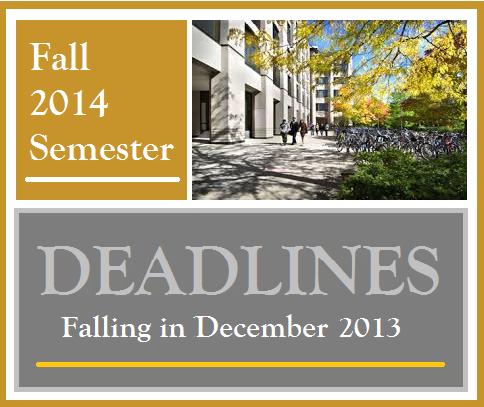
Deadlines for Fall 2014 Coming Up in this Month (Dec 13)

As you know, the deadlines for admission to the fall 2014 semester begin in December 2013 and stretch all the way up to August 2014. So, if you are applying for fall 2014 the deadlines have begun. Keep watching this blog, we’ll keep updating you on the deadlines for the month every month from now.

This month there are just a few coming up – only 6 in all – but they are the first deadlines for fall. Here they are:

Universities with Deadlines in December

  1. Indiana University, Bloomington – 1 December
  2. University of Miami, Coral Gables – 1 December
  3. University of North Carolina, Chapel Hill – 1 December
  4. Harvard University – 14 December
  5. Massachusetts Institute of Technology – 15 December
  6. Michigan State University, East Lansing – December

Related Blogs:


Success Stories of Indians Who Made It Big in America – Ajay Bhatt Inventor of the USB and Other Achievers

If you use a desktop, laptop, mobile phone, tablet or external hard disk drive, it’s impossible not to know about the USB (universal serial bus) port. The news is that this port, used to transfer both information and power between devices, is now about to become more versatile – there are plans to make it flippable and also able to deliver the power required by larger networks. But did you know that the inventor of the USB port is an Indian? Well, it’s true and his name is Ajay Bhatt.

After graduating from the Maharaja Sayajirao University of Baroda Bhatt went on to The City University of New York, where he received his master’s degree. In 1990, Bhatt joined Intel Corporation as a senior staff architect on the chipset architecture team. Currently, he holds thirty-one U.S. patents, and several others are in various stages of filing. Some time ago IEEE Spectrum did an interesting interview with him about how Intel made the USB truly universal and other things like an ‘all-day’ computer project he is working on (read: a computer that you can use all day on a single charge) and some of his past achievements (click here to see “Ajay Bhatt: Intel’s Rock-Star Inventor”).

However, despite his ‘rock star’ inventor status Bhatt is only one of a highly talented group of Indian movers and shakers in the field of technology in the US. Here are few of the many other outstanding achievers in the list:

Continue reading

Salaries Post MS/Phd/MBA

Jobs are available in all fields since the American economy needs people from all walks of life: engineers, managers, graduates from the field of science etc.Of course there are periodic booms and recessions in all fields. But an enterprising person can usually find a good job in any field.

The salaries after completing a master’s-level course of studies in the United States is quite good. After an MS or an MBA, you can get a salary in the range of $55,000 to $85,000 per annum. Of course, the salary structure depends on several factors, including your field of specialization, the university from where you obtained your degree, the geographical are where you get the job and of course your ability to convince your employers of your calibre.

After a PhD you can expect a salary of around $85,000 per year.

Jobs After Studying in America

Is there scope to take up jobs after studying in America? Most students do take up a job in the United States after they have finished their course of study there. However, the student (F1) visa that you get from the US embassy in India does not permit you to take up full-time employment. You have to take permission from the Immigration Department first. The good thing is that obtaining this permission is not very difficult. You are allowed to work after finishing your MS, MBA etc. under Optional Practical Training (OPT).

Once you have got a job it often happens that your employer will request the authorities for a change of status in your visa from F1 (education visa) to H1 (work permit). This can be renewed for 3 years more. During this time many people apply for a Green Card i.e. permission to live in the United States permanently. Once you get your Green Card you will be able to live and work in the United States for as many years as you want.

Working while Studying: On Campus Jobs

Working while studying in America is quite well-accepted. You can work on campus for 20 hours per week. Almost all students studying in a university find on campus jobs. The pay varies from 6-9 dollars per hour depending on the area and the type of work you get. Even if you get an average of $7 per hours, you can earn around $500 per month which is more than enough to take care of your costs of living. You may even be able to pay part of your tuition costs out of your savings.

On campus jobs can vary from working in a computer lab, or in a library or cafeteria. In America all work is respected because Americans believe in the dignity of labour and in being able to pay for one’s own education. Indians are widely accepted in computer-related fields. You should try to get a job in this area since the jobs are more comfortable and the pay is better.

Changing Your Field of Study

The American system is very flexible, so changing your field of study is acceptable even in the middle of a course. So, for example a student doing his or her MS in the engineering department of a particular university might shift to a program in the computer science department of that university.

Though this is acceptable, you must remember that when you transfer to a new department, the department may not accept all your credits. They may treat you as a fresh admission and accept only those credits that are common to both programs. So, before you change your course find out what credits will be accepted, see how many you will have to do all over again and then see whether it is really worth it. Only then is it worth thinking of changing your field.

Changing Universities

Changing universities is possible and is allowed in the American system of education. You may want to change your university for a number of reasons:

  1. You were earlier not given financial assistance in any university, so you took up the best available, but now you have been offered financial assistance by a university that you would like to go to
  2. After you have joined the university you may find that it is not exactly what you wanted – a faculty member who you thought would be teaching is on an assignment elsewhere or the course that you had wanted to study has been changed for some reason and so on
  3. You had to take admission to a low-grade university since your GRE/GMAT scores were not good, but now you have done well in the first semester and on the strength of your improved academic performance, you want to transfer credits to another university.

Change universities for any of these reasons is quite acceptable to and you can change universities at any time but, this is normally done after the first or second semester. Also keep in mind that there are some potential problems that you should be aware of: because of the differences between one university and another, your new university may not accept all your credits and may ask you to take some extra credits.

Free GMAT Score Reports

You may select up to five business school programs to which your Official GMAT Score Report will be sent free of cost. You have to make your choice of programs to which your free GMAT score reports will be sent at the test center on the day you take the GMAT® exam. This has to be done before you begin the test and once you have made your selections, you will not be able to change or delete them. (Click this link: GMAT program database to see a list of programs to which your GMAT scores can be sent.)

The Official GMAT Score Report will be sent to the five programs you have chosen within 20 calendar days of your test. This free GMAT test score reporting service is covered by your registration fee. If you wish to send more than 5 score reports, however, a fee of US $28 will be charged.(For more information click here)

Deadlines for Spring 2014 in This Month (Nov 13)

You Can Still Make It for Spring

This might come as a surprise, but there are still 16 universities that have deadlines for spring 2014 that fall in this month i.e. November 13. Want to have a look?
By the way, there are also some deadlines for spring ’14 that are coming up in December. You can either wait for next month to see or look at the post on deadlines for spring 2014 below
Related blogs:
Here are the deadlines for this month:
Universities with deadlines falling in November 13
  1. Florida State University – 1 Nov
  2. Idaho State University – 1 Nov
  3. Monmouth University – 1 Nov
  4. University of Louisville, Louisville – 1 Nov
  5. University of Miami, Coral Gables – 1 Nov
  6. University of Utah, Salt Lake City –1 Nov
  7. University of Wyoming, Laramie –1 Nov
  8. Vanderbilt University – 1 Nov
  9. Arkansas State University – 14 Nov
  10. City University of New York, City College –15 Nov
  11. Missouri University of Science & Technology, Rolla –15 Nov
  12. Montana State University, Bozeman –15 Nov
  13. New Jersey Institute of Technology – 15-Nov
  14. University of Massachusetts, Dartmouth – 15 Nov
  15. Marist College, Poughkeepsie – 30 Nov
  16. Southern Methodist University – 30 Nov

October-December Alert for Students Applying for Fall 2014

October-December 2013

For many of you who are applying for admission in fall 2014, the months from October to December will be when several important phases of the application process will draw to a close for you. Here’s what you have to do in that critical phase:

Continue reading