Applying for Transcripts from Pune University

In Pune University the process of applying for transcripts is as follows:

  1. Download the transcript form from the website of Pune University
  2. Fill up the form and submit the form in person at the transcripts department – this is located on university campus. Do not forget to carry original mark sheets if required for verification. In case you are asked to submit mark sheets, submit photocopies not originals.
  3. Pay the required fees immediately at Bank of Maharashtra counter located on the university campus. Continue reading

Types of Transcripts – and Why you Need Them

Some universities accept only university transcripts; others accept college transcripts or even an attested mark sheet. Some universities require you to submit 2 transcripts. It is very important that you read the American university requirements carefully before applying. Make sure you do not send them the wrong document type as it will delay the admission process.
These are issued by the university your college is affiliated to e.g. M.I.T. College in Pune is affiliated to Pune University. If you are a student of that college and the American university you are applying to requires university transcripts, you should get transcripts from Pune University.

Continue reading

The University Transcript: What Exactly is It and Why is It Important?

The transcript is an official summary of your academic performance and progress to date. It is one of the key documents you have to submit when you are applying for admission to a doctoral or master’s program of studies in an American college or university (the others are the statement of purpose, recommendation letters, a resume and of course your GRE and TOEFL scores). In order for the transcript to be acceptable to American universities as an official document, it must conform to the following specifications – it should be:

  • printed on the university or college letterhead
  • signed by the appropriate college or university authorities i.e. the college principal or registrar or the university registrar
  • in the format required by American universities (not in the ordinary mark sheet format usually provided by Indian colleges and universities)

Continue reading

The University Transcript: A Comprehensive Description of the Details Included

Your transcript should contain the following:

  • a ‘bona fide certificate’ containing:
    • your name
    • the name of the college where you studied
    • the name of the course you studied
    • the duration for which you were at the university/college and date of completion of the course
  • the examination scheme which, includes details such as:
    • whether all subjects are compulsory or whether there are elective subjects, a project etc.
    • the number of semesters in the course and the duration of each semester
    • the duration of each lecture
    • the minimum marks required to pass in a subject
    • the maximum number of grace marks that may be given so that a student may pass or obtain a higher class
    • the score scheme used: grade point average (GPA) or aggregate percentage/class system
  • the ‘mark sheet’ section which, states:
    • the breakup of subjects studied in each semester
    • the number of hours per week for lectures and practical work in each subject
    • the maximum marks per subject
    • the marks you obtained in each subject
    • your total marks, percentage (or relative grade), class and relative rank in the class, college or university in each year
  • the highlights and history of your college or university (in brief)

Related Links

September Alert for Students Applying for Admission in Fall 2014

fall 2014September 2013

Here’s your checklist of tasks for this month – and note there’s a lot of heavy documentation work that you have to be doing, so be prepared to do a lot of running around to your college and your university

  1. Arrange for 10-13 sets of transcripts in sealed covers from your college or university – some universities insist on university transcripts
  2. Choose your recommenders (generally 3 recommendations are required, at least one of which should be from the educational institute last attended) and give them the necessary details – resume, copies of your mark sheets etc.
  3. Start working on your Statement of Purpose (target date for completion 31 October 2013) and resume

Note: for the full schedule see: timeline for fall 2014

Related Links:

Recommendation Letters – Part 1: Who the Best Letters Come From

Recommendation Letters – What They are and Who You Should Get Them From

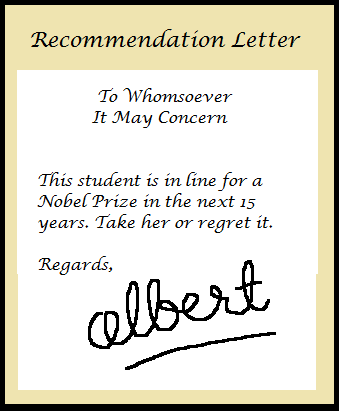
In the context of higher education in America, recommendation letters are statements by teachers, supervisors or employers which highlight your qualities, background and achievements and show that you are a good candidate for a doctoral or master’s program of studies.

To make sure that you are an applicant of good caliber every university will ask you to submit at least 3 recommendation letters along with your application form. If you are a student, these recommendation letters should come from teachers who have taught you important subjects or supervised relevant project work, research papers or seminars. If you are a working professional and your work experience is relevant to the field you plan to do your degree in, one letter can come from your immediate superior in the organization (if you have been working for a very long time then you can take letters from two people in organizations you have worked with, but at least one recommendation should be academic).

Continue reading

All About The Resume – Part 1: Why You Must Send a Resume in Your Application Packet


Why Sending a Resume Matters

Resumes (pronounced re-syoo-mayz) are included in your application for an American university for three reasons:

  • firstly, to give the admissions committee a brief snapshot of your academic performance – academic performance carries great weightage in deciding whether you will be admitted or not and in some universities admissions committees form their first impressions of your academic performance by looking at your resume
  • secondly, to present your qualifications for a research or teaching assistantship – for this reason remember to attach a covering letter to your resume requesting that it be circulated to interested professors
  • thirdly, to provide details of projects, seminars, industrial training etc. that you could not include in your SOP because of the word limit

All About the Resume – Part 2: Make It Easy for Professors Select You

Why the Resume is Different from a Bio Data or a CV – and Why It Should Stay that Way

Note that the resume is different from a bio data or a curriculum vitae (CV) in several respects: whereas bio datas and CVs are all-inclusive, data bank-like documents written in chronological order, resumes are compact, focused documents written in reverse chronological order that highlight only the most relevant and important information for course (or post) being applied for. So, don’t turn your resume into a Bio Data or CV – that would defeat the very purpose of the document.

Your resume should contain only the relevant information because professors are busy people who are hard pressed for time: if you bury the information they need in a sea of irrelevancies they might lose interest – and you might lose a position they might otherwise have awarded you. In other words, don’t hide the information that tells them that you are the candidate that they are looking for: make sure that when they see your resume they can’t miss it.

Continue reading

All About the Resume – Part 3: How to Create a Snapshot of Yourself in One Brief Page

Tips for Writing Resumes

A resume, like all other application documents, is designed to answer one crucial question: “Why should you be selected?” Of all the application documents (the SOP, the recommendation letters, and the transcripts), the resume answers that question in the briefest yet most comprehensive way. In order to achieve its goals, the resume must present the most important facts about you in their most concentrated form, in the smallest possible space. This will enable it to present a compelling snapshot of your strengths as a candidate and persuade the Admissions Committee that you are a good choice. Here are some tips that will help your resume to achieve its intended goals:

Continue reading

University Application Deadlines For Fall 2014

The application season is on, December is just round the corner …and university deadlines are coming up soon. So, here is our much awaited blog for university application deadlines for fall 2014.

Our list covers 125 universities with deadlines ranging from December 2013 all the way up to August 2014. At the end is a section on universities with rolling deadlines (click here to find out what is meant by rolling deadlines).

Remember that American universities update deadlines on their websites at different times during the academic year so, we will update this blog to keep up with changes on their official websites.

Presenting the first in our round of deadline alerts.

Continue reading

August Alert for Students Applying for Admission in Fall 2014

Fall in an American UniversityIf you are thinking of getting admission in fall 2014 the clock is ticking and August is drawing to a close. So, if you want to be in your American university at around this time next year, what should be your priorities in the next couple of months (and as you can see from the picture above, it really is beautiful there during fall). Hint: one thing that you will need to do is start thinking about which universities to apply to – and then there is going to be a lot of head scratching that you will have to do to select universities to apply to …and so much interviewing and researching that you are going to feel .like a news reporter! The details are below. Ready to read? Well, get set and go!

Continue reading

Preparing for GMAT: Important Links for You

Gathered together here are some useful links that will help you get prepared for that all-important exam!

Reading Comprehension

Data Sufficiency

Read these blogs and never get confused about Data Sufficiency questions on the GMAT again:

Integrated Reassoning

Wondering what Integrated Reasoning is and why it was introduced? Find out with these simple explanations.

Analytical Writing Helps

Problems with writing good essays in English affect almost everyone. Here are some important links on cutting out the mistakes that pull you down.

Find out about:
– how to how to move smoothly from one paragraph to another by using transition words and phrases effectively
– tips on how to improve sentence clarity through using parallel constructions, transition phrases, clear pronoun references and other grammatical devices
– when to use capital letters and when to go with small case:
– making sure you don’t confuse your a’s, an’s and the’s:
– advice on proper subject-verb agreement