Choosing the Right Field of Study

A lot of students want to know what a particular field of study covers and what fits best according to their interest. Here are a few fields of study and their scope to help you choose the right field for you!!

Electrical Engineering:

Electrical engineers study and apply the physics and mathematics of electricity, electronics, and electromagnetism to both large and small-scale systems to process information and transmit energy. To do this, electrical engineers design computers, electronic devices, communication systems, test equipment, and improve systems through problem solving techniques.

The field covers a wide range of sub-disciplines including:

  • Electromagnetics and wave propagation
  • Power electronics
  • Control systems
  • Electro-optics
  • Digital signal processing and communications
  • Telecommunications
  • Nanotechnology
  • Mechatronics
  • Electromagnetics and wave propagation,
  • Optoelectronics,
  • Nanostructures and devices,
  • Computer engineering. (Is considered separate discipline in its own right)

Computer Engineering:

Computer engineers work for companies that build or use computer-based systems, such as telecommunications, automotive, aerospace, etc. Many computer engineers also get jobs as programmers. While they have less programming experience than computer science graduates, their understanding of hardware gives them an advantage in dealing with overall systems. Computer engineers have the option of moving into hardware or software positions, or blending the two.

While sharing much history and many areas of interest with computer science, computer engineering concentrates its effort on the ways in which computing ideas are mapped into working physical systems. Emerging equally from the disciplines of computer science and electrical engineering, computer engineering rests on the intellectual foundations of these disciplines, the basic physical sciences and mathematics.

The field covers sub-disciplines as follows:

  • Embedded Systems
  • Networking
  • Design automation
  • Machine intelligence
  • Compilers
  • Computer Security
  • Coding, cryptography, and information protection
  • Communications and wireless networks
  • Robotics
  • Integrated circuits, VLSI design, testing and CAD
  • Signal, image and speech processing

Computer Science:

Computer Science is the study of principles, applications, and technologies of computing and computers. It involves the study of data and data structures and the algorithms to process these structures; of principles of computer architecture-both hardware and software; of problem-solving and design methodologies; of computer-related topics such as numerical analysis, operations research, and artificial intelligence; and of language design, structure, and translation technique. Computer Science provides a foundation of knowledge for students with career objectives in a wide range of computing and computer-related professions.

Computer science covers the following areas:

  • Software Development
  • Database Administration
  • Computer Hardware Engineering
  • Computer Systems Analysis
  • Computer Network Architecture
  • Web Development
  • Information Security Analysis
  • Computer Programming

Software Engineering

Software engineers design and develop many types of software, including computer games, business applications, operating systems, network control systems, and middleware. They must be experts in the theory of computing systems, the structure of software, and the nature and limitations of hardware to ensure that the underlying systems will work properly.  They apply the theories and principles of computer science and mathematical analysis to create, test, and evaluate the software applications and systems that make computers work.

Software engineering covers the following areas:

  • Requirements engineering
  • Software Design
  • Software Construction
  • Software Testing
  • Software Maintenance
  • Software Configuration Management
  • Software Engineering Management
  • Software Quality Management

Management Information Systems (MIS)

MIS is short for Management Information Systems and focuses on solving business problems and creating new opportunities with technology. MIS is also often shortened to Information Systems (IS). MIS is a blend of business, analytics and technology. MIS professionals are business-oriented, technically proficient individuals. An MIS professional will typically not write large and complex computer programs but should know how the code works.

MIS jobs covers the following areas:

  • Business Analysis
  • Systems Analysis
  • Project Management
  • Information Technology Management
  • Data Analysis
  • Business Intelligence Analysis
  • Product Management
  • Solutions Developer
  • Database Administrator

Hope this helps!

 

University Application Deadlines For Fall 2017

The application season is on, December is just round the corner …and university deadlines are coming up soon. So, here is our much awaited blog for university application deadlines for fall 2017.

Our list covers 145 universities with deadlines ranging from December 2016 all the way up to August 2017. At the end is a section on universities with rolling deadlines (click here to find out what is meant by rolling deadlines).

Remember that US universities update deadlines on their websites at different times during the academic year so, we will update this blog to keep up with changes on their official websites. We have compiled a list of university deadlines with utmost care, however, we request you to kindly cross check the dates displayed on official websites of the university.

Presenting the first in our round of deadline alerts.

Continue reading

Indian Students Are Joining American Universities in Increasing Numbers

US UnivData released by the Student and Exchange Visitor Program (SEVP) of the US Immigration and Customs Enforcement indicates a recent surge in the number of Indian students seeking to study in American universities. According their report, there has been a “31.9% increase in the number of Indian students studying in American universities since 2014”. This bucks a trend that goes back almost a decade:  from 2008-09 to 2013-14, the number of Indian students studying at American Universities was a fairly flat 1,00,000 annually. In 2014-15, this figure jumped by around 32% to 1,32,888.

This increase is part of a rise in the number of international students studying in the US. In 2015, that number was up by about 9%. However, a staggering 76% of these were from Asia. So, the fresh influx of students seems to be a largely Asian phenomenon fuelled perhaps, by the robustness of the pan-Asian economic scene.

In this overall picture, students from India accounted for about 13.6% (or 1,32,888) of the 9,74,926 international students who enrolled for undergraduate (Bachelor’s), graduate (Master’s) & doctoral (Ph. D.) programs in the US in 2014-15. A full 31.2% or 3,04,040 of these students were Chinese. One possible reason for this is that very large numbers of Chinese students have started enrolling for the undergraduate courses where the intake is larger while, the majority of Indian students join graduate courses which tend to offer more funding but have a smaller intake.

Another noteworthy trend is that Indian (and more broadly, Asian) students show a heavy preference for courses in the STEM fields – science, technology, engineering, and mathematics – especially, computer science. Currently, there are 10,54,045 international students on F and M visas in the US. Of these, 4,05,314 students are studying courses in STEM fields and of these in turn, 80% of them are from Asia. As many as 81% of all Indian students are studying STEM fields – this is the highest percentage for any country; and California, Texas and New York have emerged as popular destinations for students studying courses in the STEM category.

If these trends are any indicator, we should see a few more Satya Nadella’s and Sunder Pichai’s emerging in the coming years; If you are an engineer, a student from the field of computer science or one from the STEM category more broadly, this could be your opportunity to make it big in the United States. Even Donald Trump has said that, should he become President, he is willing to welcome bright young minds from India because he knows they contribute to America’s economy – and if Trump says so, the doors must definitely be open!

OPT Period Extension and H1B Visa

Every year U.S. Citizenship and Immigration Services (USCIS) accepts H1B petitions starting from 1st April. As such, petitions for the fiscal year 2017 will be accepted from 1st April 2016. The current quota for H1B VISA is 65,000 under the general category and 20,000 under the advanced degree exemption – also known as the Masters quota. Thus, the total quota stands at 85,000. In the previous year, USCIS received a total of nearly 233,000 H1B petitions under both the categories put together from 1st April to 7th April and then they stopped accepting new applications. For the first time, USCIS received more than the limit of 20,000 H1B petitions under the Masters quota (the exact number of applications is not declared by USCIS). Computer generated random selection process (lottery) is conducted for Masters quota petitions which selects 20,000 applicants for the Master’s degree cap completion. The H1B petitions filed under Masters quota cap, but not selected in the first round of lottery are then added to the general quota of petitions. The lottery is then conducted for this pool to select 65,000 petitions towards the general quota cap completion. USCIS rejects and returns the remaining H1B petitions.

Advantages of OPT Extension:

Since H1B VISA petitions are accepted only once a year i.e. 1st April, if the petition is rejected, the applicant has to wait for a further period of one year, i.e., till next April to be able to apply again. In case, a student has an OPT period of only one year, his OPT period lapses before the next April. Hence, he doesn’t get a second chance to apply for H1B visa and has no option but to return to his home country. But students under STEM category will now get an OPT period of 36 Months (Regular 12 months + 24 months extension). In other words, such students will get two more chances for applying for H1B visa if their first petition is rejected. For example, if a student applies for H1B visa on 1st April 2016 but does not get selected in the lottery of 2016, he would still be able to apply for H1B visa again on 1st April 2017 and once again on 1st April 2018.

24-Month STEM OPT Extension

The Department of Homeland Security (DHS) is amending it F1 non immigrant visa regulations on Optional Practical Training (OPT) for certain students with degrees in Science, Technology, Engineering or Mathematics (STEM) from US institutions of higher education.

OPT is a period during which undergraduates (BS/BA) and graduate students (MS/MBA) with F1 status who have completed or have been pursuing their degrees for more than 9 months are permitted by the United States Citizenship and Immigration Services (USCIS) to work for 12 months on a student visa towards getting practical training to complement their education. On April 2nd 2008 DHS announced a 17-month extension to the OPT for students in qualifying STEM fields to be eligible for the 12-month permit. Any degree in any field of studies is valid. For the 17-month OPT extension a student must have received a STEM degree as listed on the USCIS website.

DHS is now amending its rule regarding OPT under STEM category to extend the OPT period to 24 months. This 24-month extension effectively replaces the 17-month OPT extension previously available to certain STEM students. In short, a student can now work in America for up to 36 months after completing degree even if he doesn’t qualify for H1B visa during that period. This rule will be effective from May 10th 2016.

The rule also makes F1 students who subsequently enroll in a new academic program and another STEM degree at a higher education level eligible for one additional 24 months STEM OPT extension. In other words, a student can get 36 months OPT after undergraduate education (BS) and also after completing a graduate degree (MS) from STEM category.

The rule also permits an F1 student completing a non-STEM graduate degree to use a prior eligible STEM degree from a US institution of higher education as the basis to apply for a STEM OPT extension. For e.g. if a student has completed MS in STEM category and now completes MBA which is a non-STEM degree is also eligible for the 36 months OPT extension.

To improve the integrity of the STEM OPT extension, the rule limits eligibility only to students with degrees from schools accredited by an accrediting agency recognized by the Department of Education.

Keep yourself updated on our next blog on E-Verify requirements and Cap-Gap extension.

University Deadlines For Fall 2016

It is our continued endeavour to keep you updated with the university deadlines well before the application process. As per tradition we are publishing the university deadlines for fall 2016 semester. Please bear in mind that some universities may change deadlines on their websites without prior notice. The department deadlines may differ from the graduate school deadlines, hence you are advised to cross check not only the graduate school deadlines but also the department website of the university you are applying to.
Why is it impThe deadlines mentioned below are for the graduate school only.

Deadlines in November
University of South Carolina, Columbia – 30-Nov

Deadlines in December
Massachusetts Institute of Technology – 15-Dec
Tufts University – 15-Dec
University of Illinois, Urbana Champaign – 15-Dec
Yale University – 15-Dec
Harvard University – 14-Dec
Indiana University, Bloomington – 1-Dec
University of Miami, Coral Gables – 1-Dec
University of North Carolina, Chapel Hill – 1-Dec

Deadlines in January
Rensselaer Polytechnic Institute – 1-Jan
University of Maryland, Baltimore County – 1-Jan
Worcester Polytechnic Institute – 1-Jan
Washington State University, Pullman – 10-Jan
Florida Institute of Technology – 15-Jan
Northeastern University, Boston – 15-Jan
State University of New York, Buffalo – 15-Jan
Texas A & M University, Kingsville – 15-Jan
Texas Tech University – 15-Jan
University of Central Florida – 15-Jan
University of Michigan, Ann Arbor – 15-Jan
University of Southern California – 15-Jan
Vanderbilt University – 15-Jan
Duke University – 30-Jan
Illinois Institute of Technology, Chicago – 31-Jan
Indiana University Purdue University – 15-Jan with funding 1-Mar without funding
Deadlines in February
Case Western Reserve University – 1-Feb
Colorado School of Mines – 1-Feb
East Carolina University – 1-Feb
Kansas State University – 1-Feb
Pennsylvania State University, University Park – 1-Feb
University of Connecticut, Storrs – 1-Feb
University of Rhode Island, Kingston – 1-Feb
University of Tennessee, Knoxville – 1-Feb
University of Tulsa – 1-Feb
Colorado State University, Fort Collins – 15-Feb
Eastern Michigan University – 15-Feb
Florida International University – 15-Feb
Marquette University – 15-Feb
Polytechnic Institute of New York University, Brooklyn – 15-Feb
University of Illinois, Chicago – 15-Feb
University of Massachusetts, Dartmouth – 15-Feb
University of Oregon, Eugene – 15-Feb
University of South Florida, Tampa – 15-Feb

Deadlines in March
California State University, Chico – 1-Mar
California State University, Sacramento – 1-Mar
Illinois State University, Normal – 1-Mar
New Mexico State University, Las Cruces – 1-Mar
North Carolina State University – 1-Mar
Oklahoma State University, Still Water – 1-Mar
Temple University – 1-Mar
University of North Carolina, Charlotte – 1-Mar
University of Pittsburgh – 1-Mar
University of Toledo – 1-Mar
George Washington University – 15-Mar
South Dakota School of Mines & Tech – 15-Mar
University of Colorado, Denver – 15-Mar
University of Kentucky, Lexington – 15-Mar
University of North Texas, Denton – 15-Mar
University of Pennsylvania – 15-Mar
California State University, Northridge – 31-March Online, 30-April Document submission

Deadlines in April
California State University, Fresno – 1-Apr
Idaho State University – 1-Apr
Oregon State University, Corvallis – 1-Apr
San Jose State University – 1-Apr
Stevens Institute of Technology – 1-Apr
University of Arkansas, Fayetteville – 1-Apr
University of Arkansas, Little Rock – 1-Apr
University of Houston, University Park – 1-Apr
University of New Hampshire, Durham – 1-Apr
University of Texas, Arlington – 1-Apr
University of Texas, San Antonio – 1-Apr
Villanova University – 1-Apr
Virginia Polytechnic Institute & State University – 1-Apr
West Virginia University, Morgan Town – 1-Apr
Western Michigan University, Kalamazoo – 1-Apr
Wichita State University – 1-Apr
California State University, Los Angeles – 15-Apr
Lamar University – 15-Apr
Old Dominion University, Norfolk – 15-Apr
South Dakota State University, Brookings – 15-Apr
University of Georgia – 15-Apr
University of Iowa, Iowa City – 15-Apr
California State University, Long Beach – 1-April online, 15-April Document submission

Deadlines in May
City University of New York, City College – 1-May
Clarkson University – 1-May
Minnesota State University, Mankato – 1-May
Mississippi State University – 1-May
New Jersey Institute of Technology – 1-May
North Dakota State University, Fargo – 1-May
Northern Illinois University, Dekalb – 1-May
Oakland University, Rochester – 1-May
Southern Methodist University – 1-May
Tennessee Technological University – 1-May
University of Idaho, Moscow – 1-May
University of Louisville, Louisville – 1-May
University of Memphis – 1-May
University of Michigan, Dearborn – 1-May
University of Nevada, Las Vegas – 1-May
University of New Mexico, Albuquerque – 1-May
University of Texas, Dallas – 1-May
Wayne State University – 1-May
Western Illinois University – 1-May
California State University, Fullerton – 4-May
University of Louisiana, Lafayette – 15-May
University of North Carolina, Greensboro – 15-May
Wright State University, Dayton – 15-May

Deadlines in June
Louisiana Tech University, Ruston – 1-Jun
Monmouth University – 1-Jun
Southern Illinois University, Edwardsville – 1-Jun
University of Alabama, Huntsville – 1-Jun
University of Alaska, Fairbanks – 1-Jun
University of Detroit, Mercy – 1-Jun
University of Illinois, Springfield – 1-Jun
University of Wyoming, Laramie – 1-Jun
Drexel University – 13-Jun
Marist College, Poughkeepsie – 15-Jun
Missouri University of Science & Technology, Rolla – 15-Jun
University of South Alabama, Mobile – 15-Jun

Deadlines in July
Arkansas State University – 1-Jul
Florida State University – 1-Jul
New York Institute of Technology – 1-Jul
Santa Clara University – 12-Jul
Lehigh University – 15-Jul
University of Bridgeport, Bridgeport – 15-Jul

Deadlines in August
New Mexico Institute of Mining and Technology – 1-Aug
University of Houston, Clear Lake – 1-Aug

Rolling Deadlines
Fairleigh Dickinson University, Madison
Rochester Institute of Technology

Departmental Deadlines
Johns Hopkins University
Michigan State University, East Lansing
Michigan Technological University
Montana State University, Bozeman
Northwestern University, Evanston
Ohio State University, Columbus
Portland State University
Purdue University
Rutgers, The State University of New Jersey
San Diego State University
San Francisco State University
Southern Illinois University, Carbondale
Stanford University
State University of New York, Albany
State University of New York, Binghamton
State University of New York, Stony Brook
Syracuse University
Texas A & M University, College Station
Texas State University
University of Alabama, Birmingham
University of Alabama, Tuscaloosa
University of Arizona, Tucson
University of California, Berkeley
University of California, Davis
University of California, Irvine
University of California, Los Angeles
University of California, Riverside
University of California, San Diego
University of California, Santa Barbara
University of California, Santa Cruz
University of Chicago
University of Cincinnati
University of Colorado, Boulder
University of Hawaii, Manoa
University of Kansas, Lawrence
University of Maine, Orono
University of Maryland, College Park
University of Massachusetts, Amherst
University of Minnesota, Duluth
University of Minnesota, Twin Cities
University of Missouri, Columbia
University of Missouri, Kansas City
University of Nebraska, Lincoln
University of Nevada, Reno
University of North Dakota, Grand Forks
University of Oklahoma, Norman
University of Southern Mississippi
University of Texas, Austin
University of Texas, El Paso
University of Utah, Salt Lake City
University of Vermont, Burlington
University of Virginia, Charlottesville
University of Wisconsin, Madison

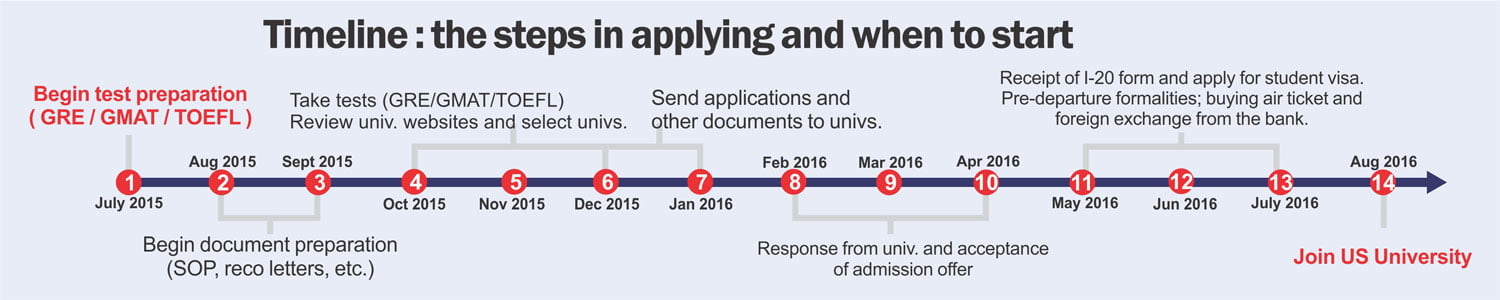
Application Timeline for Fall 2016 – Make Sure You Are on Track

Timeline_blog

If you are applying for admission in fall 2016 the clock has begun to tick. So, don’t delay. Review this Application Timeline for Fall 2016 immediately and get to work.

June 2015

Review your goals for your MS in US and choose some specific areas in which you would like to specialize.

July 2015

  1. Begin preparation for the GRE/TOEFL tests
  2. Register for the GRE and TOEFL examinations – if you are targeting the top 10 or 15 universities, you should take these examinations preferably by September 2015. If you are targeting other universities, you may take these exams by 20 December 2015 so you can meet the deadlines of universities which are in December 2015.
  3. Register for the Subject GRE – important for doctoral programs in pure sciences and biological sciences in top schools.

Note: the exam is held once in a year in November, however, seats usually get filled up by August.

August-September 2015

Make a preliminary list of about 30 universities which meet your requirements considering:

  1. Location
  2. Costs of living and education
  3. Broad specializations you are interested in (for departments and specializations see the ‘university info‘ page on online.dilipoakacademy.com)
  4. Recommendations by seniors, your professors etc.
  5. Whether your academic profile fits the universities requirements.

For more details, see: Selecting a University for Your MS in the US. Also refer to our post on university information available on the social media

September 2015

  1. Arrange for 10-13 sets of transcripts in sealed covers from your college or university – some universities insist on university transcripts/university attested mark sheets
  2. Choose your recommenders (generally 3 recommendations are required, at least one of which should be from the educational institute last attended) and give them the necessary details – resume, copies of your mark sheets etc.
  3. Start working on your Statement of Purpose and resume

October 2015-January 2016

  1. Take the GRE and TOEFL exams latest by January 2016 (ideally 20 December 2015)
  2. Carry out a comprehensive review of the 30 universities considering:
    1. Your academic performance in bachelor’s degree
    2. GRE and TOEFL scores of students admitted in the past
    3. Any minimum cut-offs with respect to GRE and TOEFL scores
    4. Whether courses of your choice are offered in the Fall semester
    5. Cost of education
  3. Make your final shortlist of 8-10 universities.
  4. Complete your Statement of Purpose (SOP) and resume
  5. Request the ETS to forward your GRE and TOEFL scores to the universities you are applying to, specifying the correct codes for the universities/departments you are applying to.
    Note: some universities require certain documents to be sent to the department you are applying to.
  6. Complete online application process and send the required documents by courier

This completes the application process; however there are further steps to be taken:

  1. Track the status of your application on your status page of the university’s website. Though universities generally communicate decisions or requirements by either e-mail or post, it often happens that the only source of information is your status page.
  2. If there are any deficiencies in your applications (missing documents, non-receipt of GRE or TOEFL scores, recommendations etc.) immediately correct the deficiencies.
  3. When you receive an offer letter from the universities (or when your status page shows that you have been given admission) email your acceptance(This is very important especially when you are offered funding)
  4. When you have accepted the university’s offer of admission and the documentation formalities are complete, the university will send you the 1-20, an immigration document, which is essential for obtaining a visa.
  5. When you receive the I-20, check that it is correct in all respects:
    1. Your name and date of birth should be exactly as in your passport
    2. Your course and course duration should be correctly specified
    3. The financial sources indicated should exceed the costs etc.
  6. Prepare the visa documentation
  7. Study the visa application formalities specified on the websites of the applicable US Consulate and the VFS (Visa Facilitation Services)
  8. Apply for a visa interview date – you can apply for a visa interview 120 days before the joining date mentioned on your I-20.

For further details on the F-1 visa see our previous blog on the subject.

Note: Dilip Oak’s Academy organizes a ‘Pre-departure Orientation’ in June-end every year for students who have been admitted to the fall semester. In the Orientation, Mr. Dilip Oak covers matters such as:

  • the student (F1) visa
  • foreign exchange
  • airport formalities (port of entry/immigration procedures)
  • insurance
  • medical checkups & immunizations
  • initial formalities in the university
  • accommodation (on- & off – campus)
  • financial and other formalities for the first semester of studies

Keep a look out for our announcement of the Orientation. The announcement will appear on this blog sometime in June.

Mechanical Engineering Jobs in America

Facts about the Field

  • Job Prospects – according to the Bureau of Labor and Statistics (BLS) 11,600 jobs will be generated for mechanical engineers in the United States by 2022 (the unemployment rate in the field is just 2.7%)
  • Employment Growth Rate – the BLS also predicts that employment in the field is expected to grow by 4.5 percent between 2012 and 2022
  • Salaries – the median salary is $80,500 with the worst-paid earning $52,580 and the best-paid earned $123,340.
  • Job Satisfaction – upward mobility in mechanical engineering jobs in America is high, flexibility is above average and stress levels are about average
  • What the Work is Like – many mechanical engineers work out of an office on a 9-5 schedule but if your job demands it you may visit sites like oil rigs or skyscrapers
  • Top-paying metropolitan areas – these include Anchorage, Alaska; Taunton, Massachusetts; and San Jose, California.

Advice on Getting a Job

  • Explore different jobs in America and specializations when you are in your 20’s – it may take you until your 30s, to figure out what you actually want to do in the field
  • On your first job find a company that lets you continue to learn – that’s more important than location or salary
  • Multidisciplinary engineering is becoming increasingly important in the industry, so familiarize yourself with related disciplines: electronics, control systems and chemical reactions are some you could consider.
  • Sustainable design is also becoming important since we are running out of resources and design has to take this into account
  • To get a good job after graduation you need to convince prospective employers that you can help their business to be successful. This means you have to have the organizational and management skills required to successfully complete a project. To acquire these skills take project-oriented courses in college and get practical experience in summer internships.

(Source: US News)


University Deadlines For Spring 2016 Semester

Spring 2016 Deadlines

The month of June is now approaching which means the spring 2016 application process should now begin. As per our standard practice we are publishing university deadlines for spring 2016 semester.

Keep in mind some universities update deadlines on their websites at different times during the academic year.

The deadlines mentioned below are for the graduate school only. The department deadlines may differ from the graduate school deadlines and hence you should cross check with your respective department for confirmation.

NO.

NAME OF THE UNIVERSITY

DEADLINE

Deadlines in June
1 University of Maryland, Baltimore County 1-Jun
2 Texas Tech University 15-Jun
3 University of Tennessee, Knoxville 15-Jun
Deadlines in July
1 Florida Institute of Technology 1-Jul
2 University of Pittsburgh 1-Jul
3 Washington State University, Pullman 1-Jul
4 North Carolina State University 15-Jul
5 University of Illinois, Chicago 15-Jul
6 University of Rhode Island, Kingston 15-Jul
Deadlines in August
1 Kansas State University 1-Aug
2 North Dakota State University, Fargo 1-Aug
3 University of Michigan, Dearborn 1-Aug
4 Western Michigan University, Kalamazoo 1-Aug
5 Wichita State University 1-Aug
6 Rensselaer Polytechnic Institute 15-Aug
7 South Dakota School of Mines & Tech 15-Aug
8 South Dakota State University, Brookings 15-Aug
9 University of Kentucky, Lexington 15-Aug
10 San Francisco State University 31-Aug
Deadlines in September
1 East Carolina University 1-Sept
2 Florida International University 1-Sept
3 George Washington University 1-Sept
4 Illinois Institute of Technology, Chicago 1-Sept
5 Indiana University, Bloomington 1-Sept
6 Lamar University 1-Sept
7 Mississippi State University 1-Sept
8 Oakland University, Rochester 1-Sept
9 University of Alaska, Fairbanks 1-Sept
10 University of Nebraska, Lincoln 1-Sept
11 University of Oklahoma, Norman 1-Sept
12 University of South Carolina, Columbia 1-Sept
13 University of Texas, Dallas 1-Sept
14 University of Texas, San Antonio 1-Sept
15 Virginia Polytechnic Institute & State University 1-Sept
16 California State University, Chico 15-Sept
17 Northeastern University, Boston 15-Sept
18 Texas A & M University, Kingsville 15-Sept
19 Tufts University 15-Sept
20 University of North Carolina, Greensboro 15-Sept
21 University of North Texas, Denton 15-Sept
22 California State University, Fresno 30-Sept
23 California State University, Northridge 30-Sept
Deadlines in October
1 California State University, Long Beach 1-Oct
2 California State University, Sacramento 1-Oct
3 Case Western Reserve University 1-Oct
4 Eastern Michigan University 1-Oct
5 Illinois State University, Normal 1-Oct
6 Indiana University Purdue University 1-Oct
7 Minnesota State University, Mankato 1-Oct
8 Northern Illinois University, Dekalb 1-Oct
9 Oklahoma State University, Still Water 1-Oct
10 Old Dominion University, Norfolk 1-Oct
11 Oregon State University, Corvallis 1-Oct
12 Pennsylvania State University, University Park 1-Oct
13 Southern Illinois University, Edwardsville 1-Oct
14 State University of New York, Stony Brook 1-Oct
15 Stevens Institute of Technology 1-Oct
16 Tennessee Technological University 1-Oct
17 University of Arkansas, Little Rock 1-Oct
18 University of Colorado, Denver 1-Oct
19 University of Detroit, Mercy 1-Oct
20 University of Houston, University Park 1-Oct
21 University of Idaho, Moscow 1-Oct
22 University of Iowa, Iowa City 1-Oct
23 University of Louisiana, Lafayette 1-Oct
24 University of Massachusetts, Amherst 1-Oct
25 University of Nevada, Las Vegas 1-Oct
26 University of New Mexico, Albuquerque 1-Oct
27 University of North Carolina, Charlotte 1-Oct
28 University of Texas, Arlington 1-Oct
29 University of Virginia, Charlottesville 1-Oct
30 West Virginia University, Morgan Town 1-Oct
31 Worcester Polytechnic Institute 1-Oct
32 California State University, Los Angeles 15-Oct
33 Duke University 15-Oct
34 Marquette University 15-Oct
35 Texas State University 15-Oct
36 University of Georgia 15-Oct
37 University of South Florida, Tampa 15-Oct
38 Villanova University 15-Oct
39 California State University, Fullerton 17-Oct
Deadlines in November
1 Florida State University 1-Nov
2 Idaho State University 1-Nov
3 Monmouth University 1-Nov
4 University of Louisville, Louisville 1-Nov
5 University of Miami, Coral Gables 1-Nov
6 University of Utah, Salt Lake City 1-Nov
7 University of Wyoming, Laramie 1-Nov
8 Vanderbilt University 1-Nov
9 Arkansas State University 14-Nov
10 City University of New York, City College 15-Nov
11 Missouri University of Science & Technology, Rolla 15-Nov
12 Montana State University, Bozeman 15-Nov
13 New Jersey Institute of Technology 15-Nov
14 University of Massachusetts, Dartmouth 15-Nov
15 Marist College, Poughkeepsie 30-Nov
16 Southern Methodist University 30-Nov
Deadlines in December
1 Lehigh University 1-Dec
2 Louisiana Tech University, Ruston 1-Dec
3 New York Institute of Technology 1-Dec
4 Polytechnic Institute of New York University, Brooklyn 1-Dec
5 University of Alabama, Birmingham 1-Dec
6 University of Alabama, Tuscaloosa 1-Dec
7 University of Houston, Clear Lake 1-Dec
8 University of South Alabama, Mobile 1-Dec
9 University of Southern California 1-Dec
Deadlines in January
1 Louisiana State University, Baton Rogue 1-Jan
2 Wayne State University 1-Jan
3 New Mexico Institute of Mining and Technology 2-Jan
4 Santa Clara University 10-Jan
5 New Mexico State University, Las Cruces 27-Jan
Deadlines in February
1 University of Maryland, College Park 7-Feb
Rolling Deadlines
1 Wright State University, Dayton Rolling
2 University of Toledo Rolling

Under rolling deadlines there is no fixed application deadline declared by the university. Applications are accepted anytime till the seats for that particular semester are full.

You may also refer to our ‘University Info’ features which provides centralized information about the top 220 universities in America, including the university rank.

We wish you all the best!

‘MS in US’: Eligibility, Costs, Job Prospects

M.S. in U.S.

When you are thinking of getting a Master’s or doctoral degree in America, some of the top questions on your mind would be:

• What are the academic requirements in order to be able to apply?

• What are the costs of getting a degree in the US?

• What are the job prospects?

Here’s a quick look at the answers to those questions.


What is the eligibility for applying for a Master’s course in America?

The basic eligibility requirement is 16 years of formal education (12 + 4), the last 4 from an accredited university. So, students who have bachelor’s degrees in engineering (whether they joined engineering courses directly after the 12th Std. or after a diploma course) can directly apply for American Master’s courses. However, students who have completed a three-year degree (e.g. B.Sc.) should ideally complete their Master’s degrees (e.g. M.Sc.) in India and then apply.

Note: External degrees and degrees from open universities that are not accredited may not accepted by American universities.


What is the cost of education in America?

The cost of education in America varies from Rs. 12,00,000 to Rs. 30,00,000 depending on:

• the type of university (private or government-aided)

• its rank

• its geographical location

Apart from tuition fees you also have to bear the costs of:

• insurance

• living (food + housing)

• transportation.

There are many ways to reduce these financial burdens however. Many students manage to get some kind of financial assistance in the form of:

• research and teaching assistantships

• tuition waivers

• on-campus jobs etc.

Such kinds of financial assistance take care of a large part of the expenses incurred when studying in America.


What are the job prospects after completing a Master’s degree course in America?

• After completing your course you are allowed to undertake Optional Practical Training (OPT) for 12 months. OPT may be extended for another 17 months if you fall under the STEM (Science, Technology, Engineering and Mathematics) category

• Ample job opportunities exist in the fields of engineering and computer science (much tech talent in America is Indian and many Indians hold top positions the field – as is evident from the case of Satya Nadella, CEO Microsoft).

Note:

• Professors’ recommendations carry a lot of weight. To get a job you must get excellent references from professors who taught you during your master’s course.

• When you are working in America, your company may apply for H1-B visa (work permit) on your behalf. After this you can apply for a green card.

So, get ready to get your MS in US!


Higher Education in America: What Tests You Need to Take


If you are considering higher education in America, either an MBA or MS you will need to take the following tests:

Graduate Record Examination® (GRE®): Those seeking admission for a Master’s degree in any field apart from management are required to take the GRE test. The GRE® is a computer-based test and consists of verbal, quantitative and essay sections. The GRE test is scored as follows. The Verbal and Quantitative sections are scored on a scale of 130-170 each and the essay section is scored on a separate scale of 0-6. The score is valid for 5 years. The test can be taken throughout the year at certified test centers.

Graduate Management Aptitude Test® (GMAT®): The GMAT test is required for students seeking a management (MBA) degree in America. The GMAT test too, is computer-based and consists of verbal, quantitative and essay and integrated reasoning sections. There is a combined score on a scale of 200-800 for the Verbal and Quantitative sections. There is separate score for the essay section on a scale of 0-6 and one for the integrated reasoning section on a scale of 1-8. The score is valid for 5 years. The test can be taken throughout the year at certified test centers.

Test of English as a Foreign Language® (TOEFL®): Since English is not our native language, all Indians seeking a degree in America are required to take the TOEFL test to prove English proficiency. The TOEFL test is internet-based and consists or reading, listening, writing and speaking sections. The TOEFL test is out of 120 and can be taken on weekends throughout the year at certified test centers. The score is valid for 2 years.

International English Language Testing System (IELTS): Like the TOEFL® test IELTS too, is an English test required to prove English proficiency. Many American universities now accept IELTS test scores. Hence you may choose to take the IELTS test in place of the TOEFL. The IELTS is paper-based and consists of reading, listening, writing and speaking sections. The score is out of 9.0 and can be taken throughout the year at certified test centers. The score is valid for 2 years.

Note: Prior registration is required for all these tests.

If you are looking for coaching for these tests click this link

Booming Trend: Why Indian Students Flock to American Universities for MS in US

Photo Credit: NRIPulseIn August 2014 alone, around 35,000 students from India joined various American universities, with the major outflow of students to American universities from Hyderabad, Chennai, and Mumbai, and Pune not far behind. The increasing demand for Indian students for Master’s courses in America has been driven by a resurgent US economy and student-friendly US government initiatives.

As even the White House has recently pointed out, science and engineering in America create the innovative processes and services that make the US economy the most productive in the world today. The revival of the American economy from 2011 onward has fueled the growing demand for working professionals in the fields of engineering and computer science. To meet this demand the American government is encouraging international students to join American universities for Master’s as well as doctoral programs. It has introduced a special category called STEM (Science, Technology, Engineering and Mathematics) and liberally provides visas for students in this category. These students also have a special quota for the work permit (H-1B visa) and are also allowed to work for 29 months after completing their master’s without a work permit under what is called Optional Practical Training (OPT) . This has provided a golden opportunity that Indian students have been quick to capitalize on.

Another vital factor fueling the outflow of Indian students to American shores is the generous financial assistance provided by American universities to their students. This brings the actual cost of education in America down to around 15 to 20 lakhs. Fortunately, most Indian banks and specialized institutions providing loans for education offer liberal loans of up to 20 lakhs for students joining American universities. Since the salary offered after completing a master’s degree in America is in the range of $65,000-$100,000 students generally repay their entire loan amount within two years of getting a job. So, if you are thinking of an ‘MS in US’, now seems to be a pretty good time to go.

For more information and help on applying to American universities for an MS in US, click here.