University Application Deadlines For Fall 2018

The application season is on, December is just round the corner …and university deadlines are coming up soon. So, here is our much awaited blog for university application deadlines for fall 2018.

deadline

Our list covers 128 universities with deadlines ranging from November 2017 all the way up to July 2018. At the end is a section on universities with rolling deadlines (click here to find out what is meant by rolling deadlines).

Remember that US universities update deadlines on their websites at different times during the academic year so, we will update this blog to keep up with changes on their official websites. We have compiled a list of university deadlines with utmost care, however, we request you to kindly cross check the dates displayed on official websites of the university.

Presenting the first in our round of deadline alerts.

Continue reading

Legislation for New Merit Based Immigration System Announced

On 2nd August, President Trump announced that he is backing a new legislation for an immigration reform (Reforming American Immigration for a Strong Economy Act, or the RAISE Act) for foreign individuals who apply for legal permanent status, or green cards, through their employer.

This is going to be immensely beneficial for Indian students in America in the long term. The legislation backs a merit based system which gives preferences to highly skilled individuals for immigration. The application process will favor applicants who can speak English, financially support themselves and their families, and demonstrate skills that will contribute to the U.S economy.

Remember that this is still a legislation and not a law, however given that the president himself backs this legislation and Republicans control both senate and house – this is likely to be great news all around.

Following are the key highlights and how this might help highly educated Indian students who currently are / will be employed in the USA.

  1. Today green cards are awarded essentially by queue, and a candidate with higher education degrees, skills and a well-paying job is treated the same way as a candidate with low skills. To make matters worse green cards are awarded by limited country based quotas, putting Indian candidates at a disadvantage due to the large number of applicants. Merit based system will end this.
  2. The change is meant to make the application process fairer and allow applicants to know what their chances are of being approved before applying. Candidates would be able go online, answer questions about their education and employment experience, and learn if their background would help fill a workplace shortage in the United States. Applicants would also receive a score to give them a concrete idea of their chances of obtaining a visa.
  3. Although this proposal will go through many changes and debates – this is a step in the right direction. Indian students who are employed in the US after they complete their education are highly skilled individuals who possess advanced degrees with impressive research & academic backgrounds, so they should be able to clear bar for the merit based systems based on their qualifications and work experience without difficulty. This system is similar to the current immigration systems adopted in Canada and Australia – which have proven to be far better in terms of making immigration fair and efficient.

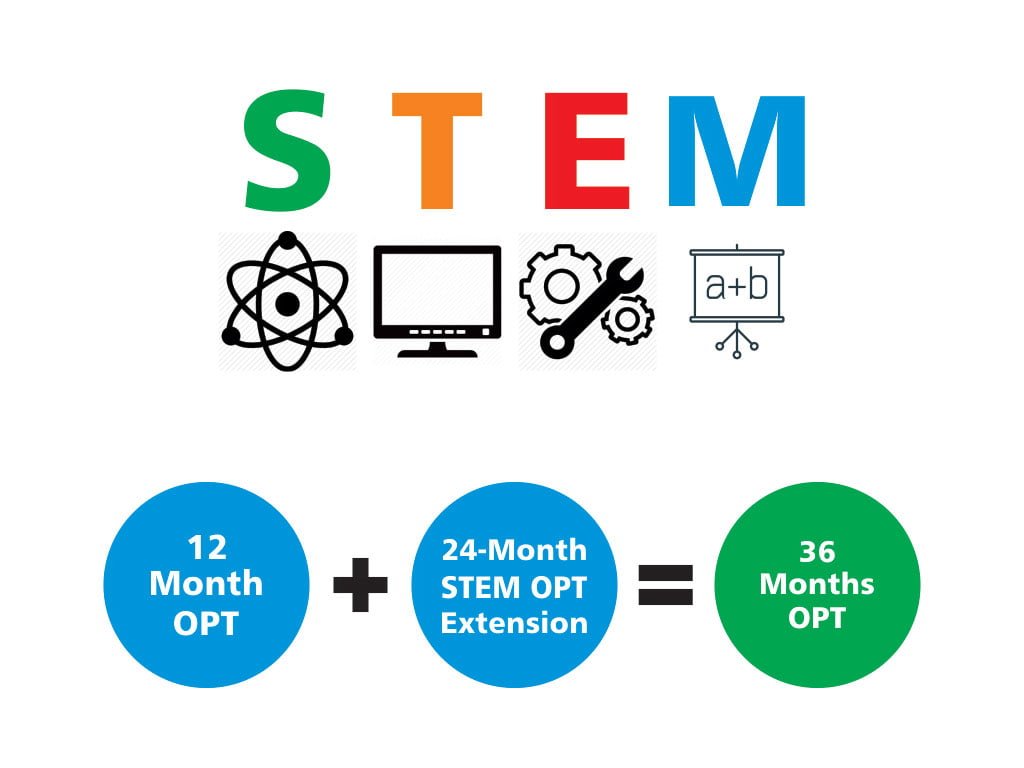
Great News (12 + 24 = 36 Months) STEM OPT Rule Survives!

Optional Practical Training (OPT)

12 Months: Granted to students on F1 (student) visa status completing undergraduate (BS/BA) or graduate (MS/MBA) degrees

24 Months Extension: Students with degrees from STEM (Science, Technology, Engineering & Mathematics) fields

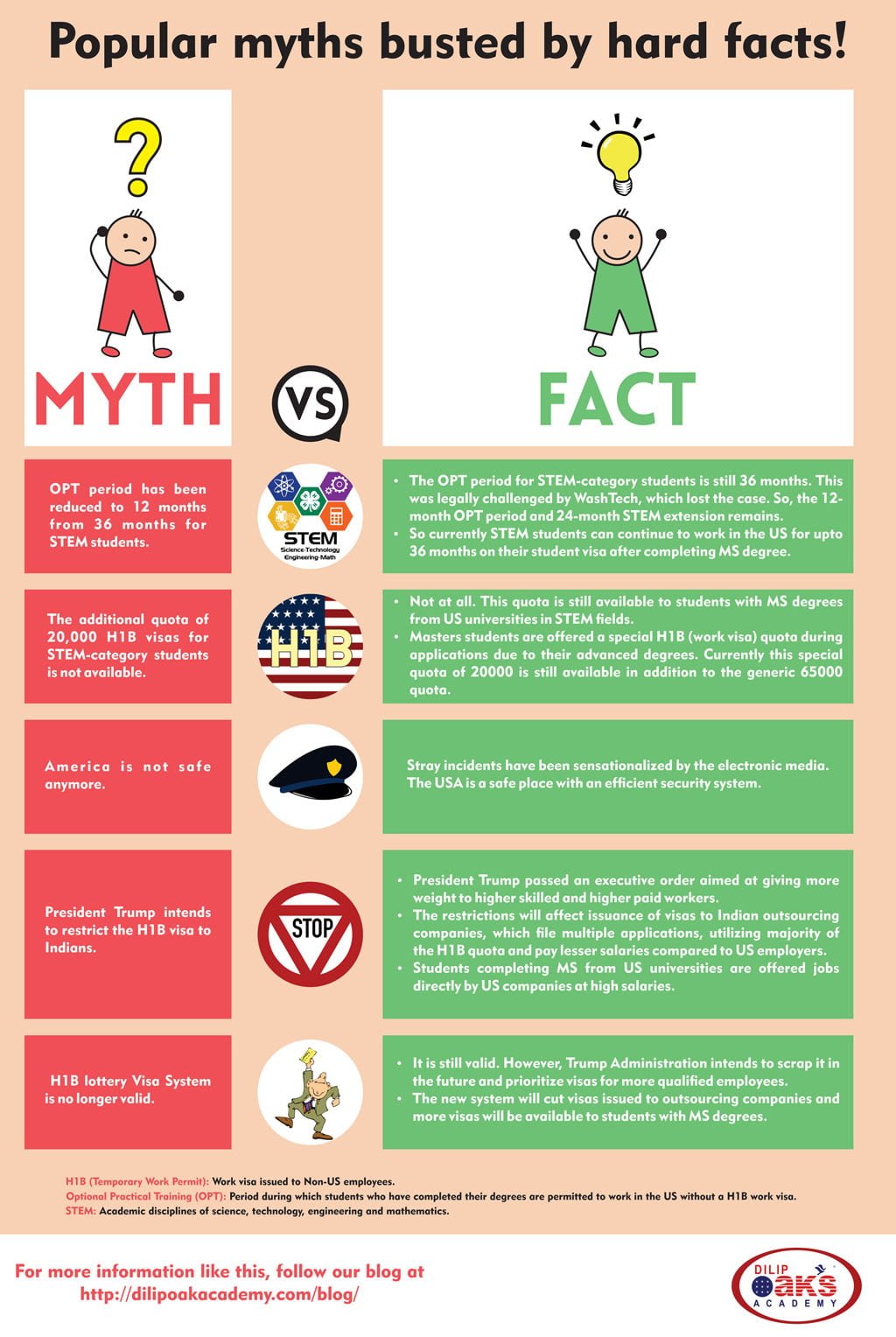
Therefore, students completing a degree from the STEM field get an OPT period of total 36 months (Regular 12 months + 24 months extension), permitting them to work in the US without H1B visa.

STEM-OPTOPT is a temporary employment authorization that is directly related to a student’s area of study. Students pursuing their education in the US on student (F1) visa are eligible to work in the US under the F1-OPT visa program, which gives them an opportunity to apply the education obtained in an academic degree to a practical work experience.

A federal judge has dismissed a lawsuit brought by the Washington Alliance of Technology Workers (WashTech) that challenged the STEM OPT regulations that allow F1 visa holders who have degrees in STEM fields to extend their one-year Optional Practical Training (OPT) period for an additional 24 months.

The dismissal ends this lawsuit, and the current rules governing 12-month OPT and the 24-month extension for students from STEM fields remain in place.

3 Solid Reasons why recent changes to H1B Visa program will help Indian students in America get more Jobs!

H1B visa

Several news articles have been published since 3rd April 2017 discussing the new rule affecting H1B visas.

Here are 3 things Indian students aspiring to study in the US should know.

1. More Visas for Students: This rule primarily affects India’s IT outsourcing industry which is the biggest user of H-1B visas. Of the top 10 companies sponsoring H1B visas, 89% visa applications are from outsourcing IT companies. This causes an acute shortage for H1B visas on a whole, reducing chances for Indian students who are directly employed by US companies , filing for H1B. With stricter regulations in place for Indian IT companies, more opportunities will open for students with advanced degrees. In other words, more visas will be available for students

2. More Jobs for Students: As this rule affects lot of outsourcing employers – these jobs need to be filled in US itself. Due to the lack of high skilled professionals with advanced degrees in US especially in the STEM areas, these jobs will open for students. As Indian students do have F1 visa with OPT – shortage of workers due to visa rules will help Indian students looking for jobs.

3. US Economy is booming and needs skilled knowledge workforce: Today US unemployment rate stands at just 4.7% lowest in 15 years. Stock market is up 15% since November 2016 – More and more investment is being made in businesses – all this means much more demand for skilled knowledge employees – all of which are in short supply today. Students should take advantage of this situation.

So Indian students doing MS in US are in reality, probably going to benefit from rules.

The Art and Science of Drafting your Statement of Purpose

Drafting your Statement of Purpose should be considered to be, essentially, a communication exercise, which you ought to take very seriously. Why do we say this? Well, for two reasons: first, going forward, there will be many such situations in which you may have to interact with others by means of the written word. And second, subject-matter knowledge is not enough. You would need to find an effective way to communicate your message so as to evoke the desired response from its target reader(s).

Below are a few tips to draft a decent SoP:

  • Cover all important points: make sure you mention your academic accomplishments and major achievements, if any, along with papers presented, seminars and workshops attended, projects undertaken, and internship experience you have had, in their order of importance.
  • Highlight your soft skills: exhibiting good communication skills will enhance the impact of your academic performance and may even prove to be decisive if you happen to be tied with another applicant for admission whose academic performance is identical or equal to yours.
  • Avoid clichés: As far as possible, avoid words like “team player”, “leadership qualities”, etc. Try and find better ways to showcase such qualities or accomplishments. For instance, you may mention how effectively you worked with others in a close-knit team to successfully complete your project in a timely manner.
  • Keep it simple: It’s a rough draft. The beautification of language can come later as your suggested draft takes on a more sophisticated shape.
  • Start early: Some people tend to put things off until the last moment. On the other hand, starting early will give you more time to reflect on what you intend to include in your SoP. It will also minimize the risk of inadvertently leaving things out, enabling you to present a comprehensive narrative and present a strong case for your candidature.
  • Get help from experts: There are experts around who can help you draft an attractive Statement of Purpose thereby increasing your chances of getting admitted to the university of your choice. So, avail of their expertise and ensure that your SoP is a winner.

American Dream – Bringing it to Reality (Part III)

An overwhelming majority of Indian students who travel to the US for higher education belong to the Science, Technology, Engineering & Mathematics (STEM) category. For the annual H1B quota of 20,000 visas reserved for this category, about 30,000 applications are usually received. On the other hand, against 65,000 H1B visas allocated for non-STEM applicants, three to four times that number apply.

Therefore, an applicant for an H1B visa from the STEM category invariably stands a much better chance. That is why several students from the non-STEM category, even if they find a job in the US after graduating, have to leave for their country of origin as they fail to acquire an H1B visa. Another factor that works in favour of STEM students is that their OPT (Optional Practical Training) is valid for 36 months, which entitles them to three attempts at seeking the coveted H1B visa.

During those three critical years, they get paid in US Dollars by their employers and recover the cost of their education. That is why we have advised students belonging to the non-STEM category, and their parents, to carefully consider these possibilities before investing in higher education in the US. Most STEM students find good jobs in the US, and statistically speaking, only about 10 percent return to India.

There are, of course, several compelling reasons why students prefer to stay on in the US. They get accustomed to a much more comfortable lifestyle, cleaner surroundings, a pollution-free environment, honest dealings, a high living standard, reliable security, and a good income, to name a few of them. Moreover, genuine opportunities for top-quality education and lucrative careers in research are also attractions that most Indian students cannot resist.  Therefore, their reluctance to return home is perfectly understandable.

Personally, I am of the considered opinion that this cannot be called “brain drain” at all.  In fact, I would go so far as to say that as brains are in such excessive numbers in India, there is nothing wrong with looking at them as potential exports. One’s ‘janma bhoomi’ and ‘karma bhoomi’ need not be one and the same. I believe there is no logical reason why one’s motherland and the land where he lives and works should be identical. People ought to be free to exercise their fundamental human right that entitles them to seek an environment they consider conducive to the realisation of their long-cherished dream.

Perhaps it is pertinent to point out here that, generally, Indian students who live in the US end up remitting some of their earnings to their next of kin back home. Such routine remittances add to the foreign exchange reserves of India. Besides, non-resident Indians also share with their relatives and friends back home new ideas thereby sowing the seeds of new enterprises.  Some such NRIs have founded technology-driven companies in their home country which have generated revenue and created new well-paid jobs. Therefore, I see it as a win-win situation.

American Dream – Bringing it to Reality (Part II)

In the US education is closely associated with philanthropy.  Individuals do not own universities.  The famous Carnegie-Mellon University is a case in point. Its governing council may have a couple of members who belong to founders’ families but the university is essentially managed by a Trust. Grateful alumni donate generously to their alma maters.

The US Government offers generous grants to universities. Deserving students get attractive scholarships from universities. Students are provided every possible opportunity to work as teaching and research assistants and take up campus jobs to earn so they can lighten their financial burden. American culture respects the dignity of labour. Working part time at a McDonald’s outlet is not looked down upon or considered below one’s dignity.

In India, the  founders of educational institutions, which have mushroomed all over the country, are scarcely concerned about the quality of education they impart. They often find it difficult to appoint good teachers to their faculty. On the other hand, in the US, Nobel laureates are professors in universities. Therefore, it should hardly come as a surprise to any of us here when India lags woefully behind the US in research. In America every university is a centre of research.

Sadly, in our country, education and research are thought to be mutually exclusive.  We seldom encounter researchers teaching at our universities. In the US, on the other hand, university professors are actively engaged in research Out there the course curriculum is revised every year to meet the ever-evolving requirements of industry and the job market.

Classrooms in the US are not crammed to capacity but have far fewer students, making it possible for professors to pay individual attention to every student.  Each graduate student is assigned a professor as his or her graduate advisor, and the two actively collaborate to configure the course content of the student by selecting the most appropriate courses for that particular student. This method and approach is unique to the US. Is it any wonder, therefore, that our students entering the US educational system, realise for the first time that education can be enjoyable, and become genuinely interested in the process.

In India the student is evaluated almost entirely on the basis of his or her scores in examinations. In the US, on the other hand, evaluation is based on the level of the student’s subject knowledge. This has a direct bearing on the employability of students as job opportunities in the US are directly linked to the education or training they have had at university. The student automatically qualifies for a job if he has performed well academically.

American Dream – Bringing it to Reality (Part I)

The United States of America presents a wide range of exciting opportunities for higher education and employment to ambitious young Indians.  However, this indisputable fact was not widely accepted in Pune, when I first pointed it out, way back in 1996.  Punekars were mostly skeptical of it..  Actually, this was not entirely surprising. In those days, someone travelling to the USA was such a rare occurrence that it made news.  However, now things have changed quite dramatically.

When I founded Dilip Oak’s Academy in 1996, only 24 students had enrolled.  Eight of them went to the USA eventually. Gradually,  the number grew over the years and, in 2016 alone, we sent as many as 1,500 students to a wide variety of the universities in the US.  These students were not from Pune alone. Many of them hailed , but even from small cities and towns in the hinterland of Maharashtra, such as Sangli, Vita, Satara, Belgavi, Kolhapur, Amaravati and Aurangabad. Some belonged to  and other states like Madhya Pradesh, Chhattisgarh and Gujarat as well.   Now, in 2017, we expect the number to climb to an unprecedented 1,800 at least. We have come a long way, indeed.

Looking back, clearly, the two Bills, Bill Gates and Bill Clinton, opened the floodgates to American education for Indian students.  Bill Gates needed intelligent young computer professionals and Bill Clinton desired stronger ties with India.  Since then, the rising number of Indian students travelling to the US has completely shattered the myth that an American education was exclusively either for the most intelligent or the super-rich.

I am often quizzed about the perceived preference for the US when it comes to higher education or employment.  In my opinion the chief reason is the immense size of the US economy.  While the Indian economy amounts to US$ 2.3 trillion, the size of the US economy, the largest in the world, is a whopping US$18 trillion. As you would see, the US, which accounts for only about 6% of the world’s population but contributes 24% (almost a quarter) of the world’s total GDP, which is mind boggling.  This has made the USA a magnet for immigrants from across the globe.

Most Americans cannot afford a university education.  One reason for this is that many American parents expect their children to become self-reliant immediately after school. Typically,   American parents do not pay for their children’s university education. Young people aspiring for higher education have to raise the money themselves.

Besides, a big chunk of many of the American high school graduates prefer to study psychology, music, languages, etc., over  science, technology, engineering and mathematics, which have collectively become known by the acronym STEM.  The humanities rank much lower on the demand scale in the job market.   American corporations have historically had a short supply of STEM-trained professionals. Therefore, they have had to depend on immigrants particularly from populous countries such as India and China, to meet this ever-growing demand gap. India and China have traditionally accorded top priority to education.  Even economically backward communities in India, for instance, somehow find the means to educate their children as best they can.

To meet its insatiable need for technically trained manpower, the US grants about 85,000 H1B visas (work visas) every year.  This annual influx of immigrants is quite negligible when compared to the country’s population which is a sizeable 320 million.  Having said so, it must be stressed, that without this import of human resource, the American corporations would not have progressed so much.

The US attracts intelligent and creative persons from all over the world because it is a “melting pot” of great diversity.  In its constant social churning, race and religion, class and culture, do not matter. Only merit is the overriding consideration for career advancement or upward social mobility. What immigrants have found to their benefit is that merit is duly rewarded without any prejudice whatsoever. The American system catapulted Mr. Sundar Pichai to the helm of affairs at the head of Google in recognition of his contribution to the organisation. Similarly, and Mr. Satya Nadela was picked to head at the helm of Microsoft for his proven merit.  A South African, Mr. Elon Musk founded Tesla, the electric car company in the US ; Steve Jobs’ father was a Syrian immigrant.  The US offers to anyone who has a dream and potential, the opportunity to live that dream, the Great American Dream.

Americans have a penchant for innovation. Venture capitalists in the USA have historically displayed an enormous ability to take risks when they invest in innovative ideas.  Almost 80% of the ideas they invest in turn out to be duds, but the rest of the ideas that work catch on and rapidly evolve into great and innovative corporations like Amazon and Facebook.  And these more than makeup for the loss.

Why does the recently re-introduced H1B visa bill seem to be in favor of the Indian Students in USA?

Are you confused as to what the latest news regarding this “ Bill introduced in the US regarding H1B work visa” is? Keep reading further to understand what all the discussion is really about.

The new bill, titled “Protect and Grow American Jobs Act,” has been re-introduced in Congress by certain republicans (this bill was already introduced in earlier years, but was never passed). It proposes key changes in the H1-B program that allows skilled workers from foreign countries to fill high-tech jobs in the US.
The bill has proposed two changes – the gist of which is as follows:

– Making it harder to get H1B for low paying jobs
– Removing Masters quota for H1B

Looking deeper into these proposed changes it looks like these will actually likely help Indian students in the USA!

American economy is currently booming and unemployment rate is at its lowest in two decades, which implies increase in job creation.

H1B visa (work visa) is designed to be used for foreign workers with highly specialized skills. Total of 85000 visas are issued every year, which comprise of 65,000 for general quota and 20,000 for US Advanced degree quota for Master’s students. Last year a whopping 233,000 applications were submitted for the limited quota of 85000.

First, a lottery was conducted for the US Master’s degree quota applications to select 20,000 petitions and then the petitions that were not selected in this this first round were added to general quota pool and lottery was conducted on this pool to select the overall 65,000 petitions for general quota. This is pretty standard over the years.

Currently the Indian IT outsourcing companies use up to 70% to 80% of the general 65000 H1B quota. This causes an acute shortage for H1B visas, creating a shortage for Master’s students from India in the USA who are added up to the general quota for H1B lottery.

For details on top H1V visa sponsor companies in 2017 kindly visit the following report from Myvisajobs.com(http://www.myvisajobs.com/Reports/2017-H1B-Visa-Sponsor.aspx). The report shows that of the top 10 companies sponsoring H1B visas, 89% visa applications are from IT companies with average salary under $100,000 per year, and only 11% are from US companies all of which have an average salary above $100,000.

Most of the American companies that employ highly educated students who have completed their Masters studies in the USA- offer a high starting salary. Also Indian students graduating in the STEM (Science, Technology, Engineering, and Mathematics) category have a period of up to 3 years on OPT where they can work on student visa before getting their get their H1B work visa. So even if the starting salary is not as high as $100,000 per year, 70% of Indian students (especially those working in computer science related fields) reach that mark within first 3 years depending on their skills and field of work.

Today many talented students with MS decrees are missing out on H1B visas because they are being denied the H1B visas in the lottery system.

Also eliminating Master’s degree quota of 20000 visas for H1B should not affect the Indian students with MS degrees, as the absence of H1B petitions from the IT companies would make room for highly paid foreign employees with advanced education and skills.

All in all, it seems like Indian students studying in American Universities will benefit from proposed bill.

Again, note that this is just a bill not the final rule – and likely will at least take a minimum of 12-18 months before it gets enacted (if it passes this time).


US relaxes green card rules for talented individuals with advanced degrees

US has relaxed the tests used to grant a National Interest Waiver (NIW) to EB-2 category of green card applicants

 The EB2 Green card category

Green card also refers to an immigration process of becoming a permanent resident in the USA. The EB-2 Green Card is a category offered to talented immigrants with advanced degrees or especially rare skills. Most of the Indian students who have completed their Masters education in the STEM (science, technology, engineering, and mathematics)category fall under EB2 green card category

EB2 Green Card Processing

Commonly, a permanent job offer and an approved labor certificate are pre-requisites to file for a green card.

Filing the labor certificate is the first step in green card processing. It is a rigorous process where your employer has to be ready to sponsor your green card by offering you a permanent job and has to undergo a series of steps to prove that no US workers are available to fill the position you are employed in, and hence you deserve green card. This process can take from six months to 3 years in some cases.

An NIW allows individuals in the EB-2 category to skip the cumbersome ‘labor certification’ process.

National Interest Waiver (NIW) Petition

On December 27 2016, the US authorities have eased the tests to get National Interest Waiver (NIW).  So, even if a person has no employer, he/she may file an NIW petition on behalf of himself/herself in order to initiate a green card filing process under the EB2 category.

In order to be eligible to file an NIW petition, an applicant must have an “advanced degree” or “exceptional ability” in the sciences, arts or business and should demonstrate that he/she seeks employment in an area of substantial merit to the U.S

NIW applications have clear advantages over other regular EB2 green card petitions. Since there is no labor certification or permanent job offer requirement, an NIW is an attractive choice for scholars, researchers, post-doctoral research fellows, PhD students, and other advanced degree professionals.

Apart from offering speedier process in the path towards a green card, NIW holders can also avail of an unlimited H-1B extension, and their spouses too can apply for work authorization.

Indian students with advanced degrees will now have a fairer chance of obtaining an NIW, which in turn will speed up the process of obtaining a green card.

Trump as the new US President: The Benefits for Indian Students

Donald Trump has been elected as the new US President. This blog intends to cover what it means for Indian students intending to pursue MS in US.

It is important to note that skilled immigrants with advanced degrees have started more than half (44 of 87) of America’s startup companies valued at $1 billion or more and are key members of management or product development teams in over 70 percent (62 of 87) of these companies- according to a 2016 National Foundation for American Policy study. Most of these entrepreneurs and key personnel at some point obtained H-1B status, often after studying at a U.S. university.

Thus, skilled immigrants have been a powerhouse of talent, proficiencies and entrepreneurship.

A. Republicans support lawful and skilled Immigration

-Republicans largely oppose illegal and unlawful immigration but they have been in favor of skilled immigration for decades. Today in US, there are over 11 million illegal residents (Largely from Mexico and other Latino countries). Compared that to just 85,000 H1B’s (work permit visas) are awarded every year for skilled foreign workers.
– Now the Republican Party controls both – the US senate and house along with the presidency – which could open up a passage for the skilled immigration bills to pass.This opens up the gridlock of the last 10+ years. Allowing more visas for students with STEM degrees.
– Today getting H1B visas (work visa) after finishing advanced degrees is hard, and permanent residency even harder. With above changes, it should get easier for Indians with advanced degrees to get more student visas and work visas, as 99% of the Indians fall under “skilled immigration (STEM)” category

B. Economy will create more Jobs – Creating higher demand for skilled workforce that America does not have today

– Trump is proposing lowering of taxes. He is also suggesting more manufacturing to happen in the US and is against outsourcing of American jobs. This implies that the US economy will have to create more skilled jobs within America itself. But today America faces a severe dearth of a skilled workforce with advanced STEM degrees. Indian students in US will be in high demand to fulfill those new jobs that will be created in US. Also fewer jobs will be outsourced – which creates increased demand for jobs within the USA, in turn benefiting Indian students in America

C. Trump thinks India as an allied nation
– This will open doors for the stronger relationship with India, as India is a natural ally in this new order. This will open up lot of opportunities for Indians