All About the Resume – Part 2: Make It Easy for Professors Select You

Why the Resume is Different from a Bio Data or a CV – and Why It Should Stay that Way

Note that the resume is different from a bio data or a curriculum vitae (CV) in several respects: whereas bio datas and CVs are all-inclusive, data bank-like documents written in chronological order, resumes are compact, focused documents written in reverse chronological order that highlight only the most relevant and important information for course (or post) being applied for. So, don’t turn your resume into a Bio Data or CV – that would defeat the very purpose of the document.

Your resume should contain only the relevant information because professors are busy people who are hard pressed for time: if you bury the information they need in a sea of irrelevancies they might lose interest – and you might lose a position they might otherwise have awarded you. In other words, don’t hide the information that tells them that you are the candidate that they are looking for: make sure that when they see your resume they can’t miss it.

Continue reading

All About the Resume – Part 3: How to Create a Snapshot of Yourself in One Brief Page

Tips for Writing Resumes

A resume, like all other application documents, is designed to answer one crucial question: “Why should you be selected?” Of all the application documents (the SOP, the recommendation letters, and the transcripts), the resume answers that question in the briefest yet most comprehensive way. In order to achieve its goals, the resume must present the most important facts about you in their most concentrated form, in the smallest possible space. This will enable it to present a compelling snapshot of your strengths as a candidate and persuade the Admissions Committee that you are a good choice. Here are some tips that will help your resume to achieve its intended goals:

Continue reading

University Application Deadlines For Fall 2014

The application season is on, December is just round the corner …and university deadlines are coming up soon. So, here is our much awaited blog for university application deadlines for fall 2014.

Our list covers 125 universities with deadlines ranging from December 2013 all the way up to August 2014. At the end is a section on universities with rolling deadlines (click here to find out what is meant by rolling deadlines).

Remember that American universities update deadlines on their websites at different times during the academic year so, we will update this blog to keep up with changes on their official websites.

Presenting the first in our round of deadline alerts.

Continue reading

August Alert for Students Applying for Admission in Fall 2014

Fall in an American UniversityIf you are thinking of getting admission in fall 2014 the clock is ticking and August is drawing to a close. So, if you want to be in your American university at around this time next year, what should be your priorities in the next couple of months (and as you can see from the picture above, it really is beautiful there during fall). Hint: one thing that you will need to do is start thinking about which universities to apply to – and then there is going to be a lot of head scratching that you will have to do to select universities to apply to …and so much interviewing and researching that you are going to feel .like a news reporter! The details are below. Ready to read? Well, get set and go!

Continue reading

How to Crack the GRE

Here’s a compilation of terrific tips on how to crack that all important exam – the GRE. The first set is from Dilip Oak’s Academy’s top scorers. The second set is from the academy itself.
Tips from Our Top Scorers

Preparing for GMAT: Important Links for You

Gathered together here are some useful links that will help you get prepared for that all-important exam!

Reading Comprehension

Data Sufficiency

Read these blogs and never get confused about Data Sufficiency questions on the GMAT again:

Integrated Reassoning

Wondering what Integrated Reasoning is and why it was introduced? Find out with these simple explanations.

Analytical Writing Helps

Problems with writing good essays in English affect almost everyone. Here are some important links on cutting out the mistakes that pull you down.

Find out about:
– how to how to move smoothly from one paragraph to another by using transition words and phrases effectively
– tips on how to improve sentence clarity through using parallel constructions, transition phrases, clear pronoun references and other grammatical devices
– when to use capital letters and when to go with small case:
– making sure you don’t confuse your a’s, an’s and the’s:
– advice on proper subject-verb agreement

MS in US: Fundas on Funding


Do You Have Any Idea of How You Are Going to Pay for Your American Degree?

Funding for your education in the United States is an important issue. Costs can range from Rs. 20 to 40 lakhs. Where is all that money going to come from?

If you’ve been wondering about that crucial question, here are two links that will help you. You don’t have to be super rich to get your master’s or a PhD from the States, nor do you have to have an uncle with a Swiss Bank account! The universities themselves will help you and so will others. Find out how with these two really important links:


Solutions to GMAT DS Questions

Solution to Question in ‘Tackle Options in GMAT DS Questions the Oak’s Academy Way’ Blog Post

Question:

Given that a, b, c, d, e are positive integers and that ‘b’ is an odd integer, is the product (a+b)(a+c)(a+d)(a+e) an odd integer?

(1) a is an odd integer

(2) c is an even integer


Continue reading

A Few Great Tips on How to Tackle the GMAT DS Questions

 by our Quantitative Reasoning Faculty

In last time’s blog we looked at why DS is so important in GMAT. In this one we’ll take a look at the 3 key things that you need to do in order to tackle this unfamiliar question type. There are:


1. Learn the Options

The first step in learning DS is to get absolutely familiar with the options. Fortunately, in DS, this is easy because the five options are always as follows:

(A) Statement (1) alone is sufficient but statement (2) alone is not sufficient to answer the question asked

(B) Statement (2) alone is sufficient but statement (1) alone is not sufficient to answer the question asked

(C) Both statements (1) and (2) together are sufficient to answer the question asked, but neither statement alone is sufficient

(D) Each statement alone is sufficient to answer the question asked

(E) Statements (1) and (2) together are not sufficient to answer the question asked and additional data are needed.


2. Remember the Aim

Remember, in DS our aim is NOT TO FIND THE FINAL ANSWER to the question but  just to verify whether the INFORMATION GIVEN IN THE TWO STATEMENTS IS SUFFICIENT TO REACH TO THE FINAL ANSWER!

So while solving the question if, at any intermediate step, you realize that you can reach the final answer then QUIT and mark the option accordingly.


3. Understand the Approach

Now let’s have a look at how you should approach DS questions.

Step 1: Carefully Read the Question Statement and Find the Crux of the Question

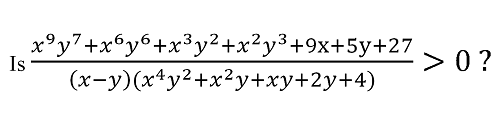
After closely examining the question statement and before you read the information given in statements (1) and (2), ‘identify the crux of the question’. What I mean by ‘the crux of the question’ is the piece of information that is the key to the solution. Sometimes you have to think a little bit before you get it. But once you have it, it will lead you straight to the answer. For example, have a look at this question statement:


If x and y are distinct positive integers then:


(1) x = 2 (y + 3)

(2) x2 = y2 + 4


Now, if you have lost touch with maths, just the sight of that forest of terms is enough to want to make you give up. But again, remember that we are not at all interested in solving this inequality. We just need find out whether the expression on the left hand side is positive or not (that’s what is implied by >0) – and this is a much simpler matter! Further, in this mass of algebraic symbols is a key that reveals itself when you examine about the expression and think about it a little.

In order to get this key, the first thing to do is to carefully observe the question statement. First and foremost, it says, that x and y are distinct positive integers. This is a very important piece of information – and you’ll understand why in a moment. Secondly, if you observe the numerator of the expression on the left, it consists of additions throughout. Given both these pieces of information, the numerator has to be positive in nature: it is the sum of distinct positive integers (which is why the information about x and y was important). By the same logic, even the second bracket in the denominator has to be positive. The only unknown factor, therefore, is the first bracket in the denominator, i.e., (x – y) and this is what holds the key to the entire problem.

The entire expression will be positive if and only if (x – y) > 0, in short, if x > y. On the other hand, if x < y, the whole expression will be negative. So, the whole gigantic problem is reduced to an extremely simple question: is x > y? Once we have arrived at this conclusion, cracking the rest of the problem is really easy: any information about the relative magnitudes of x and y will be sufficient to arrive at the answer! Thus, in this case, the crux of the question (the key to the solution) is realizing that all we need to find out in order to answer this question is whether statements (1) and (2) allow us to decide whether x is bigger than y or vice versa.

Once you have reached this stage you are can confidently take on the options of this seemingly insoluble problem. The discussion above takes care of Step 1 of the approach i.e. carefully reading the question statement and finding the crux of the question. In the next post we’ll look at Step 2 of the approach: tackling the options in DS questions – and we’ll be giving you tips that will reduce the complexities to a few simple steps! Watch for the tips in our third DS blog post next week.

Important Alert: the F-1 Visa Process has Changed

The new visa process announced by the US Consulate in September 2012 is completely new. Everything has changed right from payment of the visa fees to scheduling a date at the consulate. The following steps are involved.

  1. filling in the DS 160 form
  2. paying the visa fees
  3. scheduling appointments for:
    1. submitting biometric data and documents at the Offsite Facilitation Centre and
    2. the Visa Interview

1. Online Filling of the DS 160 Form

The first step is to fill the DS 160 form online. Filling the form generates a CONFIRMATION NUMBER. You will require this number to print the ‘Receipt of Payment’ (which, in this case, is printed out before you make any payment!) since it contains the CGI reference number that is required if you are going to pay the visa fees in cash.

2. Payment of Visa Fees

You can now pay the visa fees by:

  1. Electronic Fund Transfer
  2. Mobile Phone
  3. Cash payment at any Axis bank branch (there are over 1800 branches across the country)

If you make a cash payment of the fees (recommended), be sure to take along the ‘Receipt of Payment’ that you printed out earlier. The bank will need to see the ‘CGI Reference Number’ on it when you go to pay the visa fees. If you fail to produce the ‘Receipt of Payment’ the bank will not accept your visa fees.

3. Scheduling the Appointments

You can schedule appointments only after the receipt is ‘activated.’ Usually, this takes an hour. Once the receipt has been activated, you will have to schedule two appointments:

  1. Offsite Facilitation Center (OFC) – this appointment is for you to submit fingerprints of all ten fingers, photographs (digital and physical) and required documents. This appointment has to be scheduled at least one day prior to the visa interview date.
  2. Visa Interview – this is the actual visa interview appointment.

Note:

  1. You cannot appear for both appointments on the same date; and appointments for consecutive dates may not always be available. There have been instances where there is one whole week between the OFC appointment and the appointment for the interview. If that happens to you, you will have to make two trips to the consulate.
  2. After the visa has been granted the passport is couriered to the home address (this facility is available for select cities only) or can be collected from the VFS center nearest to the home city.

What are the pros and cons of this new process?

PROS:

  1. More ways of paying the visa fees
  2. Over 1800 Axis bank branches across the country for payment of visa fees in cash
  3. no additional documents other than the ‘Receipt of Payment’ to be carried to the bank
  4. Elimination of spelling mistakes in the applicant’s name due to manual input at the bank.
  5. No need to go to the VFS center prior to the visa interview.
  6. Time required for activation of visa fee receipt reduced from 2 working days to an hour enabling quicker scheduling of the visa interview.

CONS:

  1. DS 160 (which is a very long form) has to be completely filled before you can print the ‘Payment of Receipt’ and without the ‘Payment of Receipt’ the visa fees will not be accepted by the bank.
  2. Two appointments (OFC and visa interview) have to be scheduled on two separate dates, which may not be consecutive. Hence you may have to travel twice to the city where the consulate is located.
  3. You may have to collect your passport from the VFS centre.

If you have any queries related to:

  • filling the DS-160 form
  • payment of visa fees or
  • scheduling/changing visa appointments

these can be made at:

  • Email: support-india@ustraveldocs.com
  • Telephone: 91-120-6602222 or +91-22-67209400
  • Skype: user name: ustraveldocs-india
  • Online Chat: www.ustraveldocs.com

TIMINGS:

  • Monday-Friday: 8:00 am to 8:00 pm
  • Sunday: 9:00 am to 6:00 pm

Related Links

Other Application Documents:

Also ‘Must-See’

The Importance of Data Sufficiency Questions in GMAT

~ by our Maths Faculty


My opening GMAT blog post will focus on Data Sufficiency, an important and unique Quantitative Reasoning question type in GMAT. Later on we’ll take up some sample questions to illustrate how to tackle this strange and interesting question type but first we will look at a fundamental point: why is DS important? Well, look at Figure 1 below

Figure 1

What this pie chart tells us is that, out of 37 questions in the GMAT Quantitative Reasoning section, you can expect around 22 to 23 will be of the Problem Solving (PS) type and 14 to 15 of the Data Sufficiency (DS) type.

Now, maybe you’re thinking that what this highlights is the importance of Problem Solving questions. But that is only the most obvious thing that the data says. The other important thing that it tells you is that if you want a good score in GMAT, you cannot afford to neglect Data Sufficiency. On the contrary, DS questions play a crucial role in converting mediocre GMAT scores into first-rate ones, so, if you ignore DS questions, that great GMAT score you are looking for may never be yours. Here’s why.

When you are through with your initial preparation and have given 3-4 mock GMAT tests, like most other students, you will probably find your scores stagnating. There are various reasons for this, but, in Quant, if you find that your raw score is fluctuating between 43 and 46 out of 60, the reason will usually be low accuracy in DS.

The most important reason why many students don’t achieve high accuracy in DS is that they don’t think the way that DS demands. We never solve such questions either in school or in college so, we don’t really understand them and so, we end up ignoring or trying to avoid DS questions. But that, is a big mistake! Remember the stats: you can’t think of getting a good score in GMAT without mastering DS questions. So, how do you deal with the difficulties that this question type throws up? Watch for our next post and find out.


University Selection for MS in US!

choosing right universities

We present you the definitive guide to University Selection for MS in US. One of the most difficult and important parts of the whole process of applying to American universities is deciding which ones to apply to. And considering the large number of good universities and the wide variety of courses available, selecting the right universities is a difficult exercise. So, here are a few pointers to help you on your way.

Continue reading