Jobs After Studying in America

Is there scope to take up jobs after studying in America? Most students do take up a job in the United States after they have finished their course of study there. However, the student (F1) visa that you get from the US embassy in India does not permit you to take up full-time employment. You have to take permission from the Immigration Department first. The good thing is that obtaining this permission is not very difficult. You are allowed to work after finishing your MS, MBA etc. under Optional Practical Training (OPT).

Once you have got a job it often happens that your employer will request the authorities for a change of status in your visa from F1 (education visa) to H1 (work permit). This can be renewed for 3 years more. During this time many people apply for a Green Card i.e. permission to live in the United States permanently. Once you get your Green Card you will be able to live and work in the United States for as many years as you want.

Working while Studying: On Campus Jobs

Working while studying in America is quite well-accepted. You can work on campus for 20 hours per week. Almost all students studying in a university find on campus jobs. The pay varies from 6-9 dollars per hour depending on the area and the type of work you get. Even if you get an average of $7 per hours, you can earn around $500 per month which is more than enough to take care of your costs of living. You may even be able to pay part of your tuition costs out of your savings.

On campus jobs can vary from working in a computer lab, or in a library or cafeteria. In America all work is respected because Americans believe in the dignity of labour and in being able to pay for one’s own education. Indians are widely accepted in computer-related fields. You should try to get a job in this area since the jobs are more comfortable and the pay is better.

Changing Your Field of Study

The American system is very flexible, so changing your field of study is acceptable even in the middle of a course. So, for example a student doing his or her MS in the engineering department of a particular university might shift to a program in the computer science department of that university.

Though this is acceptable, you must remember that when you transfer to a new department, the department may not accept all your credits. They may treat you as a fresh admission and accept only those credits that are common to both programs. So, before you change your course find out what credits will be accepted, see how many you will have to do all over again and then see whether it is really worth it. Only then is it worth thinking of changing your field.

Changing Universities

Changing universities is possible and is allowed in the American system of education. You may want to change your university for a number of reasons:

  1. You were earlier not given financial assistance in any university, so you took up the best available, but now you have been offered financial assistance by a university that you would like to go to
  2. After you have joined the university you may find that it is not exactly what you wanted – a faculty member who you thought would be teaching is on an assignment elsewhere or the course that you had wanted to study has been changed for some reason and so on
  3. You had to take admission to a low-grade university since your GRE/GMAT scores were not good, but now you have done well in the first semester and on the strength of your improved academic performance, you want to transfer credits to another university.

Change universities for any of these reasons is quite acceptable to and you can change universities at any time but, this is normally done after the first or second semester. Also keep in mind that there are some potential problems that you should be aware of: because of the differences between one university and another, your new university may not accept all your credits and may ask you to take some extra credits.

Great FREE Application Tools on DOA Online: Part 3 – Question & Answer Forum

Question & Answer Forum

Question & Answer Forum

– What are transcripts?
– When should I register for the GRE test?
– Where can I find university deadlines?
– From whom do I need to take recommendation letters?

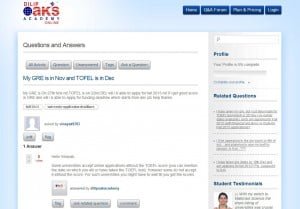
The list of questions that come up when you are applying to American universities is endless. Most probably you won’t know where to look for solutions or, whom to ask for the answers. That’s where the next of our great free application tools comes in – the DOA ONLINE Q&A FORUM.


On the Q&A Forum (click screenshot below for enlarged view) you can:

  • ask any questions you have regarding the application process for American universities
  • get answers and expert advice from the academy (look for answers by the admin!)
  • get valuable tips and insights from other registered users – since they have gone through the same situations and problems, their advice is often the best: no one understands your situation better than those traveling on the same path!
  • consult the vast database of questions and answers already on the Q&A forum.

Continue reading

Dr. Harchol-Balter on the Statement of Purpose

The statement of purpose is an extremely important part of your application packet (click here for an explanation). A well-written SOP that brings out the most important facts about you as a candidate for higher studies, can open the doors of opportunity for you. On the other hand an SOP that tries to impress but focuses on facts that the admissions committees consider irrelevant can lose you the opportunity that you have dreamed of.

In the extract below Dr. Harchol-Balter, an Associate Professor of Computer Science at Carnegie-Mellon University points out two common mistakes that many applicants make:

The grade regurgitator – “In my high school, I was ranked Number 1. Then I got a perfect score on my college entrance exams. Then I competed in a statewide math competition and I was the best. Then I competed in a national programming competition and I was 5th. In college, my GPA was 3.95 out of 4.0. For these reasons, I believe I will do well in your graduate department.”
What’s wrong with this? This portion of the essay is a waste of space. Awards are certainly relevant, however any award you won should be listed on a separate piece of paper which is titled “Awards and Honors” and which you can include with your application. There is no reason to tell us all this in your essay. It will only piss-off the people reviewing your application because they already read all this information earlier in your application and they now want to hear about research.
The boy genius – “When I was born, my mother gave me a glass ball to play with. I would lay and look at the prisms of light shining through my ball. At age 3, my father brought home our first computer and I disassembled it and then put it back together. It was then that I knew I wanted to become a computer scientist. By age 5, I had taken apart every appliance in our house. At age 6, I became a chess whiz ….”
What’s wrong with this? We simply don’t care what you did as a child, and we don’t believe you either. You’d be surprised how many applications from Einstein-wanna-be’s we get. If you really think this is relevant, put the important facts on a separate sheet of paper, and include it in your application. It’s best if your essay can stick with stuff you did in college and later.


Related Blogs on Application Documents

Related


5 Reasons Why Students Going to America Should Join LinkedIn

LinkedInIf you are reading this blog the chances are that you are a net savvy user, you have accounts on Facebook and Twitter and you are a student going to America for higher education. But have you ever thought of signing up for a LinkedIn account? Probably not: LinkedIn is supposed to be meant for professionals, and none or few of your friends are on it, so what good would it do a student to have a LinkedIn account?

When you don’t know many people on LinkedIn, it is easy to think that it doesn’t matter. Actually however, there are 5 reasons why having a LinkedIn account is very useful if you are heading for higher education in the States.


  • LinkedIn offers several tools to help get information and ideas from experts in your field viz.:
  1. LinkedIn Groups
  2. LinkedIn Answers
  3. LinkedIn Today

For college students these tools offer a great way of learning the professional language of your field, keeping up with the latest trends and topics in the field and becoming a well-informed ‘insider’. With more than 120 million users worldwide, LinkedIn offers a lot of potential avenues for learning.

Continue reading

Great FREE Application Tools on DOA Online: Part 1 – the University Info Feature

Is the Admission Process Becoming a Hassle?

If you have been struggling with the complexities of getting admission to an American university, then you need to know about the great FREE tools available on our online‘ site. They are great for two reasons. First, they will simplify the process of applying to American universities for you. Second, they are free.

There’s no payment and there are no obligations even for students who haven’t enrolled for admissions counseling at Dilip Oak’s Academy. To use them, all you have to do is sign up and start using them. So, tell all your friends about them so they can benefit from them too! This week we will begin with the University Info feature.

Continue reading

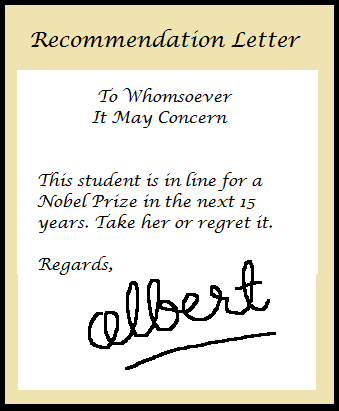
Recommendation Letters – Part 2: Ingredients of a Good Recommendation Letter

What Recommendation Letters should Cover

Recommendation letters should cover the following points (also see the links to great sample recos at the end of this post):

  • How long the recommender has known you and in what capacity (teacher, seminar or project guide, practical supervisor, project leader etc.)
  • His or her assessment of your academic performance (relative rank etc.), intellectual abilities, work habits and character
  • Your special achievements – especially in projects or in papers presented
  • Your communication skills – how well you were able to present your seminars
  • Your social skills – ability to work well with others, leadership qualities
  • Some background about the recommender – this is useful in the case of professors whose work in a field might be good but little known outside India; things to highlight include area of work, achievements in that area (papers published, awards etc.), prominent places worked in, length of experience and so on

7 Cool Services on DOA Online that will Give You an Edge in Applying for US Universities

Announcing the ‘Best Online Tool for Applying for an MS in the US’!

Here’s some terrific news for all of you who are applying for admission to US universities” – Dilip Oak’s Online, a fantastic resource launched by Dilip Oak’s Academy puts vital help at your fingertips.

DOA Online that will Give You an Edge in Applying for US Universities

Here’s a peek at what makes it so cool:

  1. US University Information and Document Checklist Feature – an invaluable list of the departments and courses available in the top 220 universities; included is a checklist to help you keep track of which application documents you have or need – get a check list for every university you apply to. This is a treasure trove of information all conveniently collected in one place! (Read more below)
  2. Question & Answer Forum – a community of advisers that you can turn to and clarify all your doubts relating to the admissions process for American universities (Read more below).
  3. Application Tracker – a handy app that allows you to monitor the status of your applications (going to apply, applied, admitted…) for every university – view the status of all universities on one convenient page (Read more below).
  4. Full-length Online GRE Practice Tests in the Revised Pattern – 4 are already available!
  5. Dilip Oak’s Blog – important news, advice and updates on standardized tests and student meets along with inputs from our past students and professionals in various fields – right on this site!

More exciting features are also coming soon:

  1. Online Admission Center Services – expert personalized guidance for every aspect of the admission process (Read more below)
  2. Visa Tips – help to tackle the last and most important obstacle – the visa interview! (Read more below)

Continue reading

Top Paying Engineering Jobs

A crucial question for engineers who are applying to an American university is: “What should I major in?” “Which stream is better, Computer Science, or Electrical?” This seemingly basic and straightforward question however, has no straightforward answer: there are a number of factors that you have to consider when choosing a major.

How to choose your Major?

  1. Identify your CORE strength – it should be something that you have both an aptitude and a passion for.
  2. Some careers have a higher entry-level qualification, such as a PhD, which is at least a four-year program. Find out if you want to study that long. If not consider what your other options are if you just have a Master’s degree.
  3. Where do you see yourself in five years, in ten, in fifteen? Do you have a long-term vision and do you feel that your current decisions will lead you to it.
  4. What are your fall-back options with this major? For example, a Computer Science major can usually switch from a role in System Development to Testing.
  5. Finally, what kind of life do you want for yourself? Is a high paying job the only thing you are interested in, or are there other things in life that you are interested in as well?

Higher Education in the US: How to Make it Happen!

US is the #1 choice for Indians going abroad for higher education

Today, the dream of getting a US degree is no longer something that only the “rich” can dream of. Now many students from middle class backgrounds can also get higher education in the US, without putting a huge financial burden on their parents. This is evident from the recent trends:

  • Overall, the number of Indian students going abroad for education increased 256% in 2000-2009
  • An estimated 21 million students will be admitted into American universities in Fall 2013

The facts also show that America is the most popular educational destination especially for engineering and business:

  • The top three destinations for Indian students going abroad are: #1 America, #2 Europe, #3 Australia
  • America dominates, with a lion’s share of over 50% of the students
  • The top two streams at American grad schools are Engineering & Business

There is great demand for higher education in the US.
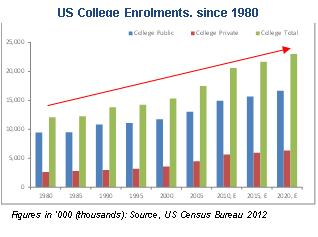
 

What is driving the trend?

As the American economy recovers from the recent 2008-2010 Global Economic Crisis, employment rates in the country are improving. There is a great need for skilled labour, particularly of engineering graduates across fields. According to US Bureau of Labor Statistics (BLS) projections, US companies alone created 178,000 engineering jobs between 2008 and 2010. In fact, Engineering (Biomedical Engineers, Software Engineers and Environmental Engineers) featured at the very top of BLS list of the “Fastest Growing Occupations.” This growth is being driven by the growth of technology giants such as Google, Apple, Oracle and a sharp rise in the number of ‘start-ups’ or new technology companies. The change in traditional businesses to automated, mechanized or digital formats is another reason driving a huge need for engineers in the US.

What makes it possible for the middle class?
The key factors that make an American education possible for all types and categories of students are the availability of:

  • a variety of easy funding and repayment options
  • focused examination preparation and coaching
  • professional counseling through each and every step of the admissions process has made this possible.

Find out more on how YOU can get an American degree at our FREE SEMINAR on “Higher Education in the US”

Time: 5.45 to 8 pm

Date: Sunday the 17th of February 2013

Venue: Ganesh Kala Krida Manch, Pune.

This seminar is open to all students, working professionals and parents.

No prior registration needed!

In case you have any questions, please contact the Dilip Oak’s Academy Office

By e-mail: support@dilipoakacademy.com, OR Call: +91-020-25656237, 25678066, 25654052