Indian Students Are Joining American Universities in Increasing Numbers

US UnivData released by the Student and Exchange Visitor Program (SEVP) of the US Immigration and Customs Enforcement indicates a recent surge in the number of Indian students seeking to study in American universities. According their report, there has been a “31.9% increase in the number of Indian students studying in American universities since 2014”. This bucks a trend that goes back almost a decade:  from 2008-09 to 2013-14, the number of Indian students studying at American Universities was a fairly flat 1,00,000 annually. In 2014-15, this figure jumped by around 32% to 1,32,888.

This increase is part of a rise in the number of international students studying in the US. In 2015, that number was up by about 9%. However, a staggering 76% of these were from Asia. So, the fresh influx of students seems to be a largely Asian phenomenon fuelled perhaps, by the robustness of the pan-Asian economic scene.

In this overall picture, students from India accounted for about 13.6% (or 1,32,888) of the 9,74,926 international students who enrolled for undergraduate (Bachelor’s), graduate (Master’s) & doctoral (Ph. D.) programs in the US in 2014-15. A full 31.2% or 3,04,040 of these students were Chinese. One possible reason for this is that very large numbers of Chinese students have started enrolling for the undergraduate courses where the intake is larger while, the majority of Indian students join graduate courses which tend to offer more funding but have a smaller intake.

Another noteworthy trend is that Indian (and more broadly, Asian) students show a heavy preference for courses in the STEM fields – science, technology, engineering, and mathematics – especially, computer science. Currently, there are 10,54,045 international students on F and M visas in the US. Of these, 4,05,314 students are studying courses in STEM fields and of these in turn, 80% of them are from Asia. As many as 81% of all Indian students are studying STEM fields – this is the highest percentage for any country; and California, Texas and New York have emerged as popular destinations for students studying courses in the STEM category.

If these trends are any indicator, we should see a few more Satya Nadella’s and Sunder Pichai’s emerging in the coming years; If you are an engineer, a student from the field of computer science or one from the STEM category more broadly, this could be your opportunity to make it big in the United States. Even Donald Trump has said that, should he become President, he is willing to welcome bright young minds from India because he knows they contribute to America’s economy – and if Trump says so, the doors must definitely be open!

OPT Period Extension and H1B Visa

Every year U.S. Citizenship and Immigration Services (USCIS) accepts H1B petitions starting from 1st April. As such, petitions for the fiscal year 2017 will be accepted from 1st April 2016. The current quota for H1B VISA is 65,000 under the general category and 20,000 under the advanced degree exemption – also known as the Masters quota. Thus, the total quota stands at 85,000. In the previous year, USCIS received a total of nearly 233,000 H1B petitions under both the categories put together from 1st April to 7th April and then they stopped accepting new applications. For the first time, USCIS received more than the limit of 20,000 H1B petitions under the Masters quota (the exact number of applications is not declared by USCIS). Computer generated random selection process (lottery) is conducted for Masters quota petitions which selects 20,000 applicants for the Master’s degree cap completion. The H1B petitions filed under Masters quota cap, but not selected in the first round of lottery are then added to the general quota of petitions. The lottery is then conducted for this pool to select 65,000 petitions towards the general quota cap completion. USCIS rejects and returns the remaining H1B petitions.

Advantages of OPT Extension:

Since H1B VISA petitions are accepted only once a year i.e. 1st April, if the petition is rejected, the applicant has to wait for a further period of one year, i.e., till next April to be able to apply again. In case, a student has an OPT period of only one year, his OPT period lapses before the next April. Hence, he doesn’t get a second chance to apply for H1B visa and has no option but to return to his home country. But students under STEM category will now get an OPT period of 36 Months (Regular 12 months + 24 months extension). In other words, such students will get two more chances for applying for H1B visa if their first petition is rejected. For example, if a student applies for H1B visa on 1st April 2016 but does not get selected in the lottery of 2016, he would still be able to apply for H1B visa again on 1st April 2017 and once again on 1st April 2018.

University Deadlines For Fall 2016

It is our continued endeavour to keep you updated with the university deadlines well before the application process. As per tradition we are publishing the university deadlines for fall 2016 semester. Please bear in mind that some universities may change deadlines on their websites without prior notice. The department deadlines may differ from the graduate school deadlines, hence you are advised to cross check not only the graduate school deadlines but also the department website of the university you are applying to.
Why is it impThe deadlines mentioned below are for the graduate school only.

Deadlines in November
University of South Carolina, Columbia – 30-Nov

Deadlines in December
Massachusetts Institute of Technology – 15-Dec
Tufts University – 15-Dec
University of Illinois, Urbana Champaign – 15-Dec
Yale University – 15-Dec
Harvard University – 14-Dec
Indiana University, Bloomington – 1-Dec
University of Miami, Coral Gables – 1-Dec
University of North Carolina, Chapel Hill – 1-Dec

Deadlines in January
Rensselaer Polytechnic Institute – 1-Jan
University of Maryland, Baltimore County – 1-Jan
Worcester Polytechnic Institute – 1-Jan
Washington State University, Pullman – 10-Jan
Florida Institute of Technology – 15-Jan
Northeastern University, Boston – 15-Jan
State University of New York, Buffalo – 15-Jan
Texas A & M University, Kingsville – 15-Jan
Texas Tech University – 15-Jan
University of Central Florida – 15-Jan
University of Michigan, Ann Arbor – 15-Jan
University of Southern California – 15-Jan
Vanderbilt University – 15-Jan
Duke University – 30-Jan
Illinois Institute of Technology, Chicago – 31-Jan
Indiana University Purdue University – 15-Jan with funding 1-Mar without funding
Deadlines in February
Case Western Reserve University – 1-Feb
Colorado School of Mines – 1-Feb
East Carolina University – 1-Feb
Kansas State University – 1-Feb
Pennsylvania State University, University Park – 1-Feb
University of Connecticut, Storrs – 1-Feb
University of Rhode Island, Kingston – 1-Feb
University of Tennessee, Knoxville – 1-Feb
University of Tulsa – 1-Feb
Colorado State University, Fort Collins – 15-Feb
Eastern Michigan University – 15-Feb
Florida International University – 15-Feb
Marquette University – 15-Feb
Polytechnic Institute of New York University, Brooklyn – 15-Feb
University of Illinois, Chicago – 15-Feb
University of Massachusetts, Dartmouth – 15-Feb
University of Oregon, Eugene – 15-Feb
University of South Florida, Tampa – 15-Feb

Deadlines in March
California State University, Chico – 1-Mar
California State University, Sacramento – 1-Mar
Illinois State University, Normal – 1-Mar
New Mexico State University, Las Cruces – 1-Mar
North Carolina State University – 1-Mar
Oklahoma State University, Still Water – 1-Mar
Temple University – 1-Mar
University of North Carolina, Charlotte – 1-Mar
University of Pittsburgh – 1-Mar
University of Toledo – 1-Mar
George Washington University – 15-Mar
South Dakota School of Mines & Tech – 15-Mar
University of Colorado, Denver – 15-Mar
University of Kentucky, Lexington – 15-Mar
University of North Texas, Denton – 15-Mar
University of Pennsylvania – 15-Mar
California State University, Northridge – 31-March Online, 30-April Document submission

Deadlines in April
California State University, Fresno – 1-Apr
Idaho State University – 1-Apr
Oregon State University, Corvallis – 1-Apr
San Jose State University – 1-Apr
Stevens Institute of Technology – 1-Apr
University of Arkansas, Fayetteville – 1-Apr
University of Arkansas, Little Rock – 1-Apr
University of Houston, University Park – 1-Apr
University of New Hampshire, Durham – 1-Apr
University of Texas, Arlington – 1-Apr
University of Texas, San Antonio – 1-Apr
Villanova University – 1-Apr
Virginia Polytechnic Institute & State University – 1-Apr
West Virginia University, Morgan Town – 1-Apr
Western Michigan University, Kalamazoo – 1-Apr
Wichita State University – 1-Apr
California State University, Los Angeles – 15-Apr
Lamar University – 15-Apr
Old Dominion University, Norfolk – 15-Apr
South Dakota State University, Brookings – 15-Apr
University of Georgia – 15-Apr
University of Iowa, Iowa City – 15-Apr
California State University, Long Beach – 1-April online, 15-April Document submission

Deadlines in May
City University of New York, City College – 1-May
Clarkson University – 1-May
Minnesota State University, Mankato – 1-May
Mississippi State University – 1-May
New Jersey Institute of Technology – 1-May
North Dakota State University, Fargo – 1-May
Northern Illinois University, Dekalb – 1-May
Oakland University, Rochester – 1-May
Southern Methodist University – 1-May
Tennessee Technological University – 1-May
University of Idaho, Moscow – 1-May
University of Louisville, Louisville – 1-May
University of Memphis – 1-May
University of Michigan, Dearborn – 1-May
University of Nevada, Las Vegas – 1-May
University of New Mexico, Albuquerque – 1-May
University of Texas, Dallas – 1-May
Wayne State University – 1-May
Western Illinois University – 1-May
California State University, Fullerton – 4-May
University of Louisiana, Lafayette – 15-May
University of North Carolina, Greensboro – 15-May
Wright State University, Dayton – 15-May

Deadlines in June
Louisiana Tech University, Ruston – 1-Jun
Monmouth University – 1-Jun
Southern Illinois University, Edwardsville – 1-Jun
University of Alabama, Huntsville – 1-Jun
University of Alaska, Fairbanks – 1-Jun
University of Detroit, Mercy – 1-Jun
University of Illinois, Springfield – 1-Jun
University of Wyoming, Laramie – 1-Jun
Drexel University – 13-Jun
Marist College, Poughkeepsie – 15-Jun
Missouri University of Science & Technology, Rolla – 15-Jun
University of South Alabama, Mobile – 15-Jun

Deadlines in July
Arkansas State University – 1-Jul
Florida State University – 1-Jul
New York Institute of Technology – 1-Jul
Santa Clara University – 12-Jul
Lehigh University – 15-Jul
University of Bridgeport, Bridgeport – 15-Jul

Deadlines in August
New Mexico Institute of Mining and Technology – 1-Aug
University of Houston, Clear Lake – 1-Aug

Rolling Deadlines
Fairleigh Dickinson University, Madison
Rochester Institute of Technology

Departmental Deadlines
Johns Hopkins University
Michigan State University, East Lansing
Michigan Technological University
Montana State University, Bozeman
Northwestern University, Evanston
Ohio State University, Columbus
Portland State University
Purdue University
Rutgers, The State University of New Jersey
San Diego State University
San Francisco State University
Southern Illinois University, Carbondale
Stanford University
State University of New York, Albany
State University of New York, Binghamton
State University of New York, Stony Brook
Syracuse University
Texas A & M University, College Station
Texas State University
University of Alabama, Birmingham
University of Alabama, Tuscaloosa
University of Arizona, Tucson
University of California, Berkeley
University of California, Davis
University of California, Irvine
University of California, Los Angeles
University of California, Riverside
University of California, San Diego
University of California, Santa Barbara
University of California, Santa Cruz
University of Chicago
University of Cincinnati
University of Colorado, Boulder
University of Hawaii, Manoa
University of Kansas, Lawrence
University of Maine, Orono
University of Maryland, College Park
University of Massachusetts, Amherst
University of Minnesota, Duluth
University of Minnesota, Twin Cities
University of Missouri, Columbia
University of Missouri, Kansas City
University of Nebraska, Lincoln
University of Nevada, Reno
University of North Dakota, Grand Forks
University of Oklahoma, Norman
University of Southern Mississippi
University of Texas, Austin
University of Texas, El Paso
University of Utah, Salt Lake City
University of Vermont, Burlington
University of Virginia, Charlottesville
University of Wisconsin, Madison

Application Timeline for Fall 2016 – Make Sure You Are on Track

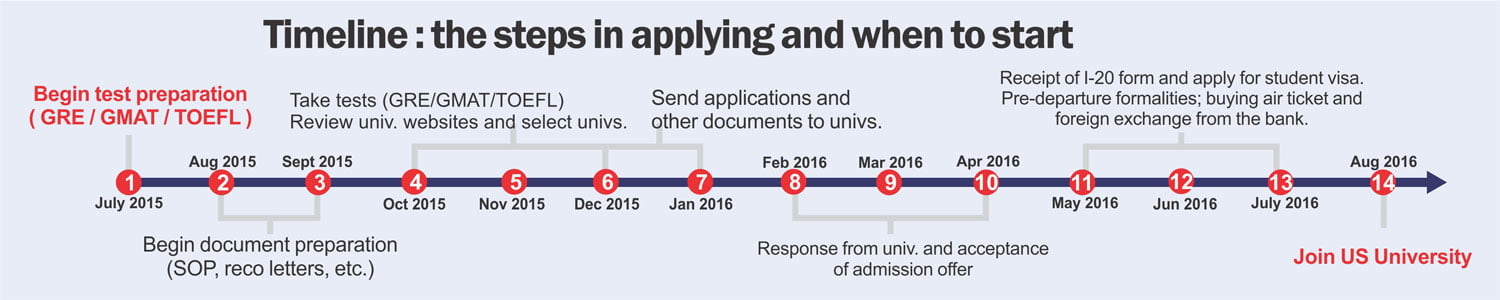
Timeline_blog

If you are applying for admission in fall 2016 the clock has begun to tick. So, don’t delay. Review this Application Timeline for Fall 2016 immediately and get to work.

June 2015

Review your goals for your MS in US and choose some specific areas in which you would like to specialize.

July 2015

  1. Begin preparation for the GRE/TOEFL tests
  2. Register for the GRE and TOEFL examinations – if you are targeting the top 10 or 15 universities, you should take these examinations preferably by September 2015. If you are targeting other universities, you may take these exams by 20 December 2015 so you can meet the deadlines of universities which are in December 2015.
  3. Register for the Subject GRE – important for doctoral programs in pure sciences and biological sciences in top schools.

Note: the exam is held once in a year in November, however, seats usually get filled up by August.

August-September 2015

Make a preliminary list of about 30 universities which meet your requirements considering:

  1. Location
  2. Costs of living and education
  3. Broad specializations you are interested in (for departments and specializations see the ‘university info‘ page on online.dilipoakacademy.com)
  4. Recommendations by seniors, your professors etc.
  5. Whether your academic profile fits the universities requirements.

For more details, see: Selecting a University for Your MS in the US. Also refer to our post on university information available on the social media

September 2015

  1. Arrange for 10-13 sets of transcripts in sealed covers from your college or university – some universities insist on university transcripts/university attested mark sheets
  2. Choose your recommenders (generally 3 recommendations are required, at least one of which should be from the educational institute last attended) and give them the necessary details – resume, copies of your mark sheets etc.
  3. Start working on your Statement of Purpose and resume

October 2015-January 2016

  1. Take the GRE and TOEFL exams latest by January 2016 (ideally 20 December 2015)
  2. Carry out a comprehensive review of the 30 universities considering:
    1. Your academic performance in bachelor’s degree
    2. GRE and TOEFL scores of students admitted in the past
    3. Any minimum cut-offs with respect to GRE and TOEFL scores
    4. Whether courses of your choice are offered in the Fall semester
    5. Cost of education
  3. Make your final shortlist of 8-10 universities.
  4. Complete your Statement of Purpose (SOP) and resume
  5. Request the ETS to forward your GRE and TOEFL scores to the universities you are applying to, specifying the correct codes for the universities/departments you are applying to.
    Note: some universities require certain documents to be sent to the department you are applying to.
  6. Complete online application process and send the required documents by courier

This completes the application process; however there are further steps to be taken:

  1. Track the status of your application on your status page of the university’s website. Though universities generally communicate decisions or requirements by either e-mail or post, it often happens that the only source of information is your status page.
  2. If there are any deficiencies in your applications (missing documents, non-receipt of GRE or TOEFL scores, recommendations etc.) immediately correct the deficiencies.
  3. When you receive an offer letter from the universities (or when your status page shows that you have been given admission) email your acceptance(This is very important especially when you are offered funding)
  4. When you have accepted the university’s offer of admission and the documentation formalities are complete, the university will send you the 1-20, an immigration document, which is essential for obtaining a visa.
  5. When you receive the I-20, check that it is correct in all respects:
    1. Your name and date of birth should be exactly as in your passport
    2. Your course and course duration should be correctly specified
    3. The financial sources indicated should exceed the costs etc.
  6. Prepare the visa documentation
  7. Study the visa application formalities specified on the websites of the applicable US Consulate and the VFS (Visa Facilitation Services)
  8. Apply for a visa interview date – you can apply for a visa interview 120 days before the joining date mentioned on your I-20.

For further details on the F-1 visa see our previous blog on the subject.

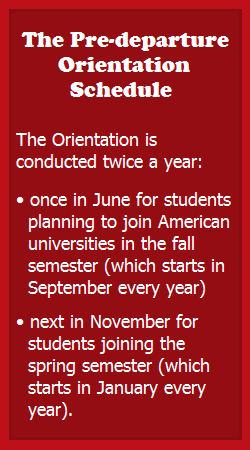
Note: Dilip Oak’s Academy organizes a ‘Pre-departure Orientation’ in June-end every year for students who have been admitted to the fall semester. In the Orientation, Mr. Dilip Oak covers matters such as:

  • the student (F1) visa
  • foreign exchange
  • airport formalities (port of entry/immigration procedures)
  • insurance
  • medical checkups & immunizations
  • initial formalities in the university
  • accommodation (on- & off – campus)
  • financial and other formalities for the first semester of studies

Keep a look out for our announcement of the Orientation. The announcement will appear on this blog sometime in June.

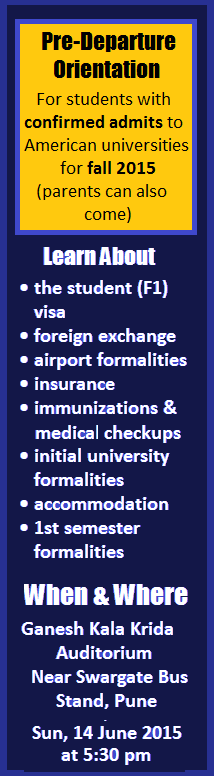
Fall 2015 Pre-departure Orientation

PreDep Orientation Fall 15 DarkMake Your Journey to Your American University Smooth and Hassle-Free

So, you cracked the GRE and TOEFL exams and secured your coveted admit. Perhaps you even cleared the dreaded visa interview. Congratulations! But are you really ready to go? Not quite. One thing remains to be done – you and your parents have to attend Dilip Oak’s Academy’s Pre-departure Orientation for Fall 2014. Here’s why.

What is the Pre-Departure Orientation (and What’s It For)?

If you are joining an American university in fall 2015 and want to make travelling there (and the process of settling in) an organized, tension-free process, then Dilip Oak’s Academy’s Pre-Departure Orientation is a must for you and your parents. There are several matters that you have to think through and preparations you and your parents have to make before you can begin your education in America. The orientation will explain them all. For example:

  • Accommodation – where are you going to stay when you land up in America? Is there someone who can help you get temporary accommodation until you find more permanent accommodation of your own? And what important points should you consider when looking for a good place to stay?
  • Insurance – should you take Indian or American medical and travel insurance policies? Which one is better and for what purpose?
  • Travel and Other Formalities – are you aware of the foreign exchange and airport formalities, the port of entry procedures? Did you know that you have to get a Social Security Number when you join your universities? Also, are medical check-ups or any immunizations required?
  • Documents – which ones must you carry with you? Which ones should you keep at home? And what’s the best place to keep your passport and traveler’s cheques?
  • Planning for Emergencies and Other Situation – suppose your baggage is lost or reaches you only after several days, how do you manage then? Or, if you got your luggage did you remember that you would need American coins to get a luggage trolley? And did you remember to arrange to be picked up”
  • Food, Groceries and Cooking – your mother is going to be worried about how you are going to survive when you get to America. So, should you take every single kitchen vessel that she gives you and, what about all the papad, pickle and masala she is planning to load you up with? Can you get it all there instead or, only some of it? What should you take with you then? And what about cooking lessons?

That’s just a sample of the things you have to think through but, by now you probably have got the picture.

So, in the Oak’s pre-departure orientation program, Mr. Oak will guide you through all the complexities of going to America, adapting to your new environment and settling in there. He will even cover such day-to-day matters as driving and commuting, seeing doctors and what medicines to take. He will even get into clothing and laundry. With his decades of experience in the field and as a public speaker, he will make it an extremely informative and interesting program which you and your parents must attend.

What are the Other Benefits of Attending?

1. Get a free book with all the information in it
At the orientation, you will be given ‘Get Set to Go’, a booklet written by Mr. Dilip Oak, which explains all these matters in detail – so, even after the orientation, you have a written guide to go back to any time you have a doubt.

  1. Meet other students going to your university
    At the end of the program we form groups of students joining the same university so that you can make joint travel plans and staying arrangements at the university.
  1. Get contact details of seniors at your university
    To get this information, when you come to get your pass, simply fill up a form with your contact details and we will email you the details around a week after the orientation. With this information in hand, you will be able to contact your seniors in advance and ask them for help to:
  • schedule airport pick-up
  • make temporary housing arrangements and
  • help you cope with the initial settling process

PreDep Orientation ScheduleWho can Attend?

This orientation is for students (and parents of students) who are joining American universities in the fall 2015 semester. Please note however: you will be able to attend only if you (or your child) has received confirmed admission to an American university for the fall 2015 semester. To get passes for the program therefore, show the I-20 form issued by your university (or your stamped F1 visa).

When and Where is the Orientation?

Date: Sunday, 14 June 2015
Time: 5:30 p.m.
Venue: Ganesh Kala Krida Auditorium, Near Swargate Bus Stand, Pune – 411051

Where Can I Get Passes?

You can contact our office for entry passes from 1st June.

PLEASE NOTE: SEATS ARE LIMITED
COLLECT YOUR ENTRY PASS FROM THE ACADEMY EARLY

University Deadlines For Spring 2016 Semester

Spring 2016 Deadlines

The month of June is now approaching which means the spring 2016 application process should now begin. As per our standard practice we are publishing university deadlines for spring 2016 semester.

Keep in mind some universities update deadlines on their websites at different times during the academic year.

The deadlines mentioned below are for the graduate school only. The department deadlines may differ from the graduate school deadlines and hence you should cross check with your respective department for confirmation.

NO.

NAME OF THE UNIVERSITY

DEADLINE

Deadlines in June
1 University of Maryland, Baltimore County 1-Jun
2 Texas Tech University 15-Jun
3 University of Tennessee, Knoxville 15-Jun
Deadlines in July
1 Florida Institute of Technology 1-Jul
2 University of Pittsburgh 1-Jul
3 Washington State University, Pullman 1-Jul
4 North Carolina State University 15-Jul
5 University of Illinois, Chicago 15-Jul
6 University of Rhode Island, Kingston 15-Jul
Deadlines in August
1 Kansas State University 1-Aug
2 North Dakota State University, Fargo 1-Aug
3 University of Michigan, Dearborn 1-Aug
4 Western Michigan University, Kalamazoo 1-Aug
5 Wichita State University 1-Aug
6 Rensselaer Polytechnic Institute 15-Aug
7 South Dakota School of Mines & Tech 15-Aug
8 South Dakota State University, Brookings 15-Aug
9 University of Kentucky, Lexington 15-Aug
10 San Francisco State University 31-Aug
Deadlines in September
1 East Carolina University 1-Sept
2 Florida International University 1-Sept
3 George Washington University 1-Sept
4 Illinois Institute of Technology, Chicago 1-Sept
5 Indiana University, Bloomington 1-Sept
6 Lamar University 1-Sept
7 Mississippi State University 1-Sept
8 Oakland University, Rochester 1-Sept
9 University of Alaska, Fairbanks 1-Sept
10 University of Nebraska, Lincoln 1-Sept
11 University of Oklahoma, Norman 1-Sept
12 University of South Carolina, Columbia 1-Sept
13 University of Texas, Dallas 1-Sept
14 University of Texas, San Antonio 1-Sept
15 Virginia Polytechnic Institute & State University 1-Sept
16 California State University, Chico 15-Sept
17 Northeastern University, Boston 15-Sept
18 Texas A & M University, Kingsville 15-Sept
19 Tufts University 15-Sept
20 University of North Carolina, Greensboro 15-Sept
21 University of North Texas, Denton 15-Sept
22 California State University, Fresno 30-Sept
23 California State University, Northridge 30-Sept
Deadlines in October
1 California State University, Long Beach 1-Oct
2 California State University, Sacramento 1-Oct
3 Case Western Reserve University 1-Oct
4 Eastern Michigan University 1-Oct
5 Illinois State University, Normal 1-Oct
6 Indiana University Purdue University 1-Oct
7 Minnesota State University, Mankato 1-Oct
8 Northern Illinois University, Dekalb 1-Oct
9 Oklahoma State University, Still Water 1-Oct
10 Old Dominion University, Norfolk 1-Oct
11 Oregon State University, Corvallis 1-Oct
12 Pennsylvania State University, University Park 1-Oct
13 Southern Illinois University, Edwardsville 1-Oct
14 State University of New York, Stony Brook 1-Oct
15 Stevens Institute of Technology 1-Oct
16 Tennessee Technological University 1-Oct
17 University of Arkansas, Little Rock 1-Oct
18 University of Colorado, Denver 1-Oct
19 University of Detroit, Mercy 1-Oct
20 University of Houston, University Park 1-Oct
21 University of Idaho, Moscow 1-Oct
22 University of Iowa, Iowa City 1-Oct
23 University of Louisiana, Lafayette 1-Oct
24 University of Massachusetts, Amherst 1-Oct
25 University of Nevada, Las Vegas 1-Oct
26 University of New Mexico, Albuquerque 1-Oct
27 University of North Carolina, Charlotte 1-Oct
28 University of Texas, Arlington 1-Oct
29 University of Virginia, Charlottesville 1-Oct
30 West Virginia University, Morgan Town 1-Oct
31 Worcester Polytechnic Institute 1-Oct
32 California State University, Los Angeles 15-Oct
33 Duke University 15-Oct
34 Marquette University 15-Oct
35 Texas State University 15-Oct
36 University of Georgia 15-Oct
37 University of South Florida, Tampa 15-Oct
38 Villanova University 15-Oct
39 California State University, Fullerton 17-Oct
Deadlines in November
1 Florida State University 1-Nov
2 Idaho State University 1-Nov
3 Monmouth University 1-Nov
4 University of Louisville, Louisville 1-Nov
5 University of Miami, Coral Gables 1-Nov
6 University of Utah, Salt Lake City 1-Nov
7 University of Wyoming, Laramie 1-Nov
8 Vanderbilt University 1-Nov
9 Arkansas State University 14-Nov
10 City University of New York, City College 15-Nov
11 Missouri University of Science & Technology, Rolla 15-Nov
12 Montana State University, Bozeman 15-Nov
13 New Jersey Institute of Technology 15-Nov
14 University of Massachusetts, Dartmouth 15-Nov
15 Marist College, Poughkeepsie 30-Nov
16 Southern Methodist University 30-Nov
Deadlines in December
1 Lehigh University 1-Dec
2 Louisiana Tech University, Ruston 1-Dec
3 New York Institute of Technology 1-Dec
4 Polytechnic Institute of New York University, Brooklyn 1-Dec
5 University of Alabama, Birmingham 1-Dec
6 University of Alabama, Tuscaloosa 1-Dec
7 University of Houston, Clear Lake 1-Dec
8 University of South Alabama, Mobile 1-Dec
9 University of Southern California 1-Dec
Deadlines in January
1 Louisiana State University, Baton Rogue 1-Jan
2 Wayne State University 1-Jan
3 New Mexico Institute of Mining and Technology 2-Jan
4 Santa Clara University 10-Jan
5 New Mexico State University, Las Cruces 27-Jan
Deadlines in February
1 University of Maryland, College Park 7-Feb
Rolling Deadlines
1 Wright State University, Dayton Rolling
2 University of Toledo Rolling

Under rolling deadlines there is no fixed application deadline declared by the university. Applications are accepted anytime till the seats for that particular semester are full.

You may also refer to our ‘University Info’ features which provides centralized information about the top 220 universities in America, including the university rank.

We wish you all the best!

GRE Score Reports: Things You Should Know

Score Card

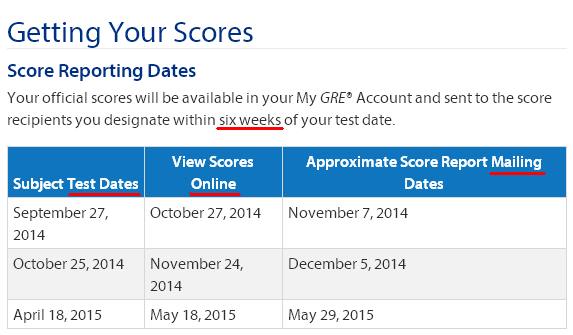
The first thing you should know: take your GRE about 1 ½ to 2 months before your earliest important deadline. It is going to take approximately that much time for your score reports to reach the universities you have chosen as score recipients (i.e. the universities you chose to send your score reports to). Here’s what the ETS says:

Getting Your GRE ScoresAbout 15 days to a month after your test, you will be able to view online and print out, for your own records, your score report in the PDF format shown below:

Examinee GRE Score Report Image

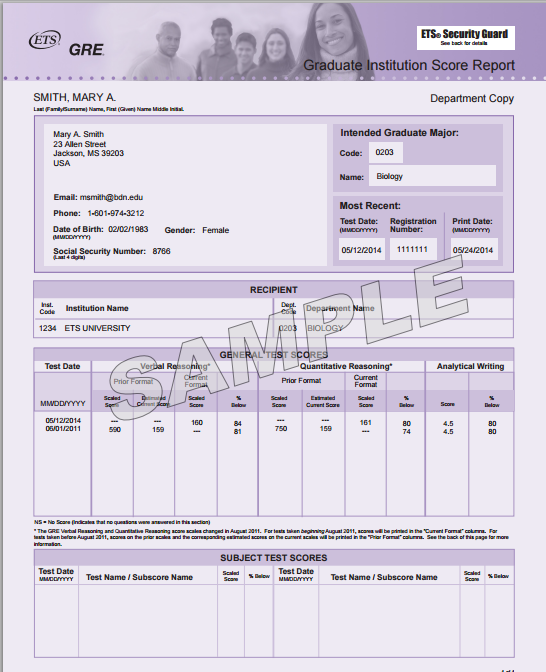
Having seen the format, you probably have some questions: for example, why are the scores for the Verbal and Sections given under two different headings: prior format and current format? And what is the estimated current score under prior format for?

Well, before August 2011, the GRE used to score the Verbal and Quantitative sections on a scale of 200-800 instead of between 130-170 as they now do. According to the ETS, GRE scores are valid for 5 years. This means that GRE scores taken in September 2011 will continue to be valid according to the ETS till September 2016. Until then the ETS has to provide a way of comparing the old and new scores. They do this by providing:

  • an old score equivalent for tests taken under the Revised General GRE format (taken on or after 01 August 2011)
  • a new score equivalent for tests taken under the earlier GRE format (i.e. before 01 August 2011)

This is why the scores for the Verbal and Quantitative sections in the PDF shown above are given in two columns: ‘Prior Format’ and ‘Current Format’. This allows universities to easily compare the scores of students who have taken the older versions of test and those who have taken the newer one without too much difficulty. The ‘Estimated Current Score’ column (under ‘prior format’) was specially meant for candidates who had taken the old format of the test and for whom American universities needed an estimated equivalent score in the new format.

Somewhat pointlessly, the ‘estimated current score’ is also given for students who have taken the new version of the test (the Revised General GRE as it is called) – this is pointless since they already have an actual score in the new column. But we guess, since the ETS had the columns, they had to fill them up! Perhaps, reports after August 2016 will be simpler. Practically, however, this comparative data will not make much of a difference to you since most universities do not accept GRE scores that are older than 3 years. So, American universities probably stopped accepting September 2011 reports in September 2014.

Here are some other important links to check out:

Can I ask the ETS to show universities only the scores I want them to see?

Free GRE score reports

Ordering additional GRE score reports

And just in case, you are interested here’s the PDF format the score report that the universities you are applying will see if you have asked the ETS to send them a score:

Graduate Institution GRE Score Report Image

Have you Met our Roommate Finder!

Living in a foreign country can be both exhilarating and daunting. So can finding the ‘perfect’ roommate.

Anyone who plans to do an ‘MS in US’ has to stay away from family and venture out on their own; and most of you will have come a ton across of horror stories about staying with complete strangers. Differences over how to arrange the apartment, food preferences, keeping different hours or even a sharing a bathroom can turn your dream of studying in America pretty sour! What may not have been significant when you lived with your family may become huge issues when you start sharing living space with others. So, maybe this will sound like advice for someone who is looking for a life partner rather than just a room partner but remember you are going to be sharing cooking, washing up and even laundry duties with that person (or those people). You are going to have to make arrangements to pay the rent and other bills and to share the keys – if that’s not like being married then what is? So, you have to make up your mind about what you are looking for in someone you are probably going to see, be with and work with almost every single day of your stay in the United States.

Do you simply need someone to help pay the bills or are you looking for someone you could be comfortable just being with as well? Would you like to work together with your roommates on cooking and washing and laundry or would you prefer that everyone made their own independent arrangements. Are you the social, friendly, partying type who would like to invite friends over for get-togethers on weekends? Or are you more of a reclusive loner who would prefer others to respect his or her privacy? And so, for example, would you like your roommates to welcome social ‘invasions’ or strongly resist them.

Even if you are the more gregarious type, remember that your new-found roommates may not automatically become your new best friends; people come with their own social circles ‘pre-loaded’. So, if you expect to immediately integrate into the social life of your roomies, you may end up feeling shut out for a while. Conversely some lifelong friendships begin when people started sharing a room, and you too might discover that meeting your roommate was one of the best things that ever happened to you.

On another note, you also need to find good accommodation. You are going to a foreign land, but you can still use your common sense to sniff out and avoid bad options. Here’s a simple pointer: if something seems too good to be true it usually is. Be especially careful if:

  • An ad quotes rates that seem too low for the area and the standard shown in the photos.
  • The landlord tries to get you to pay before you have seen anything (they may sometimes claim that they can’t show you the place but you have to pay if you want to seal the deal – in such cases, just say, “No thanks!”).

But as they say, joys are doubled and sorrows halved when you share them with friends – or roommates! A fresh, completely free and, very importantly, safe way of finding a room or roommate is Dilip Oak Academy’s Roommate Finder. This feature will help you find other students who are already in your desired US University or who are headed there.

Here’s how it works: if you are a signed up member of Dilip Oak’s Academy Online, all it requires is that you update your application status. Once you’ve done that, the names of other students going to the same university as you are will automatically be updated on your Roommate Finder page. Then, just hit the contact button.

If you’re not a member then, joining up is free and easy – it just takes a minute or two – and then you will be able to find roommates.

Remember, Dilip Oaks Academy Online is free to join! So, tell all your friends who are applying for an ‘MS in US’ to join and update their admission updates. The more people join, the more everybody benefits! But, even now there are enough folks like you signed up with us to make this feature a big help to you!

Centre Shock: The Unexpected Challenges Your GRE Test Center May Throw at You!

Hi folks! Today’s post is a write up by Shraddha Barawkar, an engineering student (see brief bio below) about her GRE test experiences at the Prometric Center at Goregaon. We thought it might be interesting for all you GRE candidates out there to hear about how things worked out for her.


  • Name: Shraddha Barawkar
  • Branch: Mechanical Engineering
  • College: Pune Vidhyarthi Griha’s College of Engineering and Technology
  • GRE Date: 5 December 2014
  • GRE Center: Prometric Testing Pvt Ltd
  • Center Location: Techniplex I, Goregaon (West), Mumbai


Ideally, you should enter your GRE test center full of pep and leave it with a smile! But if you don’t prepare for conditions at the test center or think about travelling there, you may be in for an energy drain that can wipe the smile right off your face. And that can throw off your performance in the GRE!

One of the first things I realized is that it would have been better to be at the test location the day before. I live in Pune and my GRE test center in Goregaon West, Mumbai, was about 120 kms. away – that’s for non-Maharashtrian readers! (Google map and more details here) So, I had to wake up at 4 a.m. and eventually left my house at 6.30 for Mumbai. Not a good idea on the day of the exam!

However, it was early morning, there was only light traffic and so we reached the outskirts of Mumbai at 10 a.m. I heaved a sigh of relief: I had a 12.30 p.m. slot, there were still 2-½ hours for my test and we thought it would take only half an hour to cover the approximately 25 kms to the test center. But by then, the traffic had started up and so, it took us 1-½ hours. As a result, I didn’t even get to have breakfast in peace. Luckily though, my father was able to grab a couple of wadas for me from the vendors outside the center. Finally, at 12.25 p.m., I walked into the center.

My test room was on the 8th floor. As I entered the room, I saw 50 expressionless faces looking blankly at me: those of my fellow test-takers. Simultaneously, I was hit by a sharp temperature drop, from 300C outside, to around 180 inside. I felt as if I had entered a graveyard, and my hands started shivering. Nevertheless, I put a smile on my face and tried to converse with some of the folks there, but they were very reticent, adding to the nervousness I felt because of chill in the room. I could feel myself losing focus and giving in to the desire to just to get the exam over as soon as possible! The atmosphere at the test center, I realized, doesn’t help you to settle into the right frame of mind to take the test.

Shraddha's Overall Evaluation of the Test Center

Somehow, eventually, the formalities got over (passport, ID checking etc.) and, a painful half an hour later, we were asked to put our bags and accessories in the lockers. Then, one by one, we were sent to the main exam room. I relaxed a bit at that point, since I thought that the formalities were finally over. But I was wrong! Inside there was yet another room where I was asked to remove my blazer, unchain my back pockets, raise the collar of my formal shirt and unfold the lower portion of my jeans. This was all done by male authorities, which as a woman, I found quite embarrassing. Finally, I was sent to the test room.
During the exam itself, I encountered two important problems: firstly, typing with nearly numb fingers was a tough job in the analytical writing section. Secondly, during the 10 minute-break halfway through the test, I thought going to the waiting room would be a simple matter. But again I had to complete formalities involving signatures and time entry in order to check out. After the break the whole process of apparel checking was repeated which, took another 3-4 minutes. I was not aware that I had to include time for these things in the break as well and it was only by luck that I had come back early from my break. These circumstances made the GRE a tougher nut to crack!

You might wonder, why I am telling about you my frustrating experiences. It’s because I don’t want you to get demoralized by these things; I want you to be prepared for the worst. The first challenge lies in overcoming the unfavorable conditions at the test center. Only then can you attain the calm state of mind that you need to solve tricky GRE questions!

In conclusion, here’s my advice: if your test center is not located in your home town, you should be at the test location a day before. Find out about nearby places to eat and travel routes and times. Take into consideration traffic conditions too, and try to reach an hour early! You should also eat properly before the test and wear warm clothes. Sometimes the washrooms are far from the test rooms. So, be prepared for a long trek there and, if you are at the Goregaon center, all the formalities of signing in and signing out too!

Hope this helps folks.

This is Shraddha wishing you all the best to give your best!

ETS ScoreSelect for the GRE: a Boon …More or Less!

For students who have given the GRE more than once, the worry has always been that the universities will see their low scores along with their high ones. To deal with this problem the ETS launched the ScoreSelectTM feature some years ago. ScoreSelect allows you to decide which GRE scores will go to universities and colleges which means that you can omit poor scores from your graduate school applications. If you are retaking the GRE therefore, or have GRE scores that you are not keen to show the universities, it seems that ScoreSelect will allow you to breathe a little more easily. But you should be aware that this apparent boon does have its limitations.

Firstly, you won’t be able to mix and match your best maths and verbal performances from separate tests to create a super report. ScoreSelect only allows you to send score reports as a whole. Secondly, if you want the full flexibility that ScoreSelect offers then, it comes at a price.

As the ETS explains, after test day, you can send Additional Score Reports and select the ScoreSelect.

  • Most Recent option — using which, you can send your GRE scores from your most recent test
  • All option — using which, you can send your GRE scores from all tests in the last 5 years.
  • Any option — using which, you can send your GRE scores from one OR many tests in the last 5 years.

As you can see, it is the third option that gives you full scope to exclude the ‘bad’ scores you don’t want the universities to get. But, at this point, i.e. after test day, you will have to shell out $27/- per report. On test day, on the other hand, when you can choose 4 universities to send your score report to AT NO ADDITIONAL COST, this magical option is not available. All you have is the ScoreSelect Most Recent and All options. In short, if you want to get the full benefit of the ETS’s ScoreSelect option, you will have to pay for it at the rate of $27 per score report. As someone once said, there’s no such thing as a free lunch!

The third problem is that universities are all aware that you may be making use of this facility – and so, some may ask you to send score reports of all the GRE tests you have taken in the last 5 years anyway! If that’s the case with a university that you have selected, then you are stuck, and ScoreSelect is not going to help you.

So, the option exists. But it’s expensive, and it may not always be possible to use it. But, if the university you are applying to is willing to let you show them just the best side of yourself then, if you need it ScoreSelect is always there. Proceed thoughtfully!

How to Save 180 Dollars When You Take the GRE and TOEFL

Score Reporting: GRE and TOEFL

Unexpected Ways to Save Money on Test Fees

Most of you know that preparing for the GRE test involves things like hours of practice and learning lots of words and formulae by heart. For the TOEFL, as you are aware, you have to brush up on your grammar. But you most probably never thought that preparing for these tests would involve thinking through which universities or colleges you would like to apply to. But it does, and here’s why: saving the 180 dollars is as simple as selecting the names of 4 universities from a drop-down list as part of the free score reporting option. Here’s how it works.

Understanding Free Score Reporting

At the end of the GRE test, the ETS allows you to choose 4 universities to which they will send your GRE test score to WITHOUT ANY ADDITIONAL CHARGE. This is the ‘free score reporting’ feature, so called since the payment for reporting the score to those four institutes is included in the GRE registration fee. The TOEFL has a similar feature. The difference here is that the selection of the university or college you would like to send your free scores to needs to be done BEFORE the exam – any time after you have booked the TOEFL exam date up to 24 hours before your TOEFL test date.

Common Misconceptions and Mistakes

Most students don’t make use of these useful money saving features since they generally don’t decide which universities they want to apply to before their GRE or TOEFL exams. The reasoning is that the choice of university depends on the GRE test score hence, university selection can be done only after the test. So, students normally request what the ETS calls Additional Score Reports (ASRs) only after they have selected universities to apply to (according to their GRE score). At that point they end up paying a fee of 27 dollars for each additional GRE ASR they request and 19 per TOEFL report. But, if you have already made use of the free score reporting feature, you make a saving of $27 + $19 = $46/- per university and $184 for all 4 universities!

Researching and Selecting Universities

But how do you select which universities you want to apply to before you have even got your GRE score? Well, you should have some idea of what universities you want to apply to beforehand – after all, on the basis of your GRE test scores you will only be making a selection of 4 for ‘free score reporting’ from that list; and though you may not have your GRE test scores in hand before the actual test, your mock tests will give you some idea of what scores you can expect. To make that list, talk to your college seniors or get on to some well-researched discussion forums. This is something that you have to do in any case. You can also have a look at our Admission Counseling Services.

Keeping Extra Cash in Your Pocket

If, on this basis, you can make you make up your mind about what universities you would like to apply to before the GRE and TOEFL exams, you’ll be able to keep that $184 /- in your pocket! That works out to over 11,000 rupees, and you could buy a pretty decent smartphone with that amount or… plan a trip to Goa!

As India’s leading Study Abroad Consultant, Dilip Oak’s Academy offers a comprehensive suite of admission counseling services that can guide you through the entire process from Shortlisting Universities to Visa Counseling. With our expertise, we have successfully sent 32,000 students to various prestigious American universities like MIT, Stanford, Cornell, and Carnegie Mellon. We also offer classroom and online coaching for GRE, TOEFL, and IELTS, as well as GRE Self Prep. To explore our services, book a free consultation or call us at 91-20-67444222.

Vocabulary Vitamins for the GRE Available Here!

Here’s our challenge for you: a cursory glance at this blog (and even this introduction!) will radically improve your vocabulary. Read it and see if it doesn’t! If you find the words challenging, take a look at the explanations below the article below. They are all from the high-frequency GRE list.

Any journey gives you a chance to take an exciting break from the soporific routine of everyday life. In fact, travelling to places and cultures very different from your own can be a visionary experience. In some cases the sights and sounds of an exotic locale can seem surreal. But going solo takes travel to a different level altogether.

It is true that solo travel can have its disadvantages. Most of us would be wary of going solo because of the difficulties we might face: communication problems, cultural misunderstandings and loneliness among them. On the other hand, people who have never traveled on their own before often describe their first solo trip as a liberating experience. Traveling alone gives you the chance to fully indulge your own curiosity and predilections without being hampered by a companion’s prejudices, tastes, or preferences. You can do exactly what you want to do – all the time. Always wanted to try surfing? Sign up for a class and go for it! There’ll be no one sitting on the beach bored and impatient while you’re out on the waves having a great time. If you are connoisseur of food, a vacation alone will give you opportunities to experiment to your heart’s content with the local cuisine. And there are attractions that will augment the pleasure of the experience. A frenzied shopping spree at the local markets, especially for a solo woman traveler, can be an exhilarating experience.

Further, a little preparation and common sense can spare you the difficulties of solo travel. A detailed itinerary, a meticulous study of maps and other local information is the ticket to a smooth vacation. Also, as unfamiliar sights and sensations inundate you, you must take care not to be gullible or overconfident. Without a companion to watch your back, you are potentially vulnerable to antisocial people and hazardous situations. However, a solo traveler can also blend in more easily than a group; and not drawing too much attention is a good way to stay safe. And there may be compensations: solo travelers who clearly need assistance often have the good fortune to experience the benevolence and magnanimity of the locals. So, traveling solo need not necessarily is more dangerous than going to the movies or having dinner by yourself in your own city.

And, there is a final reward for the adventurous of soul: if you are willing to put away your fear of the unknown, you will discover the paradox at the heart of solo travel: traveling alone far from your roots and all you have known, you will discover not merely new places, you will discover yourself!

vocabulary vitamins

OK, for those who had a little difficulty with the blog or just want a sharper understanding of the vocabulary, here are the 23 high-frequency GRE words that this blog covered along with their meanings, and illustrative sentences. Find the ones you had trouble with and read them through.

Cursory (adjective): done or made quickly: “Even the most cursory look at the organization’s records shows problems.”

Radical (adjective): favoring extreme changes in existing views, habits, conditions, or institutions: “The new president has made some radical changes to the company.”

Benevolence (noun): an act of kindness, disposition to do good: “People either think their benevolence benefits them materially, or gain satisfaction from altruism.”

Visionary (adjective): relating to a vision (that is, a hallucinatory dreamlike experience); marvelous and unreal: “His visionary paintings seem to come from another world.” (Noun) having or showing clear ideas about what should happen or be done in the future, [She is considered a visionary leader amongst her peers]

Prejudice (noun): a bias or assumption; a poorly founded belief: “Many people have the prejudice that only native speakers can teach a language well.” “At first I doubted that he could really be an expert programmer because he didn’t have a degree, but I abandoned that prejudice as soon as I saw how brilliant his coding was.”

Surreal (adjective): seemingly unreal; giving the impression of being unreal; very strange: “I just had a rather surreal conversation with a man who came up to me on the street and told me that aliens from another planet were about to invade the earth.”

Indulge (verb): to give free rein to something; to allow something to follow its own inclination: “I didn’t really want to listen to him talk about his problems, but I indulged him because he was obviously so lonely.” “When someone insults you, you should not indulge your impulse to insult him in return: just walk away.”

Predilection (noun): a preference or tendency: “She has a predilection for chocolate soy milk.” “My dog has an embarrassing predilection to steal people’s floaters and chew them to pieces.”

Soporific (adjective): causing sleep; boring: Only an enormous cup of coffee can keep me awake during one of his soporific lectures.”

Wary (adjective): cautious (of something): “I’m wary of getting into a conversation with her, because once she starts talking she doesn’t stop for hours.”

Augment (verb): to increase something by adding something to it: “You need to augment your CV a bit. Are there any projects or work experience you may have left out?” “We can augment the effect of this drug by adding another.”

Inundate (verb): to flood; to overwhelm; to come at in great quantity; to flood with something: “I assure you that once you complete your M Tech at our college, companies will inundate you with job offers.”

Gullible (adjective): too ready to accept what one is told; too easily persuaded: “Shortly after getting off the plane at Mumbai, a gullible tourist paid a street vendor five thousand rupees for two samosas.”

Itinerary (noun): the plan of a journey: “Why is the bus stopping here? I didn’t think this town was on the itinerary.” “Once I actually start driving I tend to forget about the itinerary and just follow my heart.”

Meticulous (adjective): very careful and thorough; giving attention to details; reflecting or characterized by such carefulness: “He is an extremely meticulous programmer: his code is always perfect the first time.”

Vulnerable (adjective): in danger of being injured or attacked: “Homeless women are far more vulnerable than homeless men.” “The country was vulnerable to attack from the east because all its forces had been moved to meet the attack on its western border.”

Hazardous (adjective): dangerous; perilous: “He has been convicted twice for hazardous driving.” “This housing society was built on ground contaminated with hazardous chemicals.”

Magnanimity (noun): bigheartedness; greatness of heart; selfless generosity: “It requires great magnanimity to truly forgive someone who has badly injured you.” “He was known for the magnanimity he showed to his friends, whom he never hesitated to help with money or other assistance whenever they needed it.”

Connoisseur (noun): someone who has gained a profound knowledge of some thing or activity by frequently exposing himself to it over a long period of time: “He became a connoisseur of Japanese films by watching thousands of them over the years.” “I consider myself something of a connoisseur of idlis, having eaten tens of thousands of them over the years.”

Cuisine (noun): a type of cooking, usually defined by its national origin (Chinese cuisine; Continental cuisine; Mexican cuisine): “I don’t like Italian films much, but I love Italian cuisine.”

Frenzied (adjective, past participle of the verb to frenzy): characterized by extreme excitement, agitation, and distress: “When the dogcatcher caught the dog in his net, the animal at first made frenzied attempts to struggle free, then became still as if he realized that there was no point.”

Exhilarating (adjective, past participle of the verb to exhilarate): thrilling; causing a feeling of extreme happiness and excitement: “Climbing to the summit of a mountain is an exhilarating experience.”

Paradox (noun): an apparently self-contradictory or impossible thing, situation, or statement: “The most intelligent men are often the least effective leaders: history shows us this paradox again and again.”