California State University Conducts Interactive Session for Students at Oak’s Academy

A four-member team representing four campuses of California State University visited Dilip Oak’s Academy, at Bhandarkar Road, on Tuesday, 11th April 2017. The visiting delegation comprised:

Dr. Ray Wallace
Executive Director (International Programs and Senior International Officer)
California State University, East Bay

Dr. Paul Hofmann
Associate VP (International Programs and Global Engagement)
California State University, Sacramento

Dr. Jennifer Helzer
Director – International Education
California State University, Stanislaus

Dr. Seema Sehrawat
Associate Professor and International Officer
California State University, Chico

The university officials addressed the students on a variety of topics that were important and relevant to the latter. They also took their questions and generally dwelt on the challenges they were likely to face as graduate students in the US. They spoke with students on resource management, coping with academic pressures, on-campus employment opportunities, and safety-related issues. 
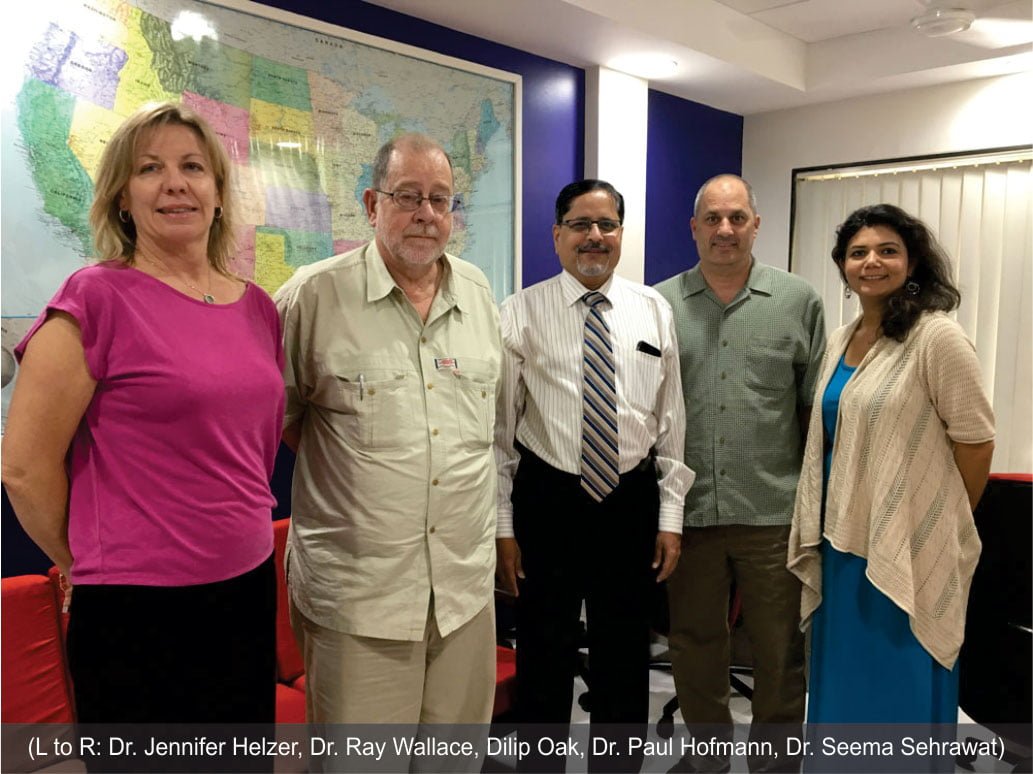
CSU-Visit-Oaks-AcademyDr. Ray Wallace dwelt on three topics: employment opportunities in the US after MS, the dynamic of the H1B immigration regulations, and what he called the “Trump effect.”

Dr. Wallace expressed the view that employment opportunities in the US after MS, particularly in the IT sector were “spectacular”.  He revealed that companies were hiring university graduates “aggressively” and that job opportunities in the US at present were “strong”. Dr. Wallace predicted that economic growth during the next couple of years “will stay positive”.

Dwelling on the dynamic of the H1B immigration regulations, Dr. Wallace was of the opinion that the Trump Administration did not have problems with overseas students coming to US universities, and added that it had issues with contracting and consulting companies like Wipro, Tata Consultancy Services, etc., which he pointed out had historically netted a large percentage of H1B visas from the quota allocated to Indians.

Seeking to allay the fears of students in general, Dr. Wallace assured them that change comes slowly with regard to regulations in the US and that change will be positive for university graduates. These changes will only present university graduates with more job opportunities, higher salaries, and less resistance in the immigration context.

Referring to what he called the “Trump effect”, Dr. Wallace shrugged off rhetoric of the US President during his election campaign and stated that he was a different man when he interacted with IT majors in the US. Dr. Wallace quipped, “Trump doesn’t speak like that to Bill Gates or people from other major IT companies like Apple,” and added that as a businessman himself, Trump understood and seemed to be sympathetic to the pleas of heads of IT companies for flexibility in immigration-related regulations as they needed to hire people from abroad. Therefore, Dr. Wallace said that change will only be positive for higher education, especially for students with master’s and PhD degrees in the STEM category.

Dr. Paul Hoffman pointed out that there was a wide range of on-campus jobs up for grabs for graduate students who chose to take up a job during their second or third semester. These included academic and non-academic job opportunities, he added. Dr. Hoffman said taking up an academic job on campus could lead to internship opportunities which receive academic credit for off-campus work experience.

On graduation, Dr. Hoffman revealed, one could transition to a period of practical training for 12 months. He stressed that STEM-major students could avail of an additional 24 months of off-campus employment, which would mean 36 months of practical exposure and experience for them. Dr. Hoffman stressed that students could thus make the most of the inherent privileges that would accrue to them by virtue of their H1B visas. He also disclosed that, often, such students are sponsored by their companies for an H1B visa, later, which allows them to continue working in the USA after this initial three-year period.

Dr. Seema Sehrawat spoke on the American education system. She pointed out that in the US students got a lot of practical knowledge. She said whenever she spoke with students of Computer Science, Computer Engineering, Electrical Engineering, and even MBA, all of them talked about how they greatly valued the practical basis of the education system in the US. Dr. Sehrawat did sound a note of caution on how this could pose a challenge initially to Indian students who are more accustomed to theory-oriented studies in India.

She pointed out that American professors were generally very dedicated and always there for their students. Referring to the current political climate, Dr. Sehrawat advised students not to go by heresay or exaggerated media reportage. She urged them to focus on their future and think of what the American system had to offer to them. Speaking of California, she emphasised that California was “quite safe” and added that it was a “melting pot” that welcomed diversity.
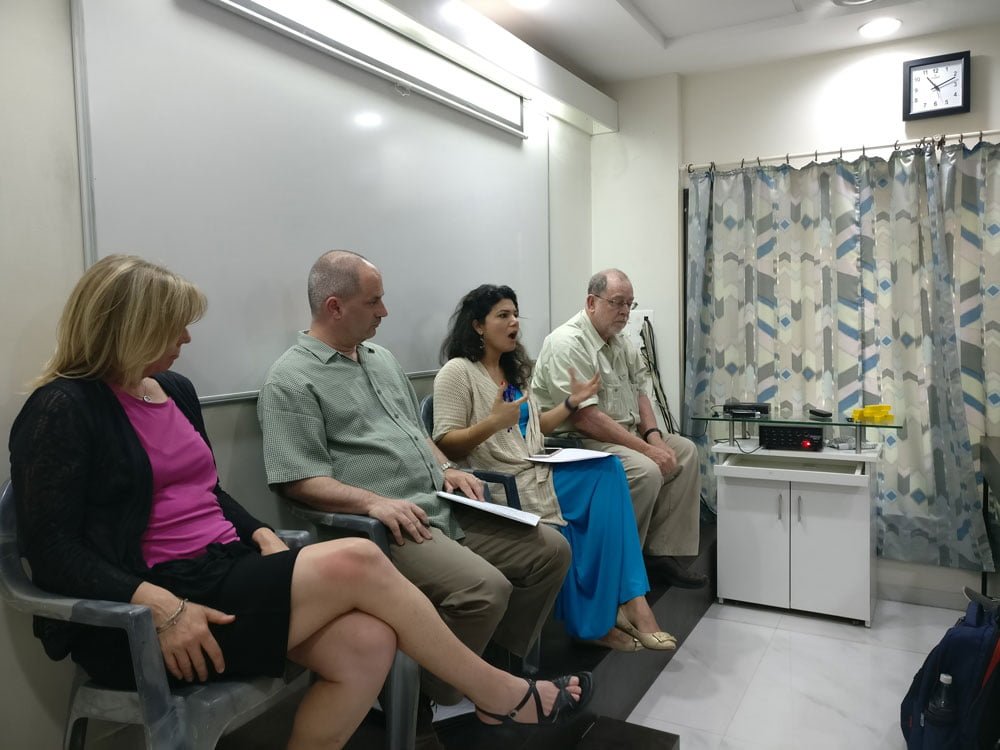
Addressing-StudentsAgainst the backdrop of attacks on Indians in the US, the experts pointed out that Indians staying in the US should be well aware of their surroundings and make the correct decision regarding matters such as whether or not stay out late at night. Untoward incidents occur usually late at night after partying. Therefore, it is advisable not to put oneself in such vulnerable positions.

University campuses and its surroundings, they stressed, are safe and every campus has a highly organised and professional police department. Every university is particular about student safety and makes it its top priority, they pointed out. The American people, they specially emphasized, are very supportive of cultural diversity. Sensational media reports usually refer to stray incidents in some trouble spots of the US such as the “Midwest” and some of the southern parts of the country.

Stressing security and safety, Dr. Sehrawat, speaking from her personal experience as an expatriate Indian, opined that American people in general were kind hearted and welcoming, and that one could easily make friends with them.

The visiting delegation of California State University officials spent a couple of hours interacting with students at Dilip Oak’s Academy. They gave students their calling cards and encouraged them to meet them when they joined their colleges.
American Dream – Bringing it to Reality (Part III)

An overwhelming majority of Indian students who travel to the US for higher education belong to the Science, Technology, Engineering & Mathematics (STEM) category. For the annual H1B quota of 20,000 visas reserved for this category, about 30,000 applications are usually received. On the other hand, against 65,000 H1B visas allocated for non-STEM applicants, three to four times that number apply.

Therefore, an applicant for an H1B visa from the STEM category invariably stands a much better chance. That is why several students from the non-STEM category, even if they find a job in the US after graduating, have to leave for their country of origin as they fail to acquire an H1B visa. Another factor that works in favour of STEM students is that their OPT (Optional Practical Training) is valid for 36 months, which entitles them to three attempts at seeking the coveted H1B visa.

During those three critical years, they get paid in US Dollars by their employers and recover the cost of their education. That is why we have advised students belonging to the non-STEM category, and their parents, to carefully consider these possibilities before investing in higher education in the US. Most STEM students find good jobs in the US, and statistically speaking, only about 10 percent return to India.

There are, of course, several compelling reasons why students prefer to stay on in the US. They get accustomed to a much more comfortable lifestyle, cleaner surroundings, a pollution-free environment, honest dealings, a high living standard, reliable security, and a good income, to name a few of them. Moreover, genuine opportunities for top-quality education and lucrative careers in research are also attractions that most Indian students cannot resist.  Therefore, their reluctance to return home is perfectly understandable.

Personally, I am of the considered opinion that this cannot be called “brain drain” at all.  In fact, I would go so far as to say that as brains are in such excessive numbers in India, there is nothing wrong with looking at them as potential exports. One’s ‘janma bhoomi’ and ‘karma bhoomi’ need not be one and the same. I believe there is no logical reason why one’s motherland and the land where he lives and works should be identical. People ought to be free to exercise their fundamental human right that entitles them to seek an environment they consider conducive to the realisation of their long-cherished dream.

Perhaps it is pertinent to point out here that, generally, Indian students who live in the US end up remitting some of their earnings to their next of kin back home. Such routine remittances add to the foreign exchange reserves of India. Besides, non-resident Indians also share with their relatives and friends back home new ideas thereby sowing the seeds of new enterprises.  Some such NRIs have founded technology-driven companies in their home country which have generated revenue and created new well-paid jobs. Therefore, I see it as a win-win situation.

OPT Period Extension and H1B Visa

Every year U.S. Citizenship and Immigration Services (USCIS) accepts H1B petitions starting from 1st April. As such, petitions for the fiscal year 2017 will be accepted from 1st April 2016. The current quota for H1B VISA is 65,000 under the general category and 20,000 under the advanced degree exemption – also known as the Masters quota. Thus, the total quota stands at 85,000. In the previous year, USCIS received a total of nearly 233,000 H1B petitions under both the categories put together from 1st April to 7th April and then they stopped accepting new applications. For the first time, USCIS received more than the limit of 20,000 H1B petitions under the Masters quota (the exact number of applications is not declared by USCIS). Computer generated random selection process (lottery) is conducted for Masters quota petitions which selects 20,000 applicants for the Master’s degree cap completion. The H1B petitions filed under Masters quota cap, but not selected in the first round of lottery are then added to the general quota of petitions. The lottery is then conducted for this pool to select 65,000 petitions towards the general quota cap completion. USCIS rejects and returns the remaining H1B petitions.

Advantages of OPT Extension:

Since H1B VISA petitions are accepted only once a year i.e. 1st April, if the petition is rejected, the applicant has to wait for a further period of one year, i.e., till next April to be able to apply again. In case, a student has an OPT period of only one year, his OPT period lapses before the next April. Hence, he doesn’t get a second chance to apply for H1B visa and has no option but to return to his home country. But students under STEM category will now get an OPT period of 36 Months (Regular 12 months + 24 months extension). In other words, such students will get two more chances for applying for H1B visa if their first petition is rejected. For example, if a student applies for H1B visa on 1st April 2016 but does not get selected in the lottery of 2016, he would still be able to apply for H1B visa again on 1st April 2017 and once again on 1st April 2018.

24-Month STEM OPT Extension

The Department of Homeland Security (DHS) is amending it F1 non immigrant visa regulations on Optional Practical Training (OPT) for certain students with degrees in Science, Technology, Engineering or Mathematics (STEM) from US institutions of higher education.

OPT is a period during which undergraduates (BS/BA) and graduate students (MS/MBA) with F1 status who have completed or have been pursuing their degrees for more than 9 months are permitted by the United States Citizenship and Immigration Services (USCIS) to work for 12 months on a student visa towards getting practical training to complement their education. On April 2nd 2008 DHS announced a 17-month extension to the OPT for students in qualifying STEM fields to be eligible for the 12-month permit. Any degree in any field of studies is valid. For the 17-month OPT extension a student must have received a STEM degree as listed on the USCIS website.

DHS is now amending its rule regarding OPT under STEM category to extend the OPT period to 24 months. This 24-month extension effectively replaces the 17-month OPT extension previously available to certain STEM students. In short, a student can now work in America for up to 36 months after completing degree even if he doesn’t qualify for H1B visa during that period. This rule will be effective from May 10th 2016.

The rule also makes F1 students who subsequently enroll in a new academic program and another STEM degree at a higher education level eligible for one additional 24 months STEM OPT extension. In other words, a student can get 36 months OPT after undergraduate education (BS) and also after completing a graduate degree (MS) from STEM category.

The rule also permits an F1 student completing a non-STEM graduate degree to use a prior eligible STEM degree from a US institution of higher education as the basis to apply for a STEM OPT extension. For e.g. if a student has completed MS in STEM category and now completes MBA which is a non-STEM degree is also eligible for the 36 months OPT extension.

To improve the integrity of the STEM OPT extension, the rule limits eligibility only to students with degrees from schools accredited by an accrediting agency recognized by the Department of Education.

Keep yourself updated on our next blog on E-Verify requirements and Cap-Gap extension.

‘MS in US’: Eligibility, Costs, Job Prospects

M.S. in U.S.

When you are thinking of getting a Master’s or doctoral degree in America, some of the top questions on your mind would be:

• What are the academic requirements in order to be able to apply?

• What are the costs of getting a degree in the US?

• What are the job prospects?

Here’s a quick look at the answers to those questions.


What is the eligibility for applying for a Master’s course in America?

The basic eligibility requirement is 16 years of formal education (12 + 4), the last 4 from an accredited university. So, students who have bachelor’s degrees in engineering (whether they joined engineering courses directly after the 12th Std. or after a diploma course) can directly apply for American Master’s courses. However, students who have completed a three-year degree (e.g. B.Sc.) should ideally complete their Master’s degrees (e.g. M.Sc.) in India and then apply.

Note: External degrees and degrees from open universities that are not accredited may not accepted by American universities.


What is the cost of education in America?

The cost of education in America varies from Rs. 12,00,000 to Rs. 30,00,000 depending on:

• the type of university (private or government-aided)

• its rank

• its geographical location

Apart from tuition fees you also have to bear the costs of:

• insurance

• living (food + housing)

• transportation.

There are many ways to reduce these financial burdens however. Many students manage to get some kind of financial assistance in the form of:

• research and teaching assistantships

• tuition waivers

• on-campus jobs etc.

Such kinds of financial assistance take care of a large part of the expenses incurred when studying in America.


What are the job prospects after completing a Master’s degree course in America?

• After completing your course you are allowed to undertake Optional Practical Training (OPT) for 12 months. OPT may be extended for another 17 months if you fall under the STEM (Science, Technology, Engineering and Mathematics) category

• Ample job opportunities exist in the fields of engineering and computer science (much tech talent in America is Indian and many Indians hold top positions the field – as is evident from the case of Satya Nadella, CEO Microsoft).

Note:

• Professors’ recommendations carry a lot of weight. To get a job you must get excellent references from professors who taught you during your master’s course.

• When you are working in America, your company may apply for H1-B visa (work permit) on your behalf. After this you can apply for a green card.

So, get ready to get your MS in US!