
 With earlier versions of the test, students would go to the ‘Big Book’ for practice on actual GRE test papers of the past. With the Revised GRE coming in August 2011, A new version of the prep book called the Official Guide came in. Now, the GRE® program also offers ‘GRE® Success Starter videos’ to help you crack the GRE®.
There are two videos:
- GRE® Success Starter: Tips & Strategies for the Quantitative Reasoning Section
- GRE® Success Starter: Tips & Strategies for the Verbal Reasoning Section
The videos are designed to help you familiarize yourself with the two most important sections of the test: Quantitative and Verbal Reasoning. According to Dawn Piacentino, Director of Communications and Services for the GRE Program at ETS, , “In less than 20 minutes each, these videos walk test takers through examples of the different question types in the test, provide strategies for answering each question type, and share useful tips and strategies.”
If you are an iPhone or iPad user, you can now download the videos at the ETS store for US$7 each. Hopefully the videos will soon become available to the massive pool of Indian students, many of whom use Android smart phones.
In the meantime you can look at this link
Related:
 Here’s an additional bit of good news for GRE test takers in India. The growing number of students taking the GRE® test in this country has pushed the GRE Program to open customer support centers here.
According to the ETS, the new GRE Customer Service Centers will “provide guidance and information for individuals preparing or planning to take the GRE® revised General Test or GRE® Subject Tests. Information about test preparation materials, test centers and dates, score reports and other test-related inquiries can be answered by call center staff.”
The ETS adds that India Indian students, “may call the new GRE Customer Support Center toll-free at 000-800-100-4072, Monday–Friday from 9 a.m.–5 p.m. IST. In addition, inquiries can be sent via email toGRESupport4India@ets.org.”
This should make registering for, scheduling and cancelling the test much easier for students.
Related:
 Starting in July this year, the GRE program made additional testing available across the country to support the growing demand in India. The cities where additional testing will be available include Ahmadabad, Bangalore, Bhopal, Calcutta, Dehradun, Hyderabad, Mumbai, New Delhi, Vadodara and Vasad. A surprise inclusion is Nasik. Pune is yet, however to get a test center of its own despite the large number of test takers from Pune.
Dawn Piacentino, Director of Communications and Services for the GRE Program at ETS explains that there are two reasons for the increase in the number of test-takers: “Interest in the GRE revised General Test has been steadily growing as more people are choosing to submit GRE scores when applying for an MBA or specialized master’s program. The number of graduate schools around the world who accept GRE scores is also on the rise, giving GRE test takers a lot of options.” The GRE is obviously still aggressively challenging the position of the GMAT a the premiere test for students seeking admission to MBA programs in the United States.
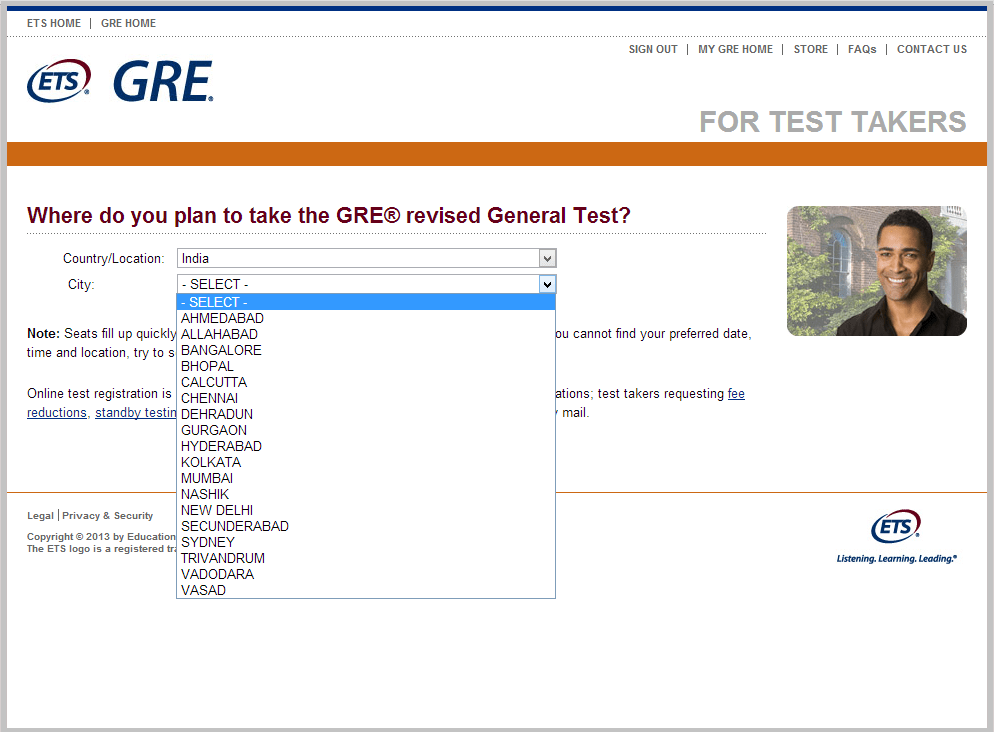
With the new inclusions the number of test centers in India has now climbed to 17. To view the test centers, however, one has to create a My GRE® Account and click “Register for the General Test.” To make things more convenient for you we have provided below a screenshot of the page that gives the names of all test centers in India (note that the inclusion of ‘Sydney’ as a test center location in India is a mistake!) Click the image to enlarge it.
Related:
 Ideally you would like to make all your letters of recommendation count. Consider the following two letters:
(i) Letter 1: “I highly recommend student X for your graduate program. Student X received an A+ in my undergraduate algorithms class. He was ranked Number 2 out of 100 students. He got the highest score on the final. He worked very hard all semester, never missed a class, and was always able to answer the questions that I asked in class. This conscientious attitude makes him an excellent candidate for any graduate program. ”
(ii) Letter 2: “I highly recommend student Y for your graduate program. Student Y received a B in my undergraduate algorithms class. He was ranked Number 29 out of 100 students. Halfway through the semester we started working on network flows. Student Y seemed extremely excited by this topic. He disappeared for 4 weeks and even missed an exam. However when he came back, he showed me some work he had been doing on a new network flow algorithm for high-degree graphs. He had done some simulations and had some proofs. I’ve been working with student Y for the past couple months since then and he is full of ideas for new algorithms. I think student Y’s initiative makes him an excellent candidate for any graduate program.”
Which letter do you think is stronger? It turns out that Letter 2 is very strong. Letter 1 actually counts as 0. At CMU we mark all letters like letter 1 with the acronym D.W.I.C.. This stands for “Did Well In Class” which counts for 0, since we already know from the student’s transcript that he did well in class. By contrast, student Y’s letter gives us a lot of information. It explains that the reason student Y didn’t do better in class was that he was busy doing research. It also tells us that student Y started doing research on his own initiative, and that he is quite good at doing research. The professor was impressed enough with student Y’s ideas that he took him on as a student researcher despite student Y not having high grades.
You want your letters to all be of type 2 (this doesn’t mean that you should skip class!). Remember that letters of type 1 will not count. You want words like self-motivated, strong research potential , own initiative, independent, and driven to appear in your letters. These are the words that we circle when reading recommendation letters. You therefore want to ask letters from people who have seen you do research. These may be professors or employers.
Related Blogs on Application Documents
Related

Question & Answer Forum
– What are transcripts?
– When should I register for the GRE test?
– Where can I find university deadlines?
– From whom do I need to take recommendation letters?
The list of questions that come up when you are applying to American universities is endless. Most probably you won’t know where to look for solutions or, whom to ask for the answers. That’s where the next of our great free application tools comes in – the DOA ONLINE Q&A FORUM.
On the Q&A Forum (click screenshot below for enlarged view) you can:
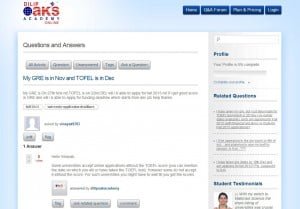 ask any questions you have regarding the application process for American universities
- get answers and expert advice from the academy (look for answers by the admin!)
- get valuable tips and insights from other registered users – since they have gone through the same situations and problems, their advice is often the best: no one understands your situation better than those traveling on the same path!
- consult the vast database of questions and answers already on the Q&A forum.
Here are some question and answers that have come up previously (click on the question to view answer):
1. What are financial aid deadline and rolling deadlines?
2. What is an Affidavit of Support?
3. Can I show support from more than one sponsor?
4. What is the difference between official transcripts, college transcripts and university transcripts?
5. What is credential evaluation and whom should I get it from?
6. I do not have a credit card, can I use an international debit card?
7. University Selection: Which university should I go for? (TTU vs UTD)
8. What is Personal Potential Index (P.P.I.)? Can I have some information about ETS P.P.I.?
9. Which top ranked universities offer MIS course?
So, as you can see, on the forum you can discuss your queries with others and get timely answers. It will give you vital help in crossing the various hurdles you come across while applying for higher education in USA – and the Q&A forum is absolutely free! Others have already benefited from this free application tool, so why be left out? Go ahead, register – and make the application process easier for yourself! Tell your friends about it too – they don’t have to be students at the Academy to benefit.
Also, in case you haven’t already done so, check out our blogs on the
And if you have any feedback for us, we’d love to hear from you. Send all your comments and suggestions to: