All About The Resume – Part 1: Why You Must Send a Resume in Your Application Packet


Why Sending a Resume Matters

Resumes (pronounced re-syoo-mayz) are included in your application for an American university for three reasons:

  • firstly, to give the admissions committee a brief snapshot of your academic performance – academic performance carries great weightage in deciding whether you will be admitted or not and in some universities admissions committees form their first impressions of your academic performance by looking at your resume
  • secondly, to present your qualifications for a research or teaching assistantship – for this reason remember to attach a covering letter to your resume requesting that it be circulated to interested professors
  • thirdly, to provide details of projects, seminars, industrial training etc. that you could not include in your SOP because of the word limit

All About the Resume – Part 2: Make It Easy for Professors Select You

Why the Resume is Different from a Bio Data or a CV – and Why It Should Stay that Way

Note that the resume is different from a bio data or a curriculum vitae (CV) in several respects: whereas bio datas and CVs are all-inclusive, data bank-like documents written in chronological order, resumes are compact, focused documents written in reverse chronological order that highlight only the most relevant and important information for course (or post) being applied for. So, don’t turn your resume into a Bio Data or CV – that would defeat the very purpose of the document.

Your resume should contain only the relevant information because professors are busy people who are hard pressed for time: if you bury the information they need in a sea of irrelevancies they might lose interest – and you might lose a position they might otherwise have awarded you. In other words, don’t hide the information that tells them that you are the candidate that they are looking for: make sure that when they see your resume they can’t miss it.

Continue reading

All About the Resume – Part 3: How to Create a Snapshot of Yourself in One Brief Page

Tips for Writing Resumes

A resume, like all other application documents, is designed to answer one crucial question: “Why should you be selected?” Of all the application documents (the SOP, the recommendation letters, and the transcripts), the resume answers that question in the briefest yet most comprehensive way. In order to achieve its goals, the resume must present the most important facts about you in their most concentrated form, in the smallest possible space. This will enable it to present a compelling snapshot of your strengths as a candidate and persuade the Admissions Committee that you are a good choice. Here are some tips that will help your resume to achieve its intended goals:

Continue reading

University Application Deadlines For Fall 2014

The application season is on, December is just round the corner …and university deadlines are coming up soon. So, here is our much awaited blog for university application deadlines for fall 2014.

Our list covers 125 universities with deadlines ranging from December 2013 all the way up to August 2014. At the end is a section on universities with rolling deadlines (click here to find out what is meant by rolling deadlines).

Remember that American universities update deadlines on their websites at different times during the academic year so, we will update this blog to keep up with changes on their official websites.

Presenting the first in our round of deadline alerts.

Continue reading

August Alert for Students Applying for Admission in Fall 2014

Fall in an American UniversityIf you are thinking of getting admission in fall 2014 the clock is ticking and August is drawing to a close. So, if you want to be in your American university at around this time next year, what should be your priorities in the next couple of months (and as you can see from the picture above, it really is beautiful there during fall). Hint: one thing that you will need to do is start thinking about which universities to apply to – and then there is going to be a lot of head scratching that you will have to do to select universities to apply to …and so much interviewing and researching that you are going to feel .like a news reporter! The details are below. Ready to read? Well, get set and go!

Continue reading

Preparing for GMAT: Important Links for You

Gathered together here are some useful links that will help you get prepared for that all-important exam!

Reading Comprehension

Data Sufficiency

Read these blogs and never get confused about Data Sufficiency questions on the GMAT again:

Integrated Reassoning

Wondering what Integrated Reasoning is and why it was introduced? Find out with these simple explanations.

Analytical Writing Helps

Problems with writing good essays in English affect almost everyone. Here are some important links on cutting out the mistakes that pull you down.

Find out about:
– how to how to move smoothly from one paragraph to another by using transition words and phrases effectively
– tips on how to improve sentence clarity through using parallel constructions, transition phrases, clear pronoun references and other grammatical devices
– when to use capital letters and when to go with small case:
– making sure you don’t confuse your a’s, an’s and the’s:
– advice on proper subject-verb agreement

MS in US: Fundas on Funding


Do You Have Any Idea of How You Are Going to Pay for Your American Degree?

Funding for your education in the United States is an important issue. Costs can range from Rs. 20 to 40 lakhs. Where is all that money going to come from?

If you’ve been wondering about that crucial question, here are two links that will help you. You don’t have to be super rich to get your master’s or a PhD from the States, nor do you have to have an uncle with a Swiss Bank account! The universities themselves will help you and so will others. Find out how with these two really important links:


Tackle Options in GMAT DS Questions the Oak’s Academy Way

~ by our Quantitative Reasoning Faculty


Step 2 of the Approach to DS Questions: Tackle the Options the Oak’s Way

Step 1 of the approach dealt with carefully reading the question statement (see previous blog). Once that is done you have to deal with the options, which are standard in DS questions:

(A) Statement (1) alone is sufficient but statement (2) alone is not sufficient to answer the question asked

(B) Statement (2) alone is sufficient but statement (1) alone is not sufficient to answer the question asked

(C) Both statements (1) and (2) together are sufficient to answer the question asked, but neither statement alone is sufficient

(D) Each statement alone is sufficient to answer the question asked

(E) Statements (1) and (2) together are not sufficient to answer the question asked and additional data are needed.

To deal with them in the most systematic way possible just follow the sufficiency/insufficiency table below. It offers the best way of thinking through the options

Continue reading

University Application Deadlines For Spring 2014 Semester

Deadlines for the Spring SemesterThe application season is on, June is just round the corner …and university deadlines are coming up soon. So, here is our much awaited blog for university application deadlines for spring 2014 covering 107 universities with application deadlines from June to December for the Spring 2014 semester. At the end is a section on universities with rolling deadlines (click here to find out what is meant by rolling deadlines).

Remember that American universities update deadlines on their websites at different times during the academic year so, we will update this blog to keep up with changes on their official websites.

Presenting the first of our deadline alerts.

Important Question: “Do you know which university you should apply to?”

A deadline is of use only if you know what university you should apply to. For those of you who are not too clear, here is how to decide:

1. Talk to seniors and decide which specialization you should apply for (examples: Networking, Data Bases etc. for Computer Engineers; Digital Signal Processing, VLSI etc. for Electronics and Telecommunications Engineers; MEMS, Robotics etc. for Mechanical Engineers)

2. To find out which universities or colleges offer the specialization you want, go to online.dilipoakacademy.com and look up your college or university in the University Information feature. All you have to do is select a university from the list of the top 220 provided (these have been selected by Mr. Dilip Oak) and you will get a list of departments and courses available. Click here to see. Registration is free and is open to all! (For more details on how to select a university see our Selecting the Right American University for Your MS in the US blog)

3. To plan your application process, check the general deadlines given in this blog. This will give you an idea of how much time you have and how to go about applying.

4. For the exact departmental deadline click the URL at the bottom of the University Information page for that university in online.dilipoakacademy.com. This will give you a more precise idea of how to plan your application process (see our Application Timeline for Spring 2014 blog – to be released in December – to see more specifically how you should go about applying)

Good luck and if your university is not in the list provided, keep looking for it. We will be updating this blog.

Related blogs:

Also see:

Deadlines in June

  1. University of Maryland, Baltimore County –1 Jun
  2. Texas Tech University –15 Jun
  3. University of Tennessee, Knoxville –15 Jun

Continue reading

Solutions to GMAT DS Questions

Solution to Question in ‘Tackle Options in GMAT DS Questions the Oak’s Academy Way’ Blog Post

Question:

Given that a, b, c, d, e are positive integers and that ‘b’ is an odd integer, is the product (a+b)(a+c)(a+d)(a+e) an odd integer?

(1) a is an odd integer

(2) c is an even integer


Continue reading

A Few Great Tips on How to Tackle the GMAT DS Questions

 by our Quantitative Reasoning Faculty

In last time’s blog we looked at why DS is so important in GMAT. In this one we’ll take a look at the 3 key things that you need to do in order to tackle this unfamiliar question type. There are:


1. Learn the Options

The first step in learning DS is to get absolutely familiar with the options. Fortunately, in DS, this is easy because the five options are always as follows:

(A) Statement (1) alone is sufficient but statement (2) alone is not sufficient to answer the question asked

(B) Statement (2) alone is sufficient but statement (1) alone is not sufficient to answer the question asked

(C) Both statements (1) and (2) together are sufficient to answer the question asked, but neither statement alone is sufficient

(D) Each statement alone is sufficient to answer the question asked

(E) Statements (1) and (2) together are not sufficient to answer the question asked and additional data are needed.


2. Remember the Aim

Remember, in DS our aim is NOT TO FIND THE FINAL ANSWER to the question but  just to verify whether the INFORMATION GIVEN IN THE TWO STATEMENTS IS SUFFICIENT TO REACH TO THE FINAL ANSWER!

So while solving the question if, at any intermediate step, you realize that you can reach the final answer then QUIT and mark the option accordingly.


3. Understand the Approach

Now let’s have a look at how you should approach DS questions.

Step 1: Carefully Read the Question Statement and Find the Crux of the Question

After closely examining the question statement and before you read the information given in statements (1) and (2), ‘identify the crux of the question’. What I mean by ‘the crux of the question’ is the piece of information that is the key to the solution. Sometimes you have to think a little bit before you get it. But once you have it, it will lead you straight to the answer. For example, have a look at this question statement:


If x and y are distinct positive integers then:
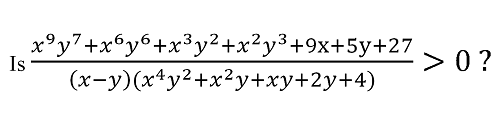


(1) x = 2 (y + 3)

(2) x2 = y2 + 4


Now, if you have lost touch with maths, just the sight of that forest of terms is enough to want to make you give up. But again, remember that we are not at all interested in solving this inequality. We just need find out whether the expression on the left hand side is positive or not (that’s what is implied by >0) – and this is a much simpler matter! Further, in this mass of algebraic symbols is a key that reveals itself when you examine about the expression and think about it a little.

In order to get this key, the first thing to do is to carefully observe the question statement. First and foremost, it says, that x and y are distinct positive integers. This is a very important piece of information – and you’ll understand why in a moment. Secondly, if you observe the numerator of the expression on the left, it consists of additions throughout. Given both these pieces of information, the numerator has to be positive in nature: it is the sum of distinct positive integers (which is why the information about x and y was important). By the same logic, even the second bracket in the denominator has to be positive. The only unknown factor, therefore, is the first bracket in the denominator, i.e., (x – y) and this is what holds the key to the entire problem.

The entire expression will be positive if and only if (x – y) > 0, in short, if x > y. On the other hand, if x < y, the whole expression will be negative. So, the whole gigantic problem is reduced to an extremely simple question: is x > y? Once we have arrived at this conclusion, cracking the rest of the problem is really easy: any information about the relative magnitudes of x and y will be sufficient to arrive at the answer! Thus, in this case, the crux of the question (the key to the solution) is realizing that all we need to find out in order to answer this question is whether statements (1) and (2) allow us to decide whether x is bigger than y or vice versa.

Once you have reached this stage you are can confidently take on the options of this seemingly insoluble problem. The discussion above takes care of Step 1 of the approach i.e. carefully reading the question statement and finding the crux of the question. In the next post we’ll look at Step 2 of the approach: tackling the options in DS questions – and we’ll be giving you tips that will reduce the complexities to a few simple steps! Watch for the tips in our third DS blog post next week.


Should I Apply for the Spring Semester (January)?

Many students are interested in joining American universities in January, that is, in the spring semester. But, there is a common misunderstanding that many universities do not accept students in the spring semester and that funding opportunities are also fewer. This, however, is not true. Almost 95% of American universities admit students for the spring semester.

Opportunities for financial assistance in spring are also as good as in fall. Of course, in some universities, a few courses are offered only in the fall semester, so students who join in spring cannot take them. However, with regard to financial aid, most universities offer Research and Teaching Assistantships, tuition waivers etc. only to students who have completed one semester, with a very good GPA (Grade Point Average). Hence, whether you join in the fall or spring semester does not really make a difference.