An Easy Way to Learn GRE Words (Through Roots) Part 2

Word RootsIf you found the last post on roots helpful, here are 2 more roots which cover 25 GRE words. For those of you who have come directly to this post, here’s a link that will help you understand why we are talking about roots so much: go to first roots post. (But basically, it helps to make learning the GRE words much easier).

genus generis (14 words)

The Latin word genus (cognate with Greek ‘genos’ and the Sanskrit root ‘jan’) has produced a number of English words. Genus has two basic forms: ‘genus’ and ‘generis’ (the second of which is more important because most derived words in English and other modern European languages have come from it whereas ‘genus’ exists as a single English word).

Continue reading

Help for Essay Writing in the GRE AW and TOEFL: Hypergrammar from Ottawa University

Prepare to be Sentenced!

One of the most important building-blocks of an essay is the sentence. Writing an essay for an Analytical Writing Task in the GRE or the GMAT – or even the TOEFL Independent Writing Task – means that you will be expressing your thoughts in an academic context. So, you need to use sentences that are acceptable in that kind of context, but also effectively to translate your ideas onto the screen

  • Complex sentences show that you are able to use the language fluently
  • Clear well-formed sentences make your essay easy to understand
  • Variety in sentence construction will make your essay interesting

How can you write like that? Simple, click on the link below and find out:

http://www.uottawa.ca/academic/arts/writcent/hypergrammar/bldsent.html

The link will take you to some useful suggestions published by the University of Ottawa, Canada on ‘Hypergrammar,’ their online resource page for grammar and writing. Use this link to understand:

  • the importance of sentence structure
  • the purpose of different types of sentences,
  • what kind of sentences work best in formal writing assignments such as essays.

Happy reading. Happy writing!

GRE Prep for Oak’s Students – Vocabulary Learning and Revision

Vocabulary Learning and Revision (to be started preferably 3-5 months in advance)

The largest, most time-consuming component of your GRE preparation is vocabulary revision. Achieving a good level of basic preparation involves getting familiar with around 4,000 words commonly used on GRE test. To really understand a word you need to know its range of meanings, some of its important secondary meanings, its usage (illustrated by sample sentences using the word) and it is often useful to know the roots of the word. Dilip Oak’s Academy has provided two very useful aids for learning and revising these various aspects. Described below is how you can use them both at home and outside.


At Home:

When at home use VaiVocabulary. VaiVocabulary is one of the best vocabulary learning softwares available in the market. It has a number of features which help to make vocabulary learning really effective. Here are some tips on how to get the most of it:

  • Try out all the features in order to select which combination works best for you – some of the more important features are given below:
    • Pictures – these are connected to the meaning and help to remind you of the meaning.
    • Sample sentences or usage – remember you don’t understand the meaning when you learn the definition: real understanding comes when you see how the word is used in sample sentences.
    • Video’ – most of this is really audio, but the videos give really good explanations of word meaning and lots of additional sample sentences.
    • Mnemonics – ways of linking the meaning of the word with the form of the word; many are given; select the ones you find most useful.
    • Word origins – these are the roots of words which help you to understand the meanings of words rather than just learning them by heart.
    • Synonyms – the easy synonyms help you to understand the meaning of a word better; the hard ones extend your vocabulary.
  • Mark any word you cannot remember ‘very difficult’ by default so that you will be able to repeatedly revise it; lower the rating when you get better at remembering.
  • most important: sincerely go through all quizzes, the rapid revision (it comes up at the beginning of a new session) and the difficulty-based revision sessions.
  • The VaiVocabulary DVD has a tutorial that will take you through all the available features and explain how to use them
  • If you run into any problems with installing or using the DVD contact the Academy – all the problems can be fixed one way or another, but don’t let problems prevent you from the enormous benefits of using this great vocabulary learning software.

Outside (i.e. when you are not at home): Use FlashCards and FlashCard Companion

  • The FlashCards contain 4,000 GRE words and their meaning; 2-3 shades of meaning are given for every word.
  • The FlashCard Companions are booklets which give you a sample phrase for every meaning of every word in the FlashCards.
  • Every page in the FlashCard Companion booklet corresponds to a FlashCard. The number of the FlashCard is given at the top of the page. Word numbers are also given for ease of reference.

GRE Prep for Oak’s Students: Plan for Taking Practice Computer-Based Tests

CBT – Practice on the Computer-Based Tests (1 month before GRE test)

The final stage of your GRE prep is taking practice GRE computer-based tests. If you are a student at Dilip Oak’s Academy, here is the plan – if you’re not, you are missing out!

  • Start doing the Computer-based tests 3 weeks-1 month before the GRE.
  • There are 10 Oaks tests (5 to be taken in the lab and 5 online) and two PowerPrep tests from the ETS, making a total of 12.
  • Going through all of them, at the rate of one every 2-3 days will take about a month.

Continue reading

Cracking the GRE Test – a Working Student’s Experience – Debanjana Nayak (GRE Score 330/340)

Trophy GRE ScoreThis week’s blog is by another of our high scorers, Debanjana Nayak who got a a really great score of 330/340. What makes this score a special one is that Debanjana is working.

So, this post is especially for all the working folks: if you are in a job and feel it might be difficult for you to prepare, here’s some inspiration! (By the way this post is just the first part. More to follow!)

———————————————————————————

Before, I start with my tips, here is a bit on my background. I graduated with an Electronics and Communication Engineering degree from WBUT in 2010 and soon after joined Tech Mahindra as a Technical Associate. I have been working there for almost 2 years now.

After having worked in the company for about 1 year, I decided to pursue higher studies in the US (targeting fall 2013). Since I intended to keep my job and prepare for the exams (GRE & TOEFL) side-by-side, I started preparation early, around October, 2011, almost 7 months in advance. I finally gave my GRE on 25th April, 2012. My scores are as follows:

  • Quantitative – 166/170
  • Verbal – 164/170
  • AWM – 4/6

Continue reading

Cracking the GRE: Tips from Tanmay – GRE Score 335


Here are some more hot tips from one of our students who is a star performer on the GRE. This time it’s Tanmay Gurjar. As you can see, his performance has won him another of our ‘gold medals’! First here is a brief ‘bio’.

—————————————————

Name: Tanmay Gurjar
Stream/College: Bachelor’s, Mechanical Engineering, COEP (currently in final year)
GRE Score: 335
Break up – Quant – 169, Verbal – 166

—————————————————


Continue reading

GRE Score – 337/340: Ashwin’s Tips for Cracking the GRE (Part 2)

TrophyThis week we bring you the second part of a really trophy-winning article: Ashwin’s tips for cracking the GRE.

In this part he gets even more specific, with tips for the Practice Tests and each of the sections – Analytical Writing, Quantitative Reasoning and the super-hard Verbal Reasoning section. Read on. There are literally dozens of pointers that you can really benefit from.

_____________________________________________________

Tips for the Practice Tests

1) If you haven’t given exams like Pravinya, MTS, NTS etc. the GRE exam may be a new experience. If that is so, I would advise you to give one of the mock tests within a week of finishing classes just in order to know where you stand (editor’s note: you can use the Oak’s free test for this purpose).

2) Practice, practice, practice. The more preparation you do the better you will score. It just works that way. There are studies that show if you prepare just one hour beyond the point where you feel you know everything, you can increase your marks by up to 5% (which is significant in an exam like this one).

Continue reading

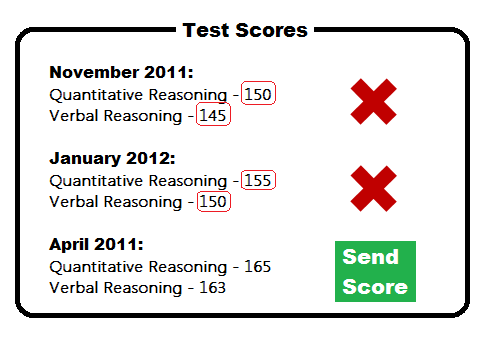
ETS’s ScoreSelect Option: Now You Can Decide Which GRE Scores You Want Universities to See

Select GRE Test ScoresFor students who have given the GRE several times, the worry has always been that the universities they are sending the scores to will see their bad scores along with their good ones. Now, however that is going to change.

The ETS has introduced a feature which it calls the ScoreSelectSM Option which allows you to select which GRE scores you want to send to the universities and colleges you are applying to. Here are the details according to ETS :

Continue reading

Why 6 and 8 are Important Numbers for the New GRE Analytical Writing Section

Analytical Writing in the Revised GRE testThose numbers are important because they are part of the changes that make Analytical Writing (earlier called the Analytical Writing Measure) trickier and more demanding on the Revised General GRE,which was released in August last year.

So, what are the changes? Firstly as noted above, the essay section is now called just Analytical Writing (or AW for short). The ETS has been making changes in various aspects of the GRE test to make it more like the GMAT. This is one of them. The second is that the Issue Essay is now just for 30 minutes rather than 45 as earlier. This again, makes the GRE more like the GMAT.

But the ‘6’ and ‘8’ are part of a feature that is entirely unique to the Analytical Writing section of the Revised General GRE test. The numbers come in because now instead of one question type for the Issue Essay, you now have 6, and instead of one question type for the Argument Essay you now have 8. Each of the question types directs the test-taker to do or comment on something very specific relating to the given topic – and in their introductory material the ETS repeatedly states that test-takers should follow the specific directions given for the topic, so obviously it is important that you better know exactly what each question type demands and also how to meet the specific requirements.

To find out more official information about this from the ETS visit the following link:

http://www.ets.org/gre/revised_general/about/content/analytical_writing

For our perspective, wait for our upcoming blogs on the Issue and Argument Tasks. Till then, happy hunting as you check out the ETS’s requirements for the tweaked and tricky AW section!

Related Links

GRE Overview:

GRE Practical Details:

GRE Maths Tips
GRE Tips From Top-Scoring Students
TOEFL/IELTS

GRE Test Prep: Reading Comprehension and Discrete Questions: Challenges & Tips

So, you are preparing for the GRE test. You know that the Verbal section is going to be demanding. What are the big challenges in the Verbal section of the Revised General GRE?

Challenge #1: Reading Comprehension Passages

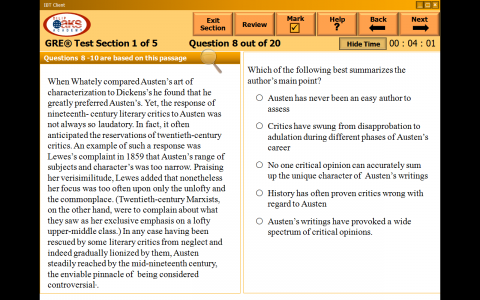
Screenshot of a Reading Comprehension question in the Revised General GRE
Reading Comprehension Question

First, a bit of good bit of news: the Reading Comprehension passages on the Revised GRE test are short. A Verbal section generally contains 5 Reading Comprehension passages, most which are 20-25 lines long; and one of them may be as short as 3-5 lines. The longest passages are of about 40 lines or so. (See ETS’s introduction to reading comprehension, sample questions and tips)

But Reading Comprehension is never very easy. Firstly, the passages cover a wide variety of topics, most of which are very unfamiliar. Here are some topics that have appeared in the past:

Continue reading

The Challenges in the Verbal Section of the Revised GRE Test (Hint: It has Gotten Tougher)

Verbal ReasoningWhen the Revised General GRE test was launched (way back on 1 August 2011), a whole host of changes was introduced. One consequence was a revamped Verbal Reasoning part in which there are now:

  • two Verbal sections in the test with a total of 40 questions, instead of one section with a total of 30 questions
  • no Antonyms and Analogy questions – these have been replaced by more Reading Comprehension passages.
  • Text Completion questions (which require you to fill up to 3 blanks in a passage which can contain up to five sentences) and
  • Sentence Equivalence questions (which require you to select two correct synonyms to fill in the blank in the sentence out of the 6 options given)
  • Sentence Completion questions with single- and double-blanks
    .

To sum up, Reading Comprehension is now more important, the Sentence Completion type questions got a little harder to get right and Vocabulary is more or less just as important as it was earlier – so, you still have to learn that GRE word list!). As a result of those two changes, students also find the Verbal section harder to complete on time. So, how do you handle that difficulty?

Continue reading

The Revised GRE Test

Online Revised GRE Test Screenshot
Revised Online GRE Test (Screenshot of Dilip Oak’s Academy Online Test)

The GRE test, conducted by ETS, is one of the world’s most widely used tests for admission to universities both in America and worldwide. On 1 August 2011, the ETS introduced the Revised GRE test. This exam lasts for about 4 hours and consists of 3 major of section types:

Continue reading