
 Make Your Journey to Your American University Smooth and Hassle-Free
So, you cracked the GRE and TOEFL exams and secured your coveted admit. Perhaps you even cleared the dreaded visa interview. Congratulations! But are you really ready to go? Not quite. One thing remains to be done – you and your parents have to attend Dilip Oak’s Academy’s Pre-departure Orientation for Fall 2014. Here’s why.
What is the Pre-Departure Orientation (and What’s It For)?
If you are joining an American university in fall 2015 and want to make travelling there (and the process of settling in) an organized, tension-free process, then Dilip Oak’s Academy’s Pre-Departure Orientation is a must for you and your parents. There are several matters that you have to think through and preparations you and your parents have to make before you can begin your education in America. The orientation will explain them all. For example:
- Accommodation – where are you going to stay when you land up in America? Is there someone who can help you get temporary accommodation until you find more permanent accommodation of your own? And what important points should you consider when looking for a good place to stay?
- Insurance – should you take Indian or American medical and travel insurance policies? Which one is better and for what purpose?
- Travel and Other Formalities – are you aware of the foreign exchange and airport formalities, the port of entry procedures? Did you know that you have to get a Social Security Number when you join your universities? Also, are medical check-ups or any immunizations required?
- Documents – which ones must you carry with you? Which ones should you keep at home? And what’s the best place to keep your passport and traveler’s cheques?
- Planning for Emergencies and Other Situation – suppose your baggage is lost or reaches you only after several days, how do you manage then? Or, if you got your luggage did you remember that you would need American coins to get a luggage trolley? And did you remember to arrange to be picked up”
- Food, Groceries and Cooking – your mother is going to be worried about how you are going to survive when you get to America. So, should you take every single kitchen vessel that she gives you and, what about all the papad, pickle and masala she is planning to load you up with? Can you get it all there instead or, only some of it? What should you take with you then? And what about cooking lessons?
That’s just a sample of the things you have to think through but, by now you probably have got the picture.
So, in the Oak’s pre-departure orientation program, Mr. Oak will guide you through all the complexities of going to America, adapting to your new environment and settling in there. He will even cover such day-to-day matters as driving and commuting, seeing doctors and what medicines to take. He will even get into clothing and laundry. With his decades of experience in the field and as a public speaker, he will make it an extremely informative and interesting program which you and your parents must attend.
What are the Other Benefits of Attending?
1. Get a free book with all the information in it
At the orientation, you will be given ‘Get Set to Go’, a booklet written by Mr. Dilip Oak, which explains all these matters in detail – so, even after the orientation, you have a written guide to go back to any time you have a doubt.
- Meet other students going to your university
At the end of the program we form groups of students joining the same university so that you can make joint travel plans and staying arrangements at the university.
- Get contact details of seniors at your university
To get this information, when you come to get your pass, simply fill up a form with your contact details and we will email you the details around a week after the orientation. With this information in hand, you will be able to contact your seniors in advance and ask them for help to:
- schedule airport pick-up
- make temporary housing arrangements and
- help you cope with the initial settling process
 Who can Attend?
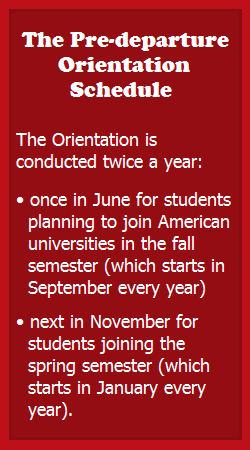
This orientation is for students (and parents of students) who are joining American universities in the fall 2015 semester. Please note however: you will be able to attend only if you (or your child) has received confirmed admission to an American university for the fall 2015 semester. To get passes for the program therefore, show the I-20 form issued by your university (or your stamped F1 visa).
When and Where is the Orientation?
Date: Sunday, 14 June 2015
Time: 5:30 p.m.
Venue: Ganesh Kala Krida Auditorium, Near Swargate Bus Stand, Pune – 411051
Where Can I Get Passes?
You can contact our office for entry passes from 1st June.
PLEASE NOTE: SEATS ARE LIMITED
COLLECT YOUR ENTRY PASS FROM THE ACADEMY EARLY
This story from the Panchatantra contains 19 high-frequency GRE words. See if you can understand the meanings from the story otherwise, the meanings are given below.
Mandavisarpini was a white flea. She lived in the folds of the luxuriant bedclothes on the bed of a king in a certain country; she lurked about in them at night and fed on his blood without anybody noticing. One day, a bug managed to enter the beautifully decorated bedroom of the king. When the flea saw him, she cried, “O bug, what are you doing in the king’s bedroom? Leave at once before you get caught!”
The bug replied, “Madam, even if I were just a nugatory good-for-nothing pest (which I most certainly am not), it would not be right to treat me this way, because I am your guest, and one should welcome a guest with comity and humility. It is the duty of the host to offer refreshments,” the bug continued, “and though I have fed myself with all types of blood, I never have I had the opportunity to savor the blood of a king. It must be very savory, for a king’s life is filled with all kinds of opulence, and so he must satisfy his palate with only the most magnificent culinary marvels. So, if you will permit, I would love to taste the king’s blood.”
The flea was dumbfounded.
“O Bug, you have a painful bite which feels like a barb perforating the skin, she said, “so the king will surely wake up when you bite him. I feed on the king’s blood only when he is in profound sleep. I can permit you to feed on the king’s blood only if you promise to wait till he is asleep.”
The bug agreed: “I promise to wait till the king is asleep, and only after you yourself have fed will I feed on his blood.”
Soon after they had resolved on this plan, the king came and lay down to sleep. The bug could not control himself, and decided to take a tiny bite of the king right away. As the king had not yet fallen asleep, he jumped when he felt the bug’s sharp bite. Distraught, the king shouted to his servants: “There is something in my bed that has bitten me! Look for it!”
On hearing this, the bug quickly ran to a corner of the bed and camouflaged himself by standing in front of the dark wood of the bedframe. The servants scrutinized the bedclothes sheet by sheet, and found the flea in one of the folds. They killed her at once, thus allaying the king’s anxiety, and the king then went to sleep in peace.
Thus the wise say: Beware the false promises of strangers and friends alike. You are the one who will end up paying for them.
GRE Vocabulary and Meanings
- luxuriant (adjective): splendid, shining, and beautiful: “He watched her as she combed her luxuriant brown hair.” “The actress came to the awards ceremony dressed in a luxuriant green sari.”
- lurk (verb): to move stealthily and cautiously so as not to be seen: “At night, rats lurk in the ground-floor rooms of our house.” “I never walk on the university campus at night, because they say that thieves lurk in the woods there.”
- nugatory (adjective): worthless: “Throughout my teens I continuously wrote poetry, most of which now seems nugatory or positively hilarious.” “A degree from a third-rate university is nugatory.”
- comity (noun): courtesy; consideration; kindness: “Political refugees deserve to be treated with comity by the host state while their applications are being considered.” “I wouldn’t recommend that hospital: I sensed a distinct lack of comity on the one occasion when I was treated there.”
- humility (noun): humbleness; lack of pride: “Despite his fame, the actor always treated his fans with humility and gratitude.” “When approaching the god in worship, you must always assume an attitude of humility.”
- savor (verb): to attentively appreciate a positive experience, particularly a taste: “Just savor the bold flavor of this new Italian wine I bought today.” “I hate it when other audience members talk at concerts while I’m trying to savor the music.”
- savory (adjective): tasty; having a pleasing taste: “This bhaji is much more savory than I expected: in fact, on the basis of its appearance, I thought it would taste disgusting.” “A little spice makes food more savory; too much spice just drowns out the taste.”
- opulence (noun): splendor of wealth; splendid show of wealth: “Having been quite poor before he became famous, the young actor was unprepared for the opulence of his new lifestyle.” “He’s a man of simple tastes, so he is very uncomfortable with the opulence of the expensive new house his wife forced him to buy.”
- palate (noun): the top of the mouth, once thought to be the location of the faculty of taste; the faculty of taste: “Our food will delight your palate with tastes you’ve never even imagined.” “There’s no point in taking him to fancy restaurants: He has the palate of a street dog.”
- culinary (adjective): relating to cooking and food: “Among the things that most attracted her to him were his culinary skills.” “For me, the most memorable thing about our trip to Europe was the great variety of culinary experiences we had in the countries we visited.”
- dumbfound (verb; almost always in the form of the past passive participle dumbfounded): astonish; appall: “Philosophers of every generation concern themselves with the same set of eternal mysteries that dumbfound the human mind.” “I was dumbfounded when my wife of twenty years sold all our property, emptied our bank account, and fled to Bolivia.”
- barb (noun): a thorn; any sharp piercing object: “As he ran through the forest, barbs and branches tore his clothes.” “Bees and wasps have a poisoned barb in their tail with which they sting their enemies.”
- perforate (verb): to penetrate; to cut through: “The bullet perforated his left side and lodged between his left lung and his heart.” “Use this machine to perforate the pages so that they can be bound.”
- profound (adjective): very deep: “The wreck of the Titanic lies at the bottom of one of the Atlantic Ocean’s most profound chasms.” “The old professor’s students were amazed by his profound knowledge of his subject.”
- resolve (verb): to decide (also resolve on): “I resolve to study Japanese for an hour a day until I have attained native fluency.” “After ten hours of deliberations, the prime minister and his cabinet resolved on a declaration of war.”
- distraught (adjective): distressed; upset; alarmed: “At the airport, distraught friends and family of the passengers waited anxiously for news of the missing plane.” “I became distraught when my wife still had not returned home at eleven PM.”
- camouflage (verb): to conceal something by making it look similar to its surroundings: “Deer camouflage themselves by standing amidst tall dry grass that is similar in color to their brown coats.” “He camouflaged his cricket bat by leaning it against the trunk of a tree.”
- scrutinize (verb): to examine or search very carefully: “Even if you have edited your written work thoroughly, you will find errors that you had missed earlier if you scrutinize it again” “Every day I scrutinize the online newspapers for stories about genetically modified crops.”
- allay (verb): to neutralize or lay to rest (fear, anger, hunger, or some other negative feeling or experience): “She tried to allay my fear of flying by telling me that in fact one is more likely to be stabbed to death by a monkey than to die in a plane crash.” “The health minister sought to allay the public’s anxiety about Ebola by announcing that every person coming into the country would now be thoroughly screened for the disease.”

The month of June is now approaching which means the spring 2016 application process should now begin. As per our standard practice we are publishing university deadlines for spring 2016 semester.
Keep in mind some universities update deadlines on their websites at different times during the academic year.
The deadlines mentioned below are for the graduate school only. The department deadlines may differ from the graduate school deadlines and hence you should cross check with your respective department for confirmation.
Under rolling deadlines there is no fixed application deadline declared by the university. Applications are accepted anytime till the seats for that particular semester are full.
You may also refer to our ‘University Info’ features which provides centralized information about the top 220 universities in America, including the university rank.
We wish you all the best!

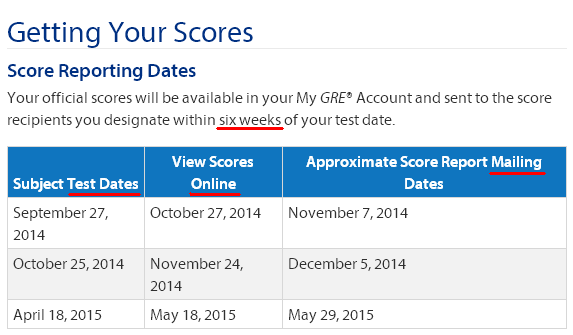
The first thing you should know: take your GRE about 1 ½ to 2 months before your earliest important deadline. It is going to take approximately that much time for your score reports to reach the universities you have chosen as score recipients (i.e. the universities you chose to send your score reports to). Here’s what the ETS says:
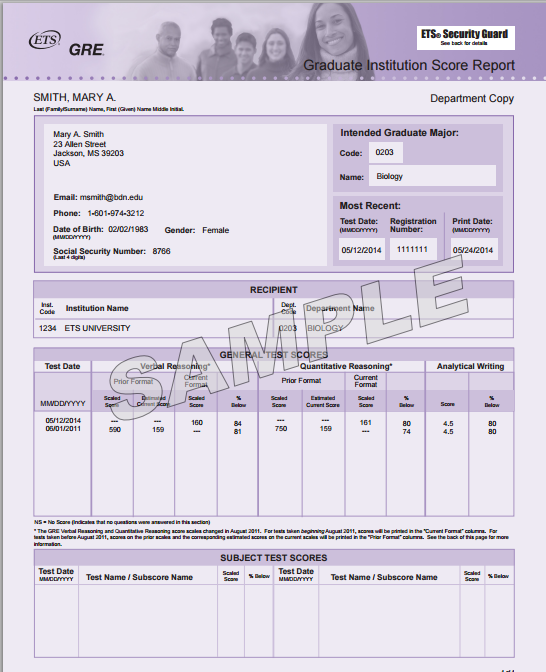
 About 15 days to a month after your test, you will be able to view online and print out, for your own records, your score report in the PDF format shown below:

Having seen the format, you probably have some questions: for example, why are the scores for the Verbal and Sections given under two different headings: prior format and current format? And what is the estimated current score under prior format for?
Well, before August 2011, the GRE used to score the Verbal and Quantitative sections on a scale of 200-800 instead of between 130-170 as they now do. According to the ETS, GRE scores are valid for 5 years. This means that GRE scores taken in September 2011 will continue to be valid according to the ETS till September 2016. Until then the ETS has to provide a way of comparing the old and new scores. They do this by providing:
- an old score equivalent for tests taken under the Revised General GRE format (taken on or after 01 August 2011)
- a new score equivalent for tests taken under the earlier GRE format (i.e. before 01 August 2011)
This is why the scores for the Verbal and Quantitative sections in the PDF shown above are given in two columns: ‘Prior Format’ and ‘Current Format’. This allows universities to easily compare the scores of students who have taken the older versions of test and those who have taken the newer one without too much difficulty. The ‘Estimated Current Score’ column (under ‘prior format’) was specially meant for candidates who had taken the old format of the test and for whom American universities needed an estimated equivalent score in the new format.
Somewhat pointlessly, the ‘estimated current score’ is also given for students who have taken the new version of the test (the Revised General GRE as it is called) – this is pointless since they already have an actual score in the new column. But we guess, since the ETS had the columns, they had to fill them up! Perhaps, reports after August 2016 will be simpler. Practically, however, this comparative data will not make much of a difference to you since most universities do not accept GRE scores that are older than 3 years. So, American universities probably stopped accepting September 2011 reports in September 2014.
Here are some other important links to check out:
Can I ask the ETS to show universities only the scores I want them to see?
Ordering additional GRE score reports
And just in case, you are interested here’s the PDF format the score report that the universities you are applying will see if you have asked the ETS to send them a score:

(The following passage on food photo sharing contains 38 GRE words. If you find it difficult to understand, read through the explanation of the meanings of the words (given with illustrative sentences) and then reread the passage.)
The food photo sharing phenomenon (or what you might call the visual department of gastronomy) is in full swing. New tools such as Foodspotting and Eat.ly are constantly proliferating. Add in the photo-handling capabilities of sites like Foursquare and it’s no surprise that the “eat and tweet” trend has inundated social media feeds. Interestingly enough, this flood of food images is being engendered not just by gourmands or even specialist food sites, but ordinary philistines like you and me who have no expertise in food beyond our own pedestrian predilections. Showing – not just telling – others what you’re eating is becoming mainstream. So is vicariously enjoying others’ food. Why is everyone suddenly so keen to snap their snacks (and gorge on images of the food that others eat)? Does this simply reflect a universal human desire to share things that gives us pleasure? Is it showing off or, is it a drive to gain status? What is the genesis of this new drive? And how is it changing our approach to food and eating?
 There are lots of theories about why people like to share pictures of food. Some experts suggest it’s because eating is one of society’s most essential communal activities, and sharing food photos is the next best thing to convivial experience of eating together. Others speculate that food photos allure us because we have always started a meal by ‘eating with our eyes’, preparing ourselves for the actual culinary experience by savoring its visual aspects first. Others still, conjecture that food has become something of a status symbol, and sharing a photo of a meal, particularly from a buzz-worthy restaurant, is as much about establishing one’s place in the social media hierarchy as it is about documenting what we ate today.
The interesting thing about food photography is that it combines two subjects that really resonate with society as a whole: food and culture. Meals, for example, are often a time when people come together to celebrate life and human relationships. So, a food photographer is a visual food anthropologist. It’s not just about the food on the plate; it’s also about the context: the moments, the connections, the scenes, the places, the stories. Think about how people relate to food and what connects them to it. Some of the most interesting photographs come out of this relationship. Mobile phones and social media are at the heart of the food image vogue because social media provide the space where a lot of us document and curate our lives and, mobile phones allow people to capture and share their experiences wherever they are. A new element has enlivened the routine of dining: snapping photos of your meal before you eat is now becoming commonplace in places ranging from the fanciest restaurants to your local café and even in less reputable dives.
Of course, filtered photos of food are no surrogate for the experience of the meal itself: they cannot replace the aromas and sensations of preparation and consumption or, the conversations that take place at the table. As for the snaps themselves – these are merely the yeast with which we leaven the pleasures of the Net. Now that’s food for thought!
 1. gourmets (noun): people who are experts in food and wine (often contrasted with gourmands – see below) “He’s very easygoing about everything else, but where food is concerned, he’s a gourmet, eating only the best he can afford.”
2. gourmands: people who enjoy eating fine food and often eat in excess (for the gourmet quality is the important thing; for the gourmand quantity is more important than quality): “He’s a typical gourmand and is quite capable of finishing off two whole tandoori chickens all by himself.”
3. phenomenon (noun): an observable thing or event; a remarkable or astonishing thing or person: “Tsunamis used to be a rare phenomenon, but in recent years they have become alarmingly frequent.” “Nobody had any idea that this small-budget independent film would become such a phenomenon at the Oscars.”
4. gastronomy (noun): the pursuit of refined eating experiences; an appreciation of good food: “Gastronomy is one of the traits that separate humanity from the animals.” “As a lover of fine food, I believe that any man who knows nothing of gastronomy does not deserve to be called civilized.”
5. proliferating (from the verb proliferate): multiplying; increasing in number: “During the nineties, call centers were rapidly proliferating in Mumbai and Bengaluru.” “NGO’s do not seem to be proliferating at the same rate as they were a few years back.”
6. inundated (verb): flooded with something; poured into (something) in great quantity: “After the storm, an underground pipe burst and inundated our housing society with drain water.” “When they heard the news of my mother’s death, my friends and family inundated my inbox with condolences.”
7. engendered (from the verb engender): given birth to; produced; created: “Hailstorms are engendered by atmospheric conditions that used to be rare in this part of the world but have recently become quite common.” “The current mood of anger against government and corporate corruption was engendered by a wave of scandals in recent years.”
8. philistine (noun): someone who lacks higher culture; an ignorant, crude and unrefined person: “She is a well-read person, but she’s very lonely because her husband is a philistine who does nothing but watch the idiot box and play video games.” “He’s such a philistine that he thought that Satyajit Ray’s notable film ‘Apu Samsaar’ was a Salman Khan film.”
9. expertise (noun): a high level of knowledge and skill in a particular domain: “The professor declined to supervise my PhD because her expertise was in a slightly different domain.” “Although he was the president of a major computer manufacturer, he had no expertise in programming.”
10. pedestrian (adjective): commonplace; ordinary; unexceptional: “All the reviews of the film were extremely positive, but I found it pedestrian.” “As a singer he is pedestrian, but as a guitarist he is really extraordinary.”
11. predilections (noun): preferences; likings: “His fatal heart attack was the result of his lifelong predilection for ghee-rice.” “Our dear old dog Nandi had a predilection for chasing cars which ultimately led to his death.”
12. mainstream (adjective): commonplace; conventional: “Twenty years ago, almost no one had a mobile phone; now they have become so mainstream that even labourers have them.” “Once, only village people and goondas got tattoos, but in recent years they have gone mainstream, and now any college student or housewife might have one.”
13. vicarious (adjective): done or experienced indirectly or through a substitute: “This video game gives you the vicarious experience of being a fighter pilot in Afghanistan.” “Today I used Bing Maps to take a vicarious walk through the streets of Tokyo.”
14. keen (adjective): eager; enthusiastic: “I have to admit that I’m not very keen to accept his lunch invitation: I find his company so boring that I have difficulty staying awake.” “I have always been very keen on horror films: I’ve seen about thirty in the last year alone.”
15. gorge (verb, always in the phrase gorge on): to eat a huge quantity of something (also figuratively): “On Saturdays I stay at home and gorge on chivda while reading vampire novels.” “On Saturdays I stay at home and gorge on vampire novels while eating chivda.”
16. universal (adjective): occurring everywhere; valid for everyone and everything: “The Canadian government provides universal health care coverage.” “A universal dengue vaccination would totally eliminate the disease within a generation.”
17. genesis (noun): origin; birth; beginning; process of coming into being: “Today, the world is witnessing the genesis of a new political world order.” “The American space program owed its genesis to the country’s military rivalry with Russia.”
18. communal (adjective): relating to a community: “Eating is the most basic communal activity.” “As a radical individualist, I have no interest in communal activities like festivals.”
19. convivial (adjective): characterized by collective happiness and enjoyment; relating to enjoyable group activities: “The convivial atmosphere of the wedding reception was ruined when the bride’s brother punched her new husband in the face.” “Even though he was generally a solitary man, he did look forward to convivial family occasions like birthdays, weddings, and holidays.”
20. speculate (verb): to guess on the basis of evidence: “Police speculate that the serial murderer may have known his victims personally.” “Environmental scientists speculate that global temperatures may have begun to rise not long after the beginning of the Industrial Revolution.”
21. allure (verb): do draw; to attract; to fascinate: “The fundamental principle of advertising is this: if an advertisement can allure the viewer’s senses, then he will remember the product.” “I didn’t want to accept the university’s job offer because I could see that it was not a first-rank institution, but they tried to allure me by telling me that it would be a permanent position.”
22. culinary (adjective): relating to cooking and food: “Among the things that most attracted her to him were his culinary skills.” “For me, the most memorable thing about our trip to Europe was the great variety of culinary experiences we had in the countries we visited.”
23. savor (verb): to attentively appreciate a positive experience, particularly a taste: “Just savor the feeling of a cold, sweet drink sliding down your throat on a hot summer’s day .” “I hate it when other audience members talk at concerts while I’m trying to savor the music.”
24. aspect (noun) one side or dimension of something: “Every aspect of a problem must be considered if an effective solution is to be found.” “Rightly understood, religion and science are two mutually complementary aspects of the same single, unified reality.”
25. conjecture (verb): to make an informed guess; to speculate about something known on the basis of known facts: “The detectives conjecture that the murderer must have thrown the murder weapon in the nearby river and fled on a train from the nearby station.” “Historians conjecture that the temple must be about one thousand five hundred years old.”
26. buzz (noun): chatter; excited discussion of a popular thing: “This popular new clothing store has generated a lot of buzz all over town.” “You can gauge the success of a new establishment by how much buzz it’s creating.”
27. hierarchy (noun): an ideal structure in which things are ranked in ascending grades of value: “Human beings have always tended to place themselves at the top of the hierarchy of living things.” “Within his first year at the company he was already getting promoted and climbing the corporate hierarchy.”
28. document (verb): to record in writing; to record with written or photographic evidence: “We have to document all our expenses on this trip so that the company will reimburse us.” “The photographs in this book document the story of India’s struggle for independence.”
29. resonate (verb): to be meaningful to someone; to make sense; to express feelings that reflect and bring out one’s own feelings on the subject: “The prime minister’s speeches, which paint an optimistic picture of a prosperous future for the country, resonate with the country’s ambitious youth.” “The story of his struggle to escape from poverty through education and hard work resonates with millions of poor people.”
30. anthropologist (noun): a scholar who scientifically studies human behavior: “An anthropologist must be a completely objective observer of human culture, and must never interfere in what he observes.”
31. context (noun): the situation and circumstances surrounding a thing; the “bigger picture”: “A biography cannot effectively tell the story of its subject’s life unless it also presents a full picture of the social context in which he lived.” “You can’t believe everything people say in the context of a heated argument.”
32. vogue (noun): craze; popular interest in a particular thing: “Italian cuisine is currently enjoying a vogue, but like all vogues it will soon pass and be replaced by another one.”
33. enliven (verb): to make something lively or interesting: “We can always count on the professor to enliven a dull party with his vast general knowledge and bizarre comments.” “Amir Khan briefly enlivens this otherwise boring film with a hilarious five-minute appearance.”
34. reputable (adjective): having a good reputation; respected: “No matter how smart you may be, if your degree isn’t from a reputable university you’ll have trouble finding a good job.”
35. dive (noun): a cheap, low-quality restaurant: “I love eating in this dive, but my wife thinks the place is so disgusting that she won’t even enter it with me.”
36. surrogate (noun): replacement; substitute: “For ensuring good health, there can be no surrogate for vigorous daily exercise.” “Saccharine was the first surrogate for sugar.”
37. aroma (noun): a smell (almost always in a positive sense): “I actually prefer the aroma of coffee to its taste.” “The aroma coming from the kitchen tells me that today’s supper is really going to be something special.”
38. leaven (verb): (said of yeast) to make bread “rise” when it is being baked; (figuratively) to make anything more lively or interesting: “He knows something about everything, and has the most interesting way of talking, so he’s always been the leaven of any get-together he attends.” “Novels were the leaven of my life during the four mind-numbing years I spent earning a bachelor’s degree in a subject I hated.”