
 So, you’ve got the admission news you were waiting for: your coveted admission for an ‘MS in US’ is confirmed. You’re scheduled to join your American university in the fall 2016 semester – and now it’s time to book airline tickets and start thinking about travel plans and accommodation.
One problem, however, is contacting senior students who are already in your desired US university, so you can arrange for a pickup and drop from the airport and some temporary accommodation. Another is finding other students who are heading to your US university, so you can choose room-mates and make joint travel plans.
So, here’s one more thing that Dilip Oak’s Academy is doing to make finding travel and room companions easier for you through Dilip Oaks Academy Online. We call it our Roommate Finder and it will help you locate and coordinate with other students joining the same university.
Here’s how it works: if you are a signed up member of Dilip Oak’s Academy Online, all it requires is that you update your application status using the University Applications Tracker. Once you’ve done that, the names of other students going to the same university as you are will automatically be updated on your Roommate Finder page. Then, just hit the contact button.
If you’re not a member then, joining up is free and easy – it just takes a minute or two – and then you will be able to find roommates as explained above.
Remember, Dilip Oaks Academy Online is free to join! So, tell all your friends who are applying for an ‘MS in US’ to join and update their admission updates. The more people join, the more everybody benefits! But, even now there are enough folks like you signed up with us to make this feature a big help to you!
P.S. we love your feedback, so let us know how we are doing at: support@dilipoakacademy.com
It is our continued endeavour to keep you updated with the university deadlines well before the application process. As per tradition we are publishing the university deadlines for fall 2016 semester. Please bear in mind that some universities may change deadlines on their websites without prior notice. The department deadlines may differ from the graduate school deadlines, hence you are advised to cross check not only the graduate school deadlines but also the department website of the university you are applying to.
 The deadlines mentioned below are for the graduate school only.
Deadlines in November
University of South Carolina, Columbia – 30-Nov
Deadlines in December
Massachusetts Institute of Technology – 15-Dec
Tufts University – 15-Dec
University of Illinois, Urbana Champaign – 15-Dec
Yale University – 15-Dec
Harvard University – 14-Dec
Indiana University, Bloomington – 1-Dec
University of Miami, Coral Gables – 1-Dec
University of North Carolina, Chapel Hill – 1-Dec
Deadlines in January
Rensselaer Polytechnic Institute – 1-Jan
University of Maryland, Baltimore County – 1-Jan
Worcester Polytechnic Institute – 1-Jan
Washington State University, Pullman – 10-Jan
Florida Institute of Technology – 15-Jan
Northeastern University, Boston – 15-Jan
State University of New York, Buffalo – 15-Jan
Texas A & M University, Kingsville – 15-Jan
Texas Tech University – 15-Jan
University of Central Florida – 15-Jan
University of Michigan, Ann Arbor – 15-Jan
University of Southern California – 15-Jan
Vanderbilt University – 15-Jan
Duke University – 30-Jan
Illinois Institute of Technology, Chicago – 31-Jan
Indiana University Purdue University – 15-Jan with funding 1-Mar without funding
Deadlines in February
Case Western Reserve University – 1-Feb
Colorado School of Mines – 1-Feb
East Carolina University – 1-Feb
Kansas State University – 1-Feb
Pennsylvania State University, University Park – 1-Feb
University of Connecticut, Storrs – 1-Feb
University of Rhode Island, Kingston – 1-Feb
University of Tennessee, Knoxville – 1-Feb
University of Tulsa – 1-Feb
Colorado State University, Fort Collins – 15-Feb
Eastern Michigan University – 15-Feb
Florida International University – 15-Feb
Marquette University – 15-Feb
Polytechnic Institute of New York University, Brooklyn – 15-Feb
University of Illinois, Chicago – 15-Feb
University of Massachusetts, Dartmouth – 15-Feb
University of Oregon, Eugene – 15-Feb
University of South Florida, Tampa – 15-Feb
Deadlines in March
California State University, Chico – 1-Mar
California State University, Sacramento – 1-Mar
Illinois State University, Normal – 1-Mar
New Mexico State University, Las Cruces – 1-Mar
North Carolina State University – 1-Mar
Oklahoma State University, Still Water – 1-Mar
Temple University – 1-Mar
University of North Carolina, Charlotte – 1-Mar
University of Pittsburgh – 1-Mar
University of Toledo – 1-Mar
George Washington University – 15-Mar
South Dakota School of Mines & Tech – 15-Mar
University of Colorado, Denver – 15-Mar
University of Kentucky, Lexington – 15-Mar
University of North Texas, Denton – 15-Mar
University of Pennsylvania – 15-Mar
California State University, Northridge – 31-March Online, 30-April Document submission
Deadlines in April
California State University, Fresno – 1-Apr
Idaho State University – 1-Apr
Oregon State University, Corvallis – 1-Apr
San Jose State University – 1-Apr
Stevens Institute of Technology – 1-Apr
University of Arkansas, Fayetteville – 1-Apr
University of Arkansas, Little Rock – 1-Apr
University of Houston, University Park – 1-Apr
University of New Hampshire, Durham – 1-Apr
University of Texas, Arlington – 1-Apr
University of Texas, San Antonio – 1-Apr
Villanova University – 1-Apr
Virginia Polytechnic Institute & State University – 1-Apr
West Virginia University, Morgan Town – 1-Apr
Western Michigan University, Kalamazoo – 1-Apr
Wichita State University – 1-Apr
California State University, Los Angeles – 15-Apr
Lamar University – 15-Apr
Old Dominion University, Norfolk – 15-Apr
South Dakota State University, Brookings – 15-Apr
University of Georgia – 15-Apr
University of Iowa, Iowa City – 15-Apr
California State University, Long Beach – 1-April online, 15-April Document submission
Deadlines in May
City University of New York, City College – 1-May
Clarkson University – 1-May
Minnesota State University, Mankato – 1-May
Mississippi State University – 1-May
New Jersey Institute of Technology – 1-May
North Dakota State University, Fargo – 1-May
Northern Illinois University, Dekalb – 1-May
Oakland University, Rochester – 1-May
Southern Methodist University – 1-May
Tennessee Technological University – 1-May
University of Idaho, Moscow – 1-May
University of Louisville, Louisville – 1-May
University of Memphis – 1-May
University of Michigan, Dearborn – 1-May
University of Nevada, Las Vegas – 1-May
University of New Mexico, Albuquerque – 1-May
University of Texas, Dallas – 1-May
Wayne State University – 1-May
Western Illinois University – 1-May
California State University, Fullerton – 4-May
University of Louisiana, Lafayette – 15-May
University of North Carolina, Greensboro – 15-May
Wright State University, Dayton – 15-May
Deadlines in June
Louisiana Tech University, Ruston – 1-Jun
Monmouth University – 1-Jun
Southern Illinois University, Edwardsville – 1-Jun
University of Alabama, Huntsville – 1-Jun
University of Alaska, Fairbanks – 1-Jun
University of Detroit, Mercy – 1-Jun
University of Illinois, Springfield – 1-Jun
University of Wyoming, Laramie – 1-Jun
Drexel University – 13-Jun
Marist College, Poughkeepsie – 15-Jun
Missouri University of Science & Technology, Rolla – 15-Jun
University of South Alabama, Mobile – 15-Jun
Deadlines in July
Arkansas State University – 1-Jul
Florida State University – 1-Jul
New York Institute of Technology – 1-Jul
Santa Clara University – 12-Jul
Lehigh University – 15-Jul
University of Bridgeport, Bridgeport – 15-Jul
Deadlines in August
New Mexico Institute of Mining and Technology – 1-Aug
University of Houston, Clear Lake – 1-Aug
Rolling Deadlines
Fairleigh Dickinson University, Madison
Rochester Institute of Technology
Departmental Deadlines
Johns Hopkins University
Michigan State University, East Lansing
Michigan Technological University
Montana State University, Bozeman
Northwestern University, Evanston
Ohio State University, Columbus
Portland State University
Purdue University
Rutgers, The State University of New Jersey
San Diego State University
San Francisco State University
Southern Illinois University, Carbondale
Stanford University
State University of New York, Albany
State University of New York, Binghamton
State University of New York, Stony Brook
Syracuse University
Texas A & M University, College Station
Texas State University
University of Alabama, Birmingham
University of Alabama, Tuscaloosa
University of Arizona, Tucson
University of California, Berkeley
University of California, Davis
University of California, Irvine
University of California, Los Angeles
University of California, Riverside
University of California, San Diego
University of California, Santa Barbara
University of California, Santa Cruz
University of Chicago
University of Cincinnati
University of Colorado, Boulder
University of Hawaii, Manoa
University of Kansas, Lawrence
University of Maine, Orono
University of Maryland, College Park
University of Massachusetts, Amherst
University of Minnesota, Duluth
University of Minnesota, Twin Cities
University of Missouri, Columbia
University of Missouri, Kansas City
University of Nebraska, Lincoln
University of Nevada, Reno
University of North Dakota, Grand Forks
University of Oklahoma, Norman
University of Southern Mississippi
University of Texas, Austin
University of Texas, El Paso
University of Utah, Salt Lake City
University of Vermont, Burlington
University of Virginia, Charlottesville
University of Wisconsin, Madison
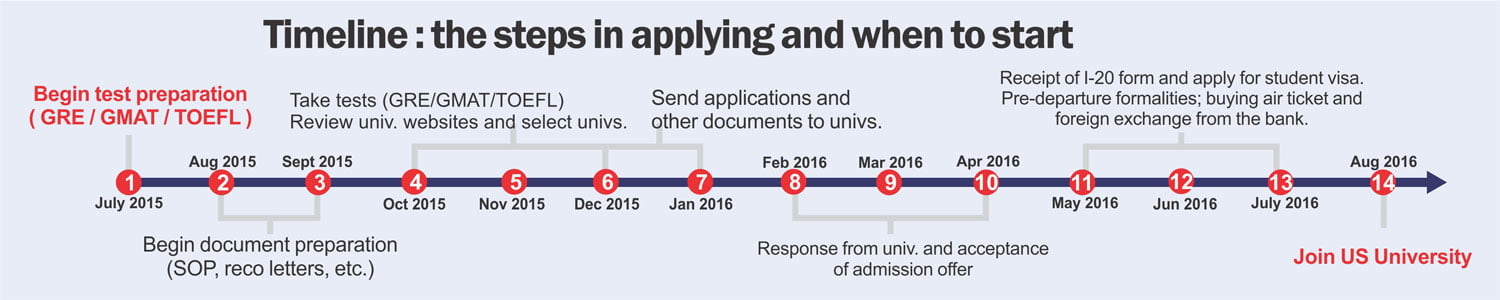

If you are applying for admission in fall 2016 the clock has begun to tick. So, don’t delay. Review this Application Timeline for Fall 2016 immediately and get to work.
June 2015
Review your goals for your MS in US and choose some specific areas in which you would like to specialize.
July 2015
- Begin preparation for the GRE/TOEFL tests
- Register for the GRE and TOEFL examinations – if you are targeting the top 10 or 15 universities, you should take these examinations preferably by September 2015. If you are targeting other universities, you may take these exams by 20 December 2015 so you can meet the deadlines of universities which are in December 2015.
- Register for the Subject GRE – important for doctoral programs in pure sciences and biological sciences in top schools.
Note: the exam is held once in a year in November, however, seats usually get filled up by August.
August-September 2015
Make a preliminary list of about 30 universities which meet your requirements considering:
- Location
- Costs of living and education
- Broad specializations you are interested in (for departments and specializations see the ‘university info‘ page on online.dilipoakacademy.com)
- Recommendations by seniors, your professors etc.
- Whether your academic profile fits the universities requirements.
For more details, see: Selecting a University for Your MS in the US. Also refer to our post on university information available on the social media
September 2015
- Arrange for 10-13 sets of transcripts in sealed covers from your college or university – some universities insist on university transcripts/university attested mark sheets
- Choose your recommenders (generally 3 recommendations are required, at least one of which should be from the educational institute last attended) and give them the necessary details – resume, copies of your mark sheets etc.
- Start working on your Statement of Purpose and resume
October 2015-January 2016
- Take the GRE and TOEFL exams latest by January 2016 (ideally 20 December 2015)
- Carry out a comprehensive review of the 30 universities considering:
- Your academic performance in bachelor’s degree
- GRE and TOEFL scores of students admitted in the past
- Any minimum cut-offs with respect to GRE and TOEFL scores
- Whether courses of your choice are offered in the Fall semester
- Cost of education
- Make your final shortlist of 8-10 universities.
- Complete your Statement of Purpose (SOP) and resume
- Request the ETS to forward your GRE and TOEFL scores to the universities you are applying to, specifying the correct codes for the universities/departments you are applying to.
Note: some universities require certain documents to be sent to the department you are applying to. - Complete online application process and send the required documents by courier
This completes the application process; however there are further steps to be taken:
- Track the status of your application on your status page of the university’s website. Though universities generally communicate decisions or requirements by either e-mail or post, it often happens that the only source of information is your status page.
- If there are any deficiencies in your applications (missing documents, non-receipt of GRE or TOEFL scores, recommendations etc.) immediately correct the deficiencies.
- When you receive an offer letter from the universities (or when your status page shows that you have been given admission) email your acceptance(This is very important especially when you are offered funding)
- When you have accepted the university’s offer of admission and the documentation formalities are complete, the university will send you the 1-20, an immigration document, which is essential for obtaining a visa.
- When you receive the I-20, check that it is correct in all respects:
- Your name and date of birth should be exactly as in your passport
- Your course and course duration should be correctly specified
- The financial sources indicated should exceed the costs etc.
- Prepare the visa documentation
- Study the visa application formalities specified on the websites of the applicable US Consulate and the VFS (Visa Facilitation Services)
- Apply for a visa interview date – you can apply for a visa interview 120 days before the joining date mentioned on your I-20.
For further details on the F-1 visa see our previous blog on the subject.
Note: Dilip Oak’s Academy organizes a ‘Pre-departure Orientation’ in June-end every year for students who have been admitted to the fall semester. In the Orientation, Mr. Dilip Oak covers matters such as:
- the student (F1) visa
- foreign exchange
- airport formalities (port of entry/immigration procedures)
- insurance
- medical checkups & immunizations
- initial formalities in the university
- accommodation (on- & off – campus)
- financial and other formalities for the first semester of studies
Keep a look out for our announcement of the Orientation. The announcement will appear on this blog sometime in June.

Facts about the Field
- Job Prospects – according to the Bureau of Labor and Statistics (BLS) 11,600 jobs will be generated for mechanical engineers in the United States by 2022 (the unemployment rate in the field is just 2.7%)
- Employment Growth Rate – the BLS also predicts that employment in the field is expected to grow by 4.5 percent between 2012 and 2022
- Salaries – the median salary is $80,500 with the worst-paid earning $52,580 and the best-paid earned $123,340.
- Job Satisfaction – upward mobility in mechanical engineering jobs in America is high, flexibility is above average and stress levels are about average
- What the Work is Like – many mechanical engineers work out of an office on a 9-5 schedule but if your job demands it you may visit sites like oil rigs or skyscrapers
- Top-paying metropolitan areas – these include Anchorage, Alaska; Taunton, Massachusetts; and San Jose, California.
Advice on Getting a Job
- Explore different jobs in America and specializations when you are in your 20’s – it may take you until your 30s, to figure out what you actually want to do in the field
- On your first job find a company that lets you continue to learn – that’s more important than location or salary
- Multidisciplinary engineering is becoming increasingly important in the industry, so familiarize yourself with related disciplines: electronics, control systems and chemical reactions are some you could consider.
- Sustainable design is also becoming important since we are running out of resources and design has to take this into account
- To get a good job after graduation you need to convince prospective employers that you can help their business to be successful. This means you have to have the organizational and management skills required to successfully complete a project. To acquire these skills take project-oriented courses in college and get practical experience in summer internships.
(Source: US News)

The following post packs 60+ high-frequency GRE words into a simple but engaging tale from the Panchatantra about how a sage found a suitable spouse for his mouse daughter.See if you can understand the exact meanings of the sentences. If not word meanings along with illustrative sentences are given below.
A Husband for a Mouse
There was once a hermitage on the bank of the Ganga where a community of hermits lived an idyllic life of quietude and meditation, quite oblivious to the world. The hermits were disciples of a sage named Yadnyavalkya, who practiced rigid self-discipline and was always rapt in meditation. One day, while he was performing his diurnal ablutions in the river, a hawk flew over with a female mouse in its talons. Suddenly, the hawk lost hold of the mouse and it plummeted from the hawk’s grip straight into the hands of the ascetic. When he perceived the hawk still lurking above, he knew he could not forsake the mouse, or the rapacious predator would seize it again. So, he placed the mouse on a leaf of a nearby Banyan tree and, using his yogic faculty of transmutation, he changed it into a little girl. He then brought her to the hermitage and said to his wife, “My dear, please accept this child as a blessing, as we do not have children of our own.” Thus, the girl became a denizen of human society, living in the hermitage and, mastering the art of meditation under the conscientious care of the sage himself.
One day some years later, the sage’s wife apprised him of the fact that their daughter was now nubile. They decided to give the matter serious thought, since she was a singular young woman and therefore deserved a no less singular husband. The next morning, using his powers of invocation, the sage summoned the sun god and said, “Please accept my daughter’s hand in marriage and, if she accepts you, may you both live in connubial bliss.”
The daughter however, balked at accepting this suitor eminent though he was, “Father”, she said, “the sun god illuminates the entire world with his transcendent brilliance, but he is torrid and choleric. I therefore do not wish to marry him. Please find a better husband for me.” The sage wondered, “Who might be a better husband than the sun god?”
The luminary suggested, “O sage, if your daughter finds my refulgent personality too resplendent for her tastes, why not solicit the consent of the king of clouds to this marriage? He is cool where I am hot and a provider of shade rather than light. Further, he is superior to me, for his cloud walls can impede my light and hide me from the sight of men.”
So the sage, using his powers, summoned the King of Clouds, and said, “Please accept my daughter’s hand in marriage and, if she accepts you, may you live with her in conjugal bliss.”
But once more there were remonstrances from the daughter: “Father, the king of clouds is swarthy in appearance and dank and tenebrous in nature. I do not wish to marry him. Please seek a better husband for me.”
The sage wondered, “Who might be a better husband than the king of clouds?” The king of clouds said, “O sage, let me suggest a solution to your quandary. Why not seek an alliance with the wind god? He neither dark nor light but, he is superior to me, for he can dispel my cloud chariots with his power.”
So the sage then summoned the wind god, and said, “Please accept my daughter’s hand. Live with her in nuptial bliss, if she accepts you.”
But there were expostulations from the daughter once again: “Father, the wind god is too volatile, restive, and fickle. He keeps changing direction. I cannot marry him. Please seek a better husband for me.”
The sage wondered, “Who might be a better husband than the wind god?” The wind god said, “O sage, why not seek the alliance of the king of mountains? He is superior to me, for he is firm and unchanging and, he alone can stand in my way and force me to change my course according his will. He might be the husband that your daughter seeks.”
So the sage, using his powers, summoned the king of mountains, and said, “Please accept my daughter’s hand. Live with her in matrimonial bliss, if she accepts you.”
But the daughter said, “Father, the king of mountains has a stony, glacial personality and he is completely unyeilding. I cannot marry such an adamant husband. Please seek a better husband for me.”
The sage sighed, “Who might be a better husband than the king of mountains?” he wondered. But the king of mountains himself advised, “O sage, the way out of your predicament is seek an alliance with the king of mice. He is superior to me, for stony and obdurate though I am, he has riddled me with holes.”
So the sage, using his powers, summoned the king of mice, and said, “Please accept my daughter’s hand in marriage and resolve my dilemma. Live with her in matrimonial bliss, if she accepts you.”
When his daughter met the king of mice, she immediately conceived an ardor for him (which in time became both obsessive and erotic) and she shyly agreed to the marriage. So the sage transformed his daughter into a beautiful female mouse, and thus she was finally married.
Thus the wise say: What is innate is immutable.
Vocabulary
- idyllic (adjective): relating to the peaceful life in the countryside: “Between the ages of eight and twelve, I lived an idyllic life on my father’s farm in the countryside.” “On the wall was a painting showing an idyllic scene with a lake and mountains.”
- meditation (noun): deep and concentrated thought: “After twenty years of continuous meditation, the sage finally perceived the ultimate truth.” “I read philosophy for two hours every morning, then spend an hour in meditation on what I have just read.”
- quietude (noun): peace and quiet; tranquillity: “The only way I can survive my office job is by looking forward to my twice-yearly holidays in the quietude of the mountains.”
- oblivious (adjective): completely unaware: “Being completely absorbed in his work, the professor was oblivious to the fact that his marriage had collapsed and his wife was about to leave him.” “The dog lay in the middle of the road eating a rat, oblivious to the rapidly approaching goods carrier.”
- rapt (adjective): completely absorbed in something: “I found him sitting on the beach, in rapt contemplation of the sunset.”
- rigid (adjective): usually stiff and hard; here it means not allowing variation or deviation from a fixed plan or path: “He followed a rigid (unvarying) daily routine.” “Immediately after death, the body of an animal begins to become rigid.” “During the night, the wet clothes left on the clothesline had frozen and become rigid.”
- diurnal (adjective): daily (rather than weekly, monthly or yearly); happening in the day (instead of in the night): “After my father’s death, I became so severely depressed that I was unable to perform even the most basic diurnal” “Records of temperature variation are kept on an annual, monthly and diurnal basis” “Bats are nocturnal creatures, most domestic animals (e.g. the dog, the cat and the cow) are diurnal”
- ablution (noun, usually as plural ablutions): the act of washing: “Many religious rituals begin with ablutions.”
- talon (noun): the claw of a bird: “The eagle dived and seized the piglet in its talons.”
- plummet (verb): to fall straight down: “The airline pilot knew that if the plane’s last engine stopped the plane would plummet ten kilometres to the ocean below.” “I saw the man plummet from the roof of the office tower to the street below.”
- ascetic (noun): a person who abstains from excessive sensual indulgence for religious reasons: “For fifty years the ascetic lived in the forest eating nothing but dead leaves.”
- perceive (verb): to notice; to apprehend (to come to know and understand) with the senses: “I am unable to perceive a difference between these two twin monkeys.” “Only people with perfect eyesight can perceive the moons of Jupiter without a telescope.”
- lurk (verb): to move stealthily and cautiously so as not to be seen: “At night, dogs and cats prowl through the alleys loking for the rats that lurk” “The superstitious villagers never use that road, because they believe that ghosts lurk in the nearby woods.”
- forsake (verb): to abandon: “You can’t depend on anyone else in your life, but you can always be sure that your dog will never forsake” “At a time when I was very discouraged about my PhD program, my sister urged me not to forsake my studies.”
- rapacious (adjective): eager to grasp; apt to seize: “In cities, the pig is a rapacious scavenger, eating several times his own body weight in garbage every day.” “The general let loose his rapacious soldiers on the conquered city, which they looted and burnt, killing every inhabitant they found.”
- predator (noun): an animal or person who pursues others as prey: “The shark is the most dangerous predator in the ocean.” “The court decided that the gangster was a dangerous predator who should be locked up in prison for the rest of his life.”
- faculty (noun): an ability; a physical or mental power: “This kind of demon has the faculty of changing his shape at will.” “Of all our faculties, the faculty of reason is the one that is most uniquely human.”
- transmutation (noun): a change of one thing into something different; a transformation: “Ancient scientists believed that there must be some way to achieve the transmutation of iron into gold.” “When we wash this dirty, shaggy dog and shear off his hair, we will bring about a transmutation, effectively making him into a new dog.”
- denizen (noun): a resident or inhabitant; in the story it means one who has become adapted to a new condition or place: “The whale is the largest denizen of the ocean.” “originally inhabitants of colder climes they became denizens of the hot desert regions.”
- conscientious (adjective): careful, attending to every detail; always striving to do what is good, right and proper; always living life and making decisions according to ethics and conscience: “Thanks to his conscientious attendance on her, his mother recovered from her grave illness within just three weeks.” “The scientist was fired by the pharmaceutical company because of his conscientious refusal to participate in experiments on animals.”
- apprise (verb): to inform: “This letter is to apprise you that your services are no longer required at our company.” “The police called her to apprise her of the fact that her husband had been arrested.”
- nubile (adjective): of marriageable age; ready for marriage: “In traditional societies, girls are generally married off as soon as they become nubile.”
- singular (adjective): unique; extraordinary: “He was a man of extraordinary brilliance and goodness, certainly the most singular individual I have ever known.” “Even after thirty years, this film remains a singular”
- invocation (noun): the act of invoking or calling upon a deity, spirit, etc., for aid, protection, inspiration and so on: “Usually the invocation of God is done only in times of distress” “The invocation ceremony involved saying lots of phrases in Sanskrit and the burning of much incense and other offerings in the sacred fire.”
- connubial (adjective): relating to marriage: “She did not believe that cooking and cleaning were among her connubial” “They remained together for thirty years of connubial misery.”
- balk (verb): stop short, as if faced with an obstacle; and refuse to continue: “He was willing to participate in the robbery but, balked at the idea of murder” “She had a fiery revolutionary spirit and there was little that could stop her since there was little that she balked”
- eminent (adjective) high, lofty; in the story it means having high status: “Of all mountains, Everest is the most eminent.” “Attending the conference were several eminent scientists including Einstein.”
- illuminate (verb): to enlighten; to light up: “We propose to illuminate the housing society with powerful new lights.”
- transcendent (adjective): above all others; supreme: “Thanks to his extraordinary achievements in many intellectual fields, he is generally regarded as a transcendent” “Draupadi was a woman of transcendent beauty.”
- torrid (adjective): very hot; passionate: “He bought a house in Uttarakashi because he was no longer able to endure the torrid summers in Tamilnadu.” “They got married after a torrid two-year love affair.”
- choleric (adjective): tending to be easily angered; irascible: “He was a choleric man who had few friends and never married.” “The rhinoceros is among the most choleric of beasts.”
- luminary (noun): one of the shining heavenly bodies (the sun, moon, and stars); (also one who is highly respected in his field or is an inspiration to others in it): “In ancient times people used to believe that the luminaries revolved around the earth.”
- refulgent (adjective): brightly shining; gleaming: “The solitary knight advanced against the opposing army, a heroic figure in refulgent silver armour.” “The burning sun, reflected in the refulgent windows of the skyscraper, nearly blinded the pilot of the helicopter as he circled the building.
- resplendent (adjective) dazzling; glorious; brilliant: “The crew of the naval vessel resplendent in their white uniforms, stood at attention on its deck.” “The crown was resplendent with jewels”
- (consent)(noun): permission or agreement: “Before you go ahead with the play, get the principal’s consent” “When asked whether she would marry him, she gave her consent.”
- solicit (verb): to strongly request; to beg: “It is illegal to solicit people for money in public places.” “The prime ministerial candidate took special care to solicit the support of the IT sector.”
- impede (verb): to block; to prevent: “A pile up of logs and other debris had impeded the flow of the river and had thus created a little lake.” “Right-wing economists charge that social programs impede economic growth.”
- conjugal (adjective): relating to marriage:“Balancing professional demands and conjugal duties is not an easy task.” “Disturbances in conjugal conjugal life can affect your performance in your place of work and vice-versa.”
- remonstrance (noun): protest; objection: “They agreed but, not without remonstrance” “The stern look that he gave them silenced all remonstrance”
- quandary (noun): a puzzling or difficult situation: “Having lost his passport and all his money, he found himself in a quandary.” “My quandary is this: how do I tell her that her husband is dead without shattering her newfound confidence in life?”
- swarthy (adjective): dark: “Under the blazing summer sun, the complexions of cricketers and other sports people can become quite swarthy.” “ The newcomers had the swarthy skins of those who work all day in the fields or travel through the deserts.”
- dank (adjective): unpleasantly damp or humid: “After walking in heavy fog for three hours, it was a relief to get back home and out of the dank” “They walked through the dank corridors of the abandoned underground storage buildings.” “The dank monsoon atmosphere is very bad for respiratory problems.”
- tenebrous (adjective): dark; relating to darkness: “For the better part of the twentieth century, the wreck of the Titanic lay undiscovered in the tenebrous depths of the north Atlantic ocean.” “In the other directions it was bright and clear but to the south we could see a tenebrous sky, darkened by thunderclouds on the southern horizon.”
- dispel (verb): to scatter; to drive away: “Police used tear gas and rubber bullets to dispel the rioting mob.” “Our NGO is working to dispel the public’s irrational fear of genetically modified foods.”
- nuptial (adjective): relating to marriage:“ modern couples might believe in taking nuptial vows but, many do not believe in nuptial rights and ceremonies.” “Different cultures associate different colours with bridal attire (clothing): in America it is the nuptial white of the brides gown; in India it is the red of her nuptial But of the nuptial couple, the bride alone has traditionally assigned colours; the groom can chose whatever colours he likes”
- expostulation (noun) protest: They submitted to the orders but, not without vigorous expostulation.
- volatile (adjective): rapidly changing; inconstant; unpredictable: “Having a volatile personality, he frequently spoke angrily to friends for no apparent reason, then apologized the next day.” “Global warming has led to a more volatile climate, with the seasons becoming unpredictable from year to year.”
- restive (adjective): agitated; restless: “Because of the raging thunderstorm, his horse was restive and difficult to control.” “Most of the animals in the zoo seemed restive and unhappy.”
- fickle (adjective): easily changing one’s mind; likely to go back on decisions and choices: “Right now, opinion polls strongly suggest that he will be elected prime minister in next week’s election, but voters are fickle, so it will be impossible to be certain until all the votes are in.” “If I had known how fickle she is, I would not have bought her the expensive car that she said she liked. Now she is telling me to take it back.”
- glacial (adjective): icy; like or relating to ice: “During the Canadian winter, glacial winds often blow down from the Arctic, bringing very low temperatures.” “Don’t expect him to be friendly when you meet him: he is known for hs glacial”
- unyielding (adjective) inflexible, firm: “The lawyer appealed to the judge for leniency but, the judge was unyielding”
- adamant (adjective) completely unyielding in opinion or attitude despite appeals, urgings, arguments etc.: “He was threatened, bribed, coaxed but he remained adamant”
- predicament (an.) an unpleasantly puzzling, difficult or dangerous situation: “He was now in a roomful of gangsters all of whom were looking at him with hostile stares – it was a predicament that he could see no easy way out of”
- obdurate (adjective) stubborn, refusing to listen: “How we are going to get this obdurate man to go along with out plan I don’t know”
- riddle (verb): to pierce something all over with holes: “With his machine gun, the terrorist riddled the side of the train with bullets.” “In every empty lot, rats riddle the ground with their burrows.”
- resolve (verb): provide a solution to: “If both sides are willing to listen, I am confident that we can resolve this problem”
- dilemma (noun) a difficult or puzzling problem or situation; a difficult choice between two equally pleasant (or unpleasant) alternatives: “His dilemma was that he had to go but he couldn’t find an excuse to leave” “The proposals were both equally attractive; how to choose between them was his dilemma”
- conceive (verb): normally this means to become pregnant; here it means to experience the beginning of a feeling, idea etc: “She conceived the idea while she was in bed with a fractured leg”
- ardor (noun): passionate love for someone or something; a passion for someone or something: “He speaks of her with such ardor that you can tell he must still be passionately in love with her.” “A good teacher is able to communicate his ardor for the subject to his students.”
- obsessive (adjective): persistently and involuntarily recurring in the mind: “She has an obsessive concern with cleanliness, and spends much of the day cleaning the house and everything in it.” “His obsessive hatred of dogs led him to put out poison for the neighborhood strays.”
- erotic (adjective): relating to sexual desire: “Nowadays few people know that there is an large body of erotic poetry in Sanskrit.” “Erotic love is different from other kinds of love, but it is a form of love.”
- innate (adjective): inborn; present in the individual since the time of birth; congenital: “It is still impossible to say with certainty whether personality traits are innate or acquired.” “The human infant has an innate linguistic ability which allows him to rapidly pick up language from people around him.”
- immutable (adjective): unchangeable; unchanging: “It is an immutable law of nature that every living thing must eventually die.” “The Himalayas have stood as immutable witnesses to thousands of years of Indian history.”