
 Many Indian students are concerned about the cost of higher education in America and seek information on opportunities for financial assistance. The cost of education in the United States ranges from $14,000 to over $40,000 per year, with State universities and institutions in the South and Mid-West are often being cheaper than private institutions and those located in California or the North-East region. In addition to tuition fees, books and food, you have to plan for expenses towards housing, health insurance and transportation. In fact, a student’s major expenses will be on two major items: tuition fees and living expenses.
 As you know, the deadlines for admission to the fall 2014 semester begin in December 2013 and stretch all the way up to August 2014. So, if you are applying for fall 2014 the deadlines have begun. Keep watching this blog, we’ll keep updating you on the deadlines for the month every month from now.
This month there are just a few coming up – only 6 in all – but they are the first deadlines for fall. Here they are:
Universities with Deadlines in December
- Indiana University, Bloomington – 1 December
- University of Miami, Coral Gables – 1 December
- University of North Carolina, Chapel Hill – 1 December
- Harvard University – 14 December
- Massachusetts Institute of Technology – 15 December
- Michigan State University, East Lansing – December
Related Blogs:
- How to Select the Right University for You
- How to Apply for Admission to an American University: Key Steps, Vital Decisions (Overview)
- Step-by-Step Guide to the Admission Process for Fall 2014
- Deadlines for Admission to an American University in Fall 2014
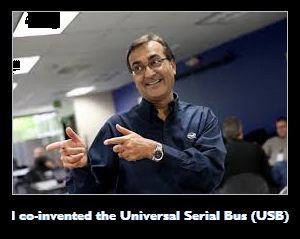 If you use a desktop, laptop, mobile phone, tablet or external hard disk drive, it’s impossible not to know about the USB (universal serial bus) port. The news is that this port, used to transfer both information and power between devices, is now about to become more versatile – there are plans to make it flippable and also able to deliver the power required by larger networks. But did you know that the inventor of the USB port is an Indian? Well, it’s true and his name is Ajay Bhatt.
After graduating from the Maharaja Sayajirao University of Baroda Bhatt went on to The City University of New York, where he received his master’s degree. In 1990, Bhatt joined Intel Corporation as a senior staff architect on the chipset architecture team. Currently, he holds thirty-one U.S. patents, and several others are in various stages of filing. Some time ago IEEE Spectrum did an interesting interview with him about how Intel made the USB truly universal and other things like an ‘all-day’ computer project he is working on (read: a computer that you can use all day on a single charge) and some of his past achievements (click here to see “Ajay Bhatt: Intel’s Rock-Star Inventor”).
However, despite his ‘rock star’ inventor status Bhatt is only one of a highly talented group of Indian movers and shakers in the field of technology in the US. Here are few of the many other outstanding achievers in the list:
• Narinder Singh Kapany, an engineer who is called the “Father of Fiber Optics”
• Sabeer Bhatia who founded Hotmail (there’s a special note of pride here for Pune-ites: Bhatia studied for some time in Bishop’s School in Pune)
• Vinod Dham who designed the Intel Pentium Chip Processor which is known as the ‘Father of the Pentium Chip’
• Avtar Saini who co-led the development of the Pentium processor Intel and holds 7 patents related to microprocessor design.
• Arun Netravali who is a pioneer of digital technology including HDTV and MPEG4, a scientist, a former President of Bell Labs and also former CTO of Lucent
These innovators and entrepreneurs par exellence blazed the trail that you are following. They did their initial engineering studies in India, went for higher studies in the States and then joined American companies there where their careers took off.
Bhatia, for example, got a foreign transfer from BITS Pilani, Rajasthan to California Institute of Technology where he earned a Bachelor’s degree. He then earned a Master’s degree in electrical engineering from Stanford University.
Vinod Dham, graduated in Electrical Engineering from Delhi College of Engineering (now Delhi Technological University) and subsequently joined University of Cincinnati, Ohio to pursue a master’s degree in Electrical Engineering, where he specialized in Solid State Science.
Krishna Bharat received an undergraduate degree in computer science from Indian Institute of Technology, Madras and then went on to earn a Ph.D. from Georgia Tech in Human Computer Interaction.
Arun Netravali received his undergraduate degree from the IIT, Mumbai and an M.S. and a Ph.D. from Rice University in Houston, Texas all in electrical engineering.
So, as you start your own journey to higher education in the States, here’s hoping that at the end of the trail you will find a portion of the success and glory that these greats did.
 Jobs are available in all fields since the American economy needs people from all walks of life: engineers, managers, graduates from the field of science etc.Of course there are periodic booms and recessions in all fields. But an enterprising person can usually find a good job in any field.
The salaries after completing a master’s-level course of studies in the United States is quite good. After an MS or an MBA, you can get a salary in the range of $55,000 to $85,000 per annum. Of course, the salary structure depends on several factors, including your field of specialization, the university from where you obtained your degree, the geographical are where you get the job and of course your ability to convince your employers of your calibre.
After a PhD you can expect a salary of around $85,000 per year.
 Is there scope to take up jobs after studying in America? Most students do take up a job in the United States after they have finished their course of study there. However, the student (F1) visa that you get from the US embassy in India does not permit you to take up full-time employment. You have to take permission from the Immigration Department first. The good thing is that obtaining this permission is not very difficult. You are allowed to work after finishing your MS, MBA etc. under Optional Practical Training (OPT).
Once you have got a job it often happens that your employer will request the authorities for a change of status in your visa from F1 (education visa) to H1 (work permit). This can be renewed for 3 years more. During this time many people apply for a Green Card i.e. permission to live in the United States permanently. Once you get your Green Card you will be able to live and work in the United States for as many years as you want.