Explaining the New Shorter GRE and Its Implications for Test-Takers

For many years, the Graduate Record Examination (GRE) has served as a crucial first step for students planning to pursue graduate study in the United States. This year, the GRE will be shorter thanks to a series of reforms. The test will have shorter versions of each section, but will still accurately assess test takers’ verbal reasoning, quantitative reasoning, critical thinking, and analytical writing skills. If you plan to take the GRE General Test after September 2023, you should familiarize yourself with these changes and prepare accordingly. The following is a comprehensive summary of all the key modifications to the new, shorter GRE:

Change 1: Reduced Number of Questions and Shorter Testing Period

The length of the GRE General Test has been reduced from 4 hours to 1 hour and 58 minutes. This is a significant change aimed at improving test-takers’ concentration and decreasing test fatigue. The reduced time has been achieved by implementing the following changes in the test.

Reduced number of questions: The number of questions in the Quantitative Reasoning and Verbal Reasoning tests will be reduced. The number of questions in each section will drop from 40 to 27. These 27 questions will be broken up into 12 and 15 for for Section 1 and 2 respectively. This change applies to both quantitative reasoning and verbal reasoning. Despite the reduction in total number of questions, the average time allotted for each question has remained unchanged.

Removal of ‘argument’ section: “Analyze an argument” task has been removed from the analytical writing section. Moving forward, the AWM section will only have the “analyze an issue” task. As a result, you’ll only have to write only one essay.

Removal of the Unscored section: The GRE currently has an unscored section that is used for evaluation of questions by ETS. This section will be removed from the new, shorter GRE, as it does not affect the test taker’s final score.

No Scheduled Breaks: The current 10-minute break after the two hours of the test will be eliminated because the new test time will be less than 2 hours.  Those taking the GRE at a testing center can still take unscheduled breaks; however, the clock will not stop. Exemptions to this policy will be made for test takers with disabilities or health-related needs.Online examinees are not permitted to take unscheduled breaks during the exam.

Change 2: faster Reporting of Test Results

Official GRE scores will be reported to test takers within 8-10 days after the exam. This is a significant improvement over the previous time frame of ten and fifteen calendar days. In the long run, this will save time for those filling out applications.

What won’t change as the GRE moves from its current format to a shorter one?

Despite the fact that the GRE General Test will be shorter, many features will remain unchanged. Given below are the important aspects of the test that won’t be changing:

  • The basic structure of the GRE, including the presence of Analytical Writing, Verbal Reasoning, and Quantitative Reasoning sections, will remain unchanged.
  • Scoring: All three sections will use the same scoring procedure, and the shorter test will use the same performance scales as the current test.
  • The shorter GRE will still be section adaptive I. e., the difficulty level of the second section will be based on your performance in the first section.
  • Although the GRE has been shortened, testing fees have not changed.
  • Graduate and professional schools will use scores from the GRE General Test similarly, regardless of the length.
  • As before, you can retake the GRE General Test up to five times in any rolling 12-month period (365 days), with a maximum of one attempt every 21 days.
  • Your GRE scores will be considered valid for five years after your test date.

Why the ETS is changing the test format

These changes are based on feedback from previous test takers and are the result of expert analysis about how a better experience could be introduced for test takers while retaining the strong validity and reliability that universities expect.

Applying to graduate and professional programs is time-consuming. While you want to show your potential in a comprehensive way, you also want to get through your application checklist ASAP. Shortening the test will help students to stay focused and reduce fatigue. The shorter test will also allow ETS to deliver GRE scores faster. Students can complete their applications sooner as well.

What is yet to be announced?

Verbal and Quantitative Reasoning have had their total number of questions cut down to 27, but how those questions will be distributed among the subsections such as sentence equivalence, text completion and  reading comprehension in verbal section, remains to be seen.

We also don’t yet have details on how the scoring algorithm might adapt to the reduced number of questions.

Which version of the test should you take- Shorter GRE vs. Current GRE

You should weigh your application deadlines against your personal preferences when deciding between the shorter GRE and the current GRE. The current GRE will be phased out on September 22, 2023, in favor of the shorter GRE. If your application deadline is early October or earlier, you should probably take the current GRE. However, if you have more time and your application deadlines are not pressing, you may want to take the shorter GRE because of its streamlined format.

At Dilip Oak’s Academy, We also provide detailed guidance on these processes under our Admission Counseling Services, including a selection of universities, documentation process and visa counseling, and mock visa interviews. In addition, as India’s leading Study Abroad Consultants, we have helped more than 33,000 students to secure their dream admits for various universities in America including MIT, Stanford, Cornell, Carnegie Mellon and other top-ranked universities.

We also offer GRE, TOEFL, and IELTS coaching, GRE Self Prep and guide students with university selection, application essays, and visa counseling under our Admission Counseling Services for USA, Germany and UK.  To enroll, call us on 91-020-67444222, 91-8007878495

How To Improve GRE Reading Comprehension

7 Techniques to improve GRE Reading Comprehension

“Reading” may not be one of your hobbies, but it is an important skill to grow. Therefore, even if you get scared or bored by looking at the long black text, somehow you have to develop a knack for effective reading. The more you read and practice, the easier it will be for you to comprehend what you are reading. Here are the seven straightforward techniques to improve your GRE reading comprehension abilities:

1. Increase vocabulary power

When you understand the meaning of the words you read, it can be easier for you to grasp the author’s perspective. You can improve your vocabulary by developing a habit of active reading. You can mark the difficult words and phrases that you come across while reading and search for their meaning in the dictionary. Once you understand the meaning of words, use it in your own language and try to use it in different contexts. This will aid in your long-term retention of those words.

2. Ask questions regarding the text you are reading

As you become more immersed in the text, asking questions about what you are reading can help you become a better reader. In order to gain a deeper understanding of what you are reading, consider themes, motifs, and other aspects of the text that you may have overlooked.

You can ask yourself the following questions as you read:

  • Why did the author choose to start the book that way?
  • What sort of bond do these two characters have?
  • What do we now know about the protagonist of the story?
  • Are there any recurring themes throughout the book? If so, what do they mean?

Click here for tips to master Text Completion and Sentence Equivalence and here to learn about mastering the GRE Quantitative Reasoning section.

3. Visualize the content

Creating mental images related to the content can aid in reading comprehension for GRE. Imagine that you’re watching a movie in your mind while you read. Picture the characters, places, and events described in the text. When you visualize what you’re reading, it’s like bringing the words to life! This technique helps you understand and remember the ideas better because you can see them in your imagination. So, next time you’re reading, try to make pictures in your mind to help you understand the content more easily!

4. Make use of situational cues

Even if you are unfamiliar with all the words being used, using context clues can really help you grasp what you are reading. The words and sentences that precede and follow the unfamiliar word can provide context cues. By concentrating on the major words or concepts in a sentence, you can use context clues to infer the sentence or paragraph’s core theme. Additionally, you can search for neighboring terms that are either synonyms or antonyms of the unknown word.

5. Identify the core idea

You can evaluate the relevance of an article by finding the main idea in a paragraph. Understanding the significance of what you’re reading may help you better understand the author’s perspective. After reading every paragraph, stop reading and try to figure out what the major point is. Then, for even better understanding, try to rephrase the primary idea in your own words.

6. Summarize the information you read

Writing a summary is a foolproof method to learn more about what you have read. In order to summarize, you must first determine what is crucial in the text and then express it in your own terms. Summarizing enables you to assess your comprehension of the text and improves your long-term retention of what you have read.

7. Diversify your reading materials

Try reading different kinds of books, articles, and stories. Each type of writing has its own style and way of presenting information. By exposing yourself to different genres and topics, you’ll become familiar with various writing styles, vocabulary, and ideas. This exposure broadens your understanding of language and context, making it easier for you to understand different types of texts. So, try to mix up what you read to improve your reading skills and learn new things along the way!

As India’s leading Study Abroad Consultant, Dilip Oak’s Academy offers a comprehensive suite of admission counseling services that can guide you through the entire process from Shortlisting Universities to Visa Counseling. With our expertise, we have successfully sent 32,000 students to various prestigious American universities like MIT, Stanford, Cornell, and Carnegie Mellon. We also offer classroom and online coaching for GRE, TOEFL, and IELTS, as well as GRE Self Prep. To explore our services, book a free consultation or call us at 91-20-67444222.

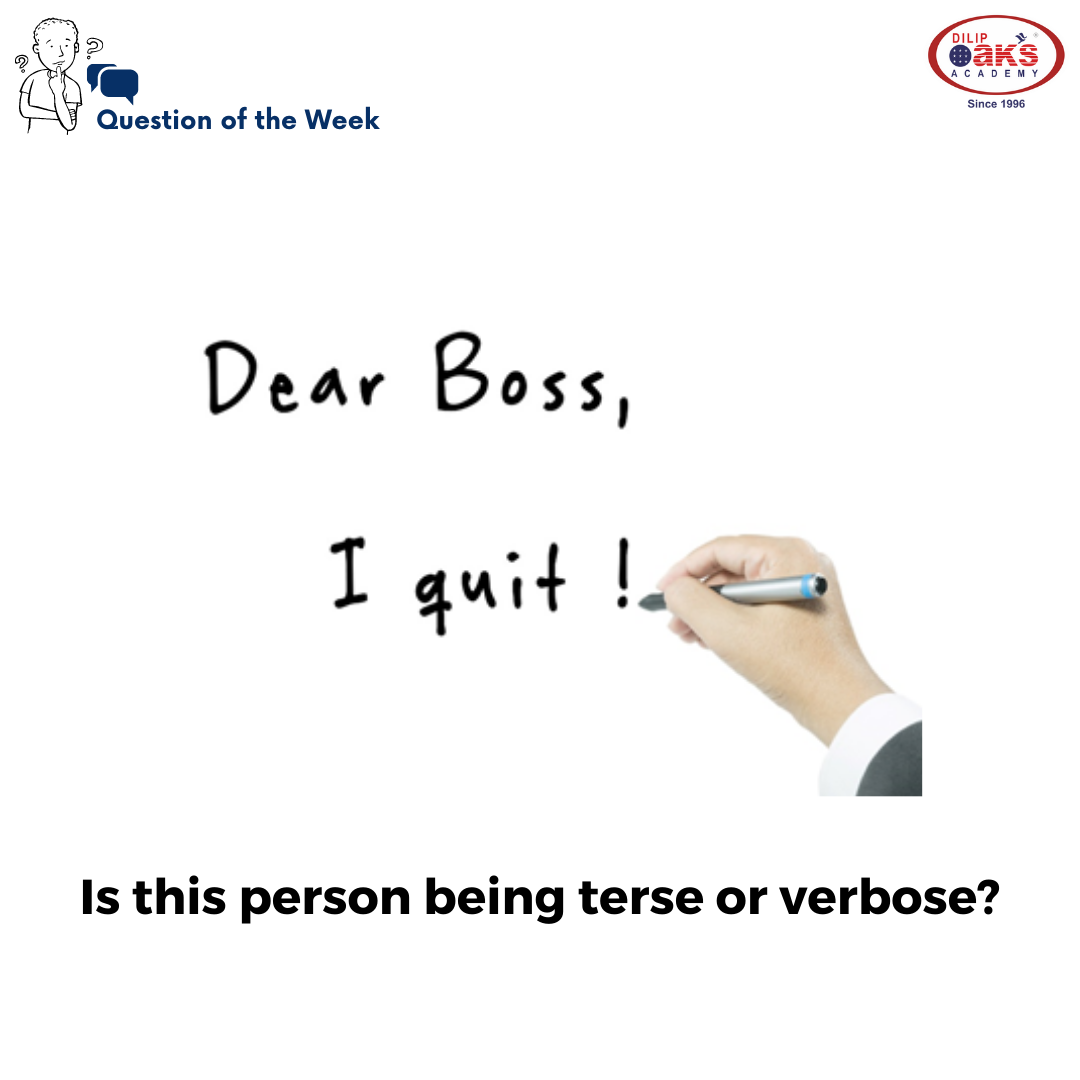
Question of the Week

GRE aspirants, it’s time to rack your brain and crack this question of the week! Our expert GRE faculty will drop in interesting questions for you every week to help you think logically and get closer to acing the GRE! Type your answer in the comments section below!

We will publish the correct answers and explanations in the comments section every Friday! STAY TUNED!

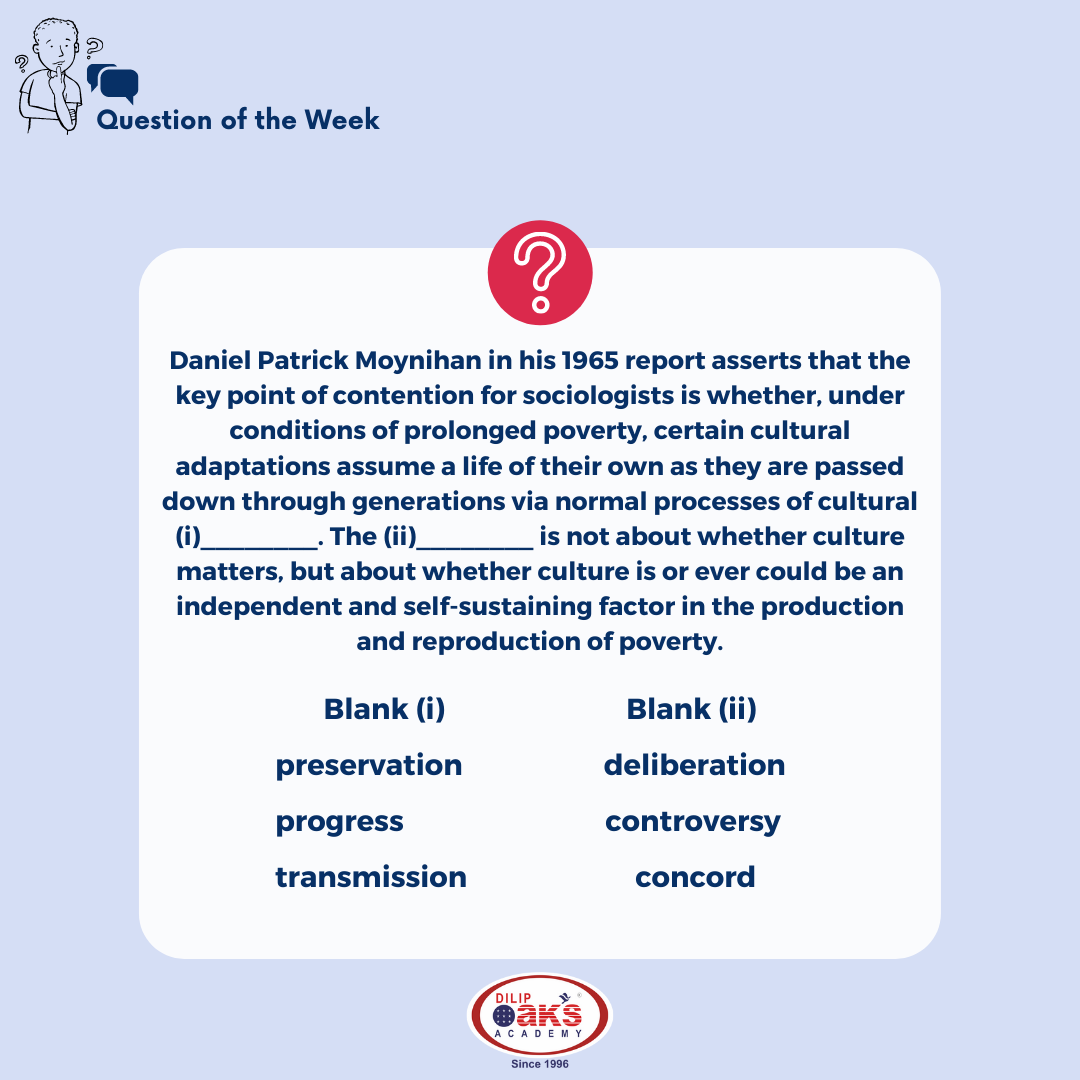
Question of the Week

GRE aspirants, it’s time to rack your brain and crack this question of the week! Our expert GRE faculty will drop in interesting questions for you every week to help you think logically and get closer to acing the GRE! Type your answers in the comments section below!

We will publish the correct answers and explanations in the comments section every Friday! STAY TUNED!

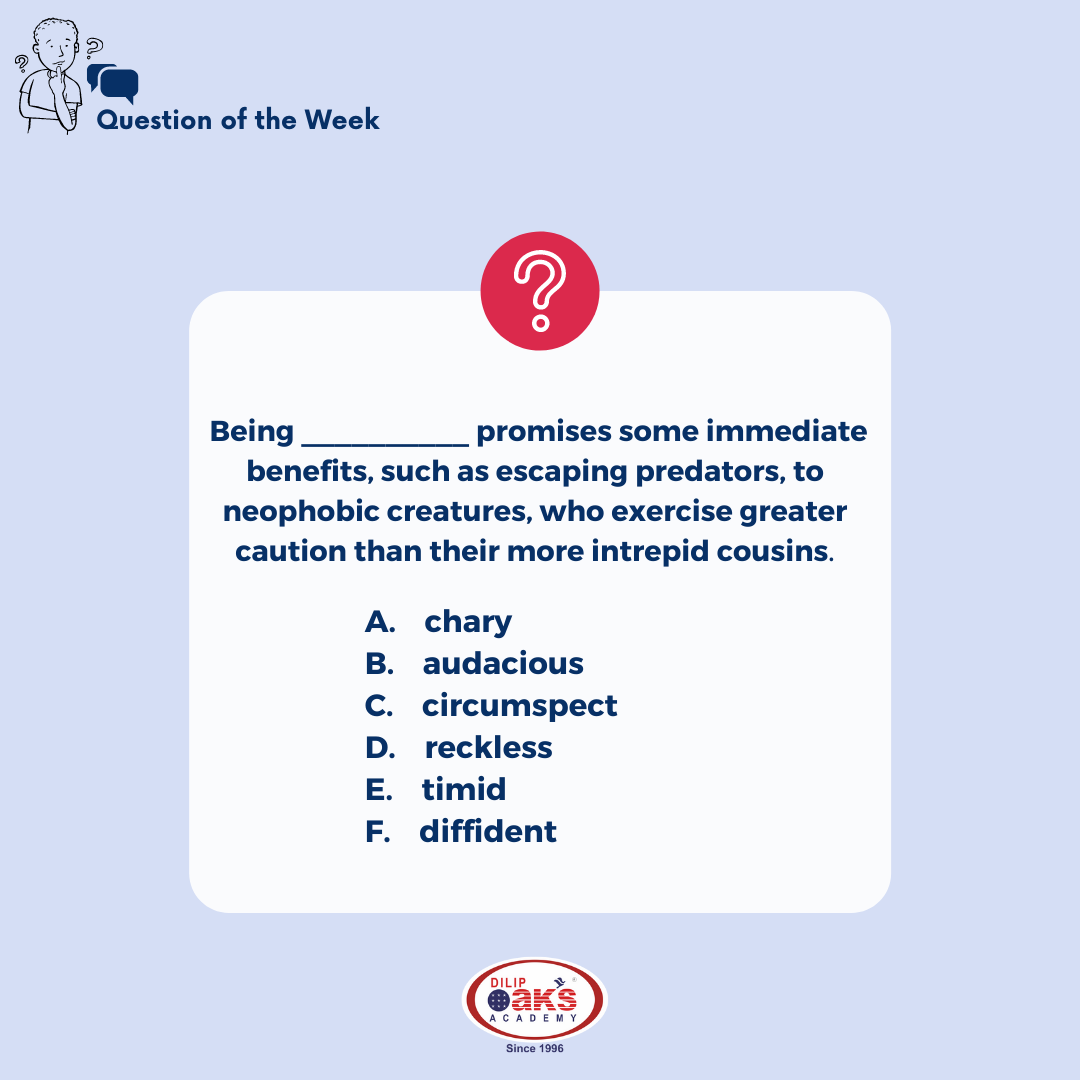
Question of the Week

GRE aspirants, it’s time to rack your brain and crack this question of the week! Our expert GRE faculty will drop in interesting questions for you every week to help you think logically and get closer to acing the GRE! Type your answers in the comments section below!

We will publish the correct answers and explanations in the comments section every Friday! STAY TUNED!

Start your GRE Prep with us! New batches starting 27th & 28th March! Enroll here: https://www.dilipoakacademy.com/gre-coaching

Struggling with GRE Vocabulary? Here are 5 tips from our expert faculty

If you are a GRE aspirant and you have just begun your prep, the GRE Vocabulary section might seem to be an impossible task, mainly because you are expected to master words which you barely use in your everyday conversations. It is certainly a daunting challenge. But if you start systematically, you can learn over a 1000 GRE words comfortably! How? By keeping in mind the following five tips:

1) Start from Day 1 of your prep
If you are planning to take the GRE after three months, start your prep today! Keeping the vocabulary section for the last few days before the exam is a grave mistake that many students make. It becomes cumbersome to learn and retain so many words in a short span and you end up making silly mistakes. So start learning at least 5 new words right from day one of your prep so that you get ample time to practice and master them. 

2) Don’t learn too many words at once 
Start slow, be steady. Instead of learning 20 words in a day, learn only five words and gradually increase the count once you gain confidence and are able to retain the words. 

3) Learn through discussions and associations 
Instead of just mugging up, try to associate the words with images, references and situations, create stories around words, and discuss them with your peers or friends. Practicing this way makes it easier to remember words without getting stressed or confused.

4) Finish learning all the words at least 15 days before the exam 
Make sure that you do not keep anything till the last minute and you finish learning words at least fifteen days before the exam and only keep practicing words after that. 

5) Revise regularly 
Make sure to revise words regularly. Consistency and practice play a huge role in mastering GRE vocabulary. Every week, revise all the words you learnt and keep practicing diligently! 

To know more interesting tricks and tips on learning vocabulary, attend our free webinar “Vocab Sunday” on 6th March, 09:30 am and interact directly with our faculty! Register herehttps://zoom.us/webinar/register/WN_i-L1JaW8QPSSFKSphog02g

GREat Five-Minute Reads: Episode 12

Dear Reader,

One of the easiest ways to learn new words is through association. Instead of trying to learn by remembering the equivalent of a word in your mother tongue or its usage in English, you can learn by thinking of words in groups. These groupings can be grammatical: all action verbs or nouns related to knowledge (ending with -logy), for instance; or logical: as found in our VocabApp.

Today, all our links and questions are about pictures and photographs, which can be helpful in recollecting a bunch of words. Here are some of those words, see how many you can guess correctly.

Question 1

For a ______ like myself, there was no wrong age to take up photography: I just had to get a smartphone!

A] tyro

B] sage

C] transgressor


Question 2

The light cast by the setting sun is the most _____________ and hence, it is known as the Golden Hour in Hollywood.

A] voluble

B] voluminous

C] luminous


Question 3

Whenever I look at these pictures of people from my past, I am filled with _________.

A] nostalgia

B] animosity

C] catharsis


Question 4

4] The only surviving picture of my great-grandmother is a small painted __________.

A] frieze

B] vignette

C] coda


Question 5

Editors often __________ black-and-white photos with colour images to choose the best ones.

A] riddle

B] amalgamate

C] juxtapose


Tell us your guesses in the comments section and look for the answers in our next edition!

Here are some articles you might interesting:

Hi-Res in Space!

Everyday Exemplars…

Recycling Could Help You Make Millions


Answers for last week’s questions:

1] “We found the glass splashed on little pieces of bone that were by the hearth, so we know that the molten glass had landed in this village while people were living there,” said coauthor Allen West, a member of the Comet Research Group, a nonprofit organization aimed at studying this particular cosmic impact and its consequences.

2] B] No magnetic marks, characteristic of lightning strikes, were found.

3] A] Climatic changes

4] B] exceptional D] atypical

5] A] imitate D] prevalent

GREat Five-Minute Reads: Episode 11

Dear Reader,

As promised, from this week onwards, we will present some old and some new articles along with questions on Reading Comprehension, Sentence Equivalence, and Text Completion from the Verbal Reasoning section.

Tell us your guesses in the comments section and look for the answers in our next edition!

Dinosaurs weren’t the only ones!

Question 1

Select a sentence in the article that provides evidence that the comet struck while the village was under human habitation.

 Question 2

Why did the scientists rule out earthly causes such as volcanic activity or thunderstorms for the fires? Select all that apply.

A] They found evidence that natural sources of fire can also reach such high temperatures.

B] No magnetic marks, characteristic of lightning strikes, were found.

C] Molten metal was not found at the site.

Question 3

None of the following were reasons for the Abu Hureyra culture becoming agrarian EXCEPT

A] Climatic changes

B] Technological modifications

C] Survival of a few people

D] Animal husbandry

E] Ground-breaking invention of systematic agriculture


Alterations to Art

Question 1

The presence of halos as identifying appurtenances of holy figures in early Netherlandish paintings is as ________ an occurrence as it is commonplace in Italian paintings of the same period.

Select the two answer choices that, when used to complete the sentence, fit the meaning of the sentence as a whole, and produce completed sentences that are alike in meaning.

A] trite

B] exceptional

C] recognizable

D] atypical

E] perceptible

F] sacral

The representation of mortals as saints, reflecting a desire to (i) ________ the lives of the saints and to follow their sacrifices and devotion to Christ, becomes increasingly (ii) _______ in the early sixteenth century. The practice reflects an extension of the beliefs of and widespread adherence to the Modern Devotion, a popular reform movement begun by Geert Grote in the late fourteenth century and initially practiced by the Brothers of the Common Life.

 Question 2

For each blank select one entry from the corresponding column of choices. Fill all blanks in the way that best completes the text.

Blank (i) Blank (ii)
A] imitate D] prevalent
B] animate E] predictable
C] stipple F] pretentious

GREat Five-Minute Reads: Episode 10

01101000 01100101 01101100 01101100 01101111

We celebrate the big 10 with a nod to big transformations and changes! From the tiniest of organisms to the infinite vastness of space, small changes tend to have big repercussions. From the next edition of the reading list, we will change too. To know more, keep following our lists.

Happy Readings!

  1. From Amoeba to Alpaca
  2. One small step for man…
  3. Marvel at the long history of an art you can read!
  4. Da Vinci: gone for 500 years, still schooling us!
  5. How technology changed us over the last 5,000 years…

Look out for a new Reading List every week on Thursday!

GREat Five-Minute Reads: Episode 9

Dear Reader,

As the end of the lockdown nears, we are on cloud nine. Let us remember to dress to the nines as we take solace in the fact that we went the whole nine yards in our fight against coronavirus, boredom, and Zoom fatigue! With prompt implementation of the lockdown and its subsequent easing, we have proudly proven that “a stitch in time saves nine”.

Read on to know more about the ninth edition of the reading list:

  1. Nine beauties for your a-muse-ment!
  2. Sorry Pluto, you just got dwarfed!
  3. Take heart, K9 lovers…this is just a myth!
  4. Divine Comedy or Infernal Tragedy?
  5. Ever wondered why the 99 cent stores are so popular?

GREat Five-Minute Reads: Episode 8

As mindfulness (OED: a mental state achieved by focusing one’s awareness on the present moment, while calmly acknowledging and accepting one’s feelings, thoughts, and bodily sensations, used as a therapeutic technique) becomes the buzzword, scientists are now claiming that the mind is more than what we imagined! This week, we present some audio-visual treats to keep your mind and body happy and humming!

  1. Mind OVER Matter!
  2. Food for Thought: Films
  3. Food for thought: Music
  4. Food for Thought: History
  5. Food for thought: Geography

Look out for a new Reading List every week on Thursday!

GREat Five-Minute Reads: Episode 7

Going into the fourth (and hopefully, final) iteration of the lockdown, forgive us for getting a little philosophical. As the quotidian becomes dishearteningly humdrum — jokes abound on how no one knows nor cares what day of the week it is — it is time to find transcendent beauty and muse on how the ordinary becomes extraordinary with patience and passion.

Here’s hoping this week’s reading helps you find your desire, something you can pursue with diligence and dedication, so, you too can achieve for perfection in an imperfect, kaput world.

  1. Way to go, Einstein!
  2. Slithering their way into each other’s hearts
  3. Bashfulness as a survival strategy: read on introverts…
  4. 105 years old and still fighting…
  5. An exceptional journey that offers a never-before-seen visual delight!

Look out for a new Reading List every week on Thursday!