GRE Prep for Oak’s Students – Vocabulary Learning and Revision

Vocabulary Learning and Revision (to be started preferably 3-5 months in advance)

The largest, most time-consuming component of your GRE preparation is vocabulary revision. Achieving a good level of basic preparation involves getting familiar with around 4,000 words commonly used on GRE test. To really understand a word you need to know its range of meanings, some of its important secondary meanings, its usage (illustrated by sample sentences using the word) and it is often useful to know the roots of the word. Dilip Oak’s Academy has provided two very useful aids for learning and revising these various aspects. Described below is how you can use them both at home and outside.


At Home:

When at home use VaiVocabulary. VaiVocabulary is one of the best vocabulary learning softwares available in the market. It has a number of features which help to make vocabulary learning really effective. Here are some tips on how to get the most of it:

  • Try out all the features in order to select which combination works best for you – some of the more important features are given below:
    • Pictures – these are connected to the meaning and help to remind you of the meaning.
    • Sample sentences or usage – remember you don’t understand the meaning when you learn the definition: real understanding comes when you see how the word is used in sample sentences.
    • Video’ – most of this is really audio, but the videos give really good explanations of word meaning and lots of additional sample sentences.
    • Mnemonics – ways of linking the meaning of the word with the form of the word; many are given; select the ones you find most useful.
    • Word origins – these are the roots of words which help you to understand the meanings of words rather than just learning them by heart.
    • Synonyms – the easy synonyms help you to understand the meaning of a word better; the hard ones extend your vocabulary.
  • Mark any word you cannot remember ‘very difficult’ by default so that you will be able to repeatedly revise it; lower the rating when you get better at remembering.
  • most important: sincerely go through all quizzes, the rapid revision (it comes up at the beginning of a new session) and the difficulty-based revision sessions.
  • The VaiVocabulary DVD has a tutorial that will take you through all the available features and explain how to use them
  • If you run into any problems with installing or using the DVD contact the Academy – all the problems can be fixed one way or another, but don’t let problems prevent you from the enormous benefits of using this great vocabulary learning software.

Outside (i.e. when you are not at home): Use FlashCards and FlashCard Companion

  • The FlashCards contain 4,000 GRE words and their meaning; 2-3 shades of meaning are given for every word.
  • The FlashCard Companions are booklets which give you a sample phrase for every meaning of every word in the FlashCards.
  • Every page in the FlashCard Companion booklet corresponds to a FlashCard. The number of the FlashCard is given at the top of the page. Word numbers are also given for ease of reference.

GRE Prep – Preliminary Reading

One of the most important aspects of preparing for reading comprehension in the GRE is preliminary reading – that is, reading to be done before you start tackling GRE RC passages in order to prepare you for the challenges that those passages will throw up.

One challenge that you will face on Reading Comprehension passages is that they tend to be about unfamiliar topics and concepts; and talk about unfamiliar terms and fields. They use difficult phrasing and vocabulary, and complicated sentence structure. The only way to get used to the level of complexity you will find in GRE passages is to read widely.

Another challenge is the fact that reading passages on screen means that you may not be able to see the whole passage at a time, and may have to scroll up and down to read the rest of the passage. This is very different from reading on paper, where you can usually see the whole passage on screen at a glance. The fact that, when reading longer passages onscreen, you will not be able to see the whole of the passage at once makes comprehending the passage much more difficult.

Reading widely both on paper and onscreen will help you build up the skills that you need to meet the challenges presented by reading comprehension passages in the GRE. The reading material suggested here is arranged, and should be read, in the following order:

Continue reading

Cracking the GRE Test – Debanjana Nayak (GRE Score 330/340) – Tips for Quantitative,Verbal and Analytical Writing

Tips

Here’s the next part of Debanjana’s tips – this time with lots of specifics for each section of the test!

______________________

Before starting with this set of tips specifically for the Quantitative, Verbal and AW sections, I must mention that I took classes from Dilip Oak’s Academy and I will be talking a lot about the Academy’s classes and materials because I found them extremely useful in preparing for these sections. In giving these tips, I am also assuming that you too are a student of Dilip Oak’s Academy. Of course, you will have your own experience and perspective, but here’s what I would suggest.

Continue reading

Cracking the GRE Test – a Working Student’s Experience – Debanjana Nayak (GRE Score 330/340)

Trophy GRE ScoreThis week’s blog is by another of our high scorers, Debanjana Nayak who got a a really great score of 330/340. What makes this score a special one is that Debanjana is working.

So, this post is especially for all the working folks: if you are in a job and feel it might be difficult for you to prepare, here’s some inspiration! (By the way this post is just the first part. More to follow!)

———————————————————————————

Before, I start with my tips, here is a bit on my background. I graduated with an Electronics and Communication Engineering degree from WBUT in 2010 and soon after joined Tech Mahindra as a Technical Associate. I have been working there for almost 2 years now.

After having worked in the company for about 1 year, I decided to pursue higher studies in the US (targeting fall 2013). Since I intended to keep my job and prepare for the exams (GRE & TOEFL) side-by-side, I started preparation early, around October, 2011, almost 7 months in advance. I finally gave my GRE on 25th April, 2012. My scores are as follows:

  • Quantitative – 166/170
  • Verbal – 164/170
  • AWM – 4/6

Continue reading

Cracking the GRE: Tips from Tanmay – GRE Score 335


Here are some more hot tips from one of our students who is a star performer on the GRE. This time it’s Tanmay Gurjar. As you can see, his performance has won him another of our ‘gold medals’! First here is a brief ‘bio’.

—————————————————

Name: Tanmay Gurjar
Stream/College: Bachelor’s, Mechanical Engineering, COEP (currently in final year)
GRE Score: 335
Break up – Quant – 169, Verbal – 166

—————————————————


Continue reading

GRE Score – 337/340: Ashwin’s Tips for Cracking the GRE (Part 2)

TrophyThis week we bring you the second part of a really trophy-winning article: Ashwin’s tips for cracking the GRE.

In this part he gets even more specific, with tips for the Practice Tests and each of the sections – Analytical Writing, Quantitative Reasoning and the super-hard Verbal Reasoning section. Read on. There are literally dozens of pointers that you can really benefit from.

_____________________________________________________

Tips for the Practice Tests

1) If you haven’t given exams like Pravinya, MTS, NTS etc. the GRE exam may be a new experience. If that is so, I would advise you to give one of the mock tests within a week of finishing classes just in order to know where you stand (editor’s note: you can use the Oak’s free test for this purpose).

2) Practice, practice, practice. The more preparation you do the better you will score. It just works that way. There are studies that show if you prepare just one hour beyond the point where you feel you know everything, you can increase your marks by up to 5% (which is significant in an exam like this one).

Continue reading

Quantitative Reasoning Question Formats in the Revised General GRE Test: Get a Peek

Quantitative Reasoning in the Revised General GRE, like Verbal Reasoning has two sections with 20 questions each and for which 35 minutes solving time is given per section. Each Quantitative Reasoning section has mix of question types:

  • quantitative comparison
  • problem solving
    • numeric entry questions (single and double)
    • multiple correct choices (vertical check-box questions)
    • single correct choice (i.e. radio button questions vertical and horizontal)
  • data interpretation

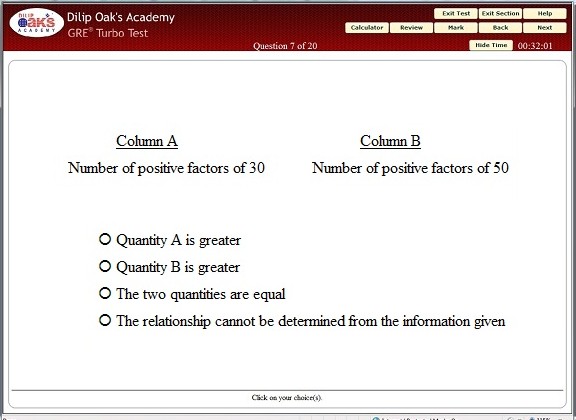
This makes a total of 7 different formats which are illustrated in the screenshots below. The screenshots are of the Dilip Oak’s Online test, but they will give you a good idea of what these formats will look like when you take the GRE computer-based test.

Quantitative Comparison

Get information on the Oak’s Online GRE test

Continue reading

GRE Test Prep: Reading Comprehension and Discrete Questions: Challenges & Tips

So, you are preparing for the GRE test. You know that the Verbal section is going to be demanding. What are the big challenges in the Verbal section of the Revised General GRE?

Challenge #1: Reading Comprehension Passages

Screenshot of a Reading Comprehension question in the Revised General GRE
Reading Comprehension Question

First, a bit of good bit of news: the Reading Comprehension passages on the Revised GRE test are short. A Verbal section generally contains 5 Reading Comprehension passages, most which are 20-25 lines long; and one of them may be as short as 3-5 lines. The longest passages are of about 40 lines or so. (See ETS’s introduction to reading comprehension, sample questions and tips)

But Reading Comprehension is never very easy. Firstly, the passages cover a wide variety of topics, most of which are very unfamiliar. Here are some topics that have appeared in the past:

Continue reading