
Did You Know these Facts about GRE Math?


~ By our Quantitative Reasoning Faculty

 

April is almost over and the countdown to the exam has already begun. You want a good overall score and if you’re an engineer, you are most probably thinking that getting 165 on Quant shouldn’t be too much of a problem (the typical engineer approaches maths questions with a raw “Just bring ‘em on” kind of arrogance and usually gets most questions right). But here’s the problem: sometimes even those with a strong background in maths may not cross the 160 mark – and when that happens, dreams of a score in the 325+ range come crashing down. To prevent that unhappy outcome, here are some basic insights about the way the math works on GRE.

One fundamental reason why some students don’t get the scores they should, is that they simply don’t understand the way the exam ‘TALKS’ maths. What this means is that the GRE test has its own way of defining mathematical terms. If you don’t understand the definitions used in the GRE exam, then time and time again you are going to end up making errors on questions you should have got right – and you are likely to end up feeling frustrated and demoralized. So, let’s have a look at a few basic differences between Indian maths and American math.
Continue reading

Answers to Practice GRE Test Quant Questions

Post: Did You Know these Facts about GRE Math?

Question: How many positive integers, less than 20, are either an even multiple of 2 or, a multiple of 9 or, the sum of a positive multiple of 2 and a positive multiple of 9?

Answer: There are 11 such integers:

  • Multiples of 2 – 4, 8, 12, 16 (total 4)
  • Multiples of 9 – 9, 18 (total 2)
  • Sums of a positive multiple of 2 and a positive multiple of 9 – 11, 13, 15, 17, 19 (total 5)


Post: Quantitative Comparison Questions: Doubtful D!


Question:

X < (1/X)

Column A Column B

X X2


Answer:: (D)

The given inequality is X< (1/X).

This is possible only in two cases:

(1) If 0 < X < 1 OR

(2) X < -2

Now, you need to compare ‘X’ with ‘X2’

If you pick the value of ‘X’ from 1st range, let’s say ‘X’ = ½, then X > X2, thus the possible answer is option (A) and hence, options (B) and (C) can be eliminated.

But if you pick up the value of ‘X’ from the second range of values, lets say X = -3, then X < X2.

That means we are not able to reach to any unique conclusion using the information given, thus the answer is option (D)


Quantitative Reasoning Question Formats in the Revised General GRE Test: Get a Peek

Quantitative Reasoning in the Revised General GRE, like Verbal Reasoning has two sections with 20 questions each and for which 35 minutes solving time is given per section. Each Quantitative Reasoning section has mix of question types:

  • quantitative comparison
  • problem solving
    • numeric entry questions (single and double)
    • multiple correct choices (vertical check-box questions)
    • single correct choice (i.e. radio button questions vertical and horizontal)
  • data interpretation

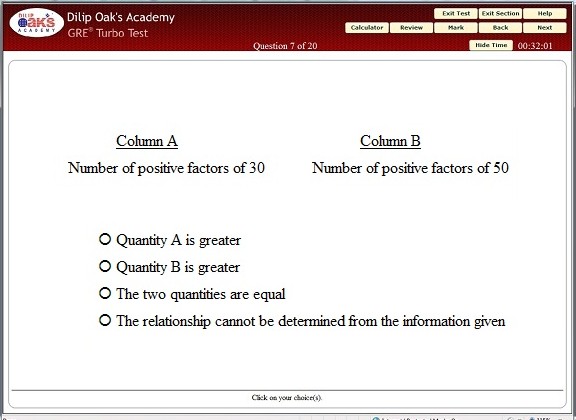
This makes a total of 7 different formats which are illustrated in the screenshots below. The screenshots are of the Dilip Oak’s Online test, but they will give you a good idea of what these formats will look like when you take the GRE computer-based test.

Quantitative Comparison

Get information on the Oak’s Online GRE test

Continue reading